Anil and I have been friends since 1992, when we were coursemates in the Navy. In September 2024 we joined a JustWravel bike trip from Srinagar to Manali by way of Leh, Nubra and Pangong. It was my third trip with them, after Spiti in winter and Spiti on a bike, and the second time Anil and I had ridden together, Spiti being the first. We were the only two riders in our fifties. Everyone else was between 25 and 32, which means the oldest of them was born at about the time Anil and I first met. Two Gen X uncles, one convoy of millennials, ten days, nine high passes. This is how it went.
Day 1 · Srinagar: the warm-up that involved no motorcycles
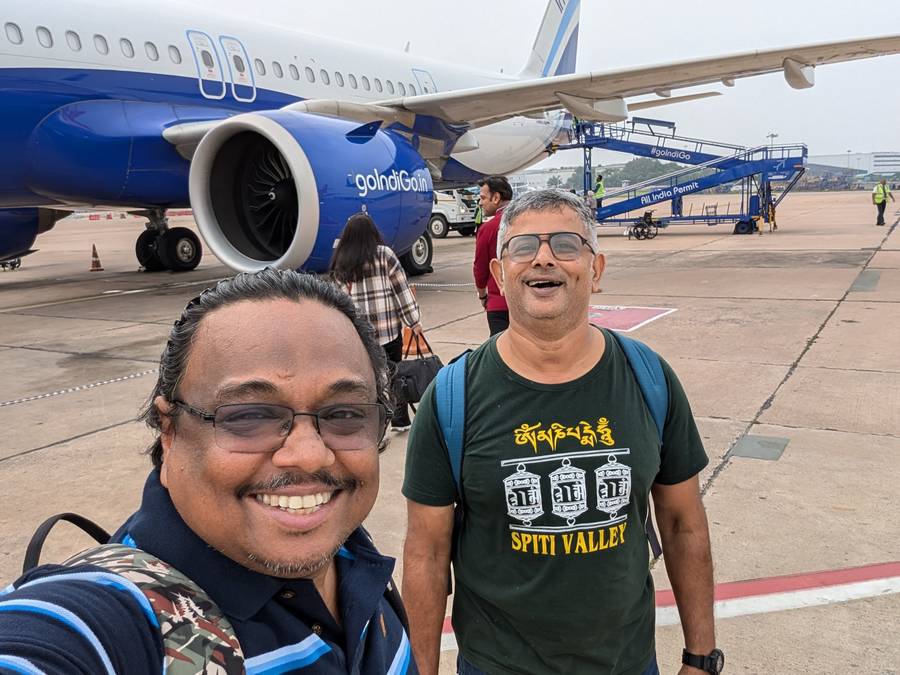
The trip started the Gen X way: an early-morning flight from Delhi, and a selfie on the tarmac to prove we were both awake. Anil wore his Spiti Valley T-shirt, which is the travel equivalent of turning up to a reunion in your old college sweatshirt.
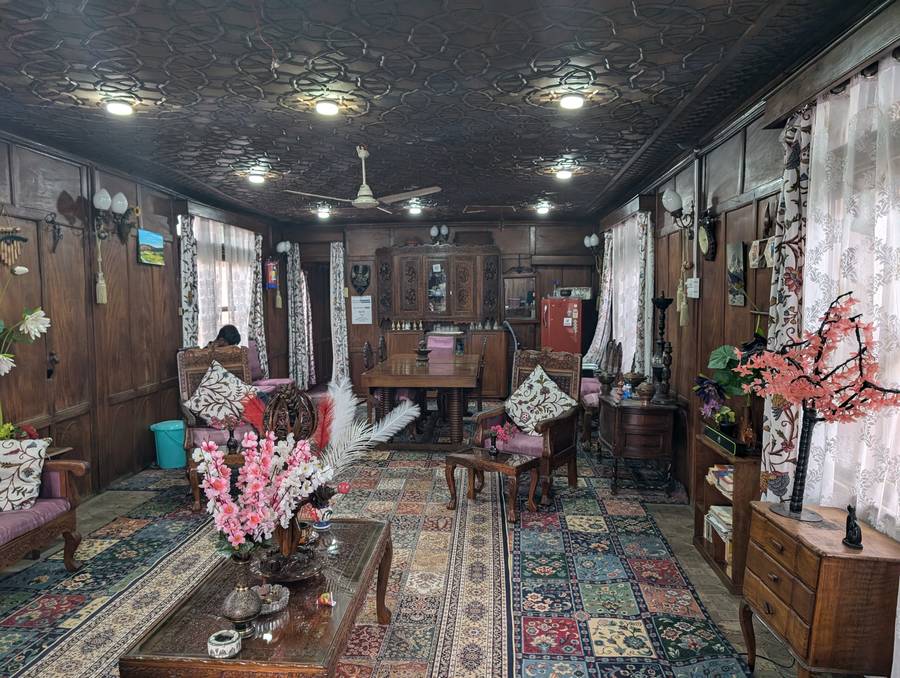
Srinagar was warm and green, T-shirt weather, and the first day had nothing to do with bikes. We started with Kashmiri kahwa at Chai Jaai, a tea room on the Bund above the Jhelum with a menu of more than sixty teas and the kind of tall white windows that make you sit up straight. A fabulous place to begin.
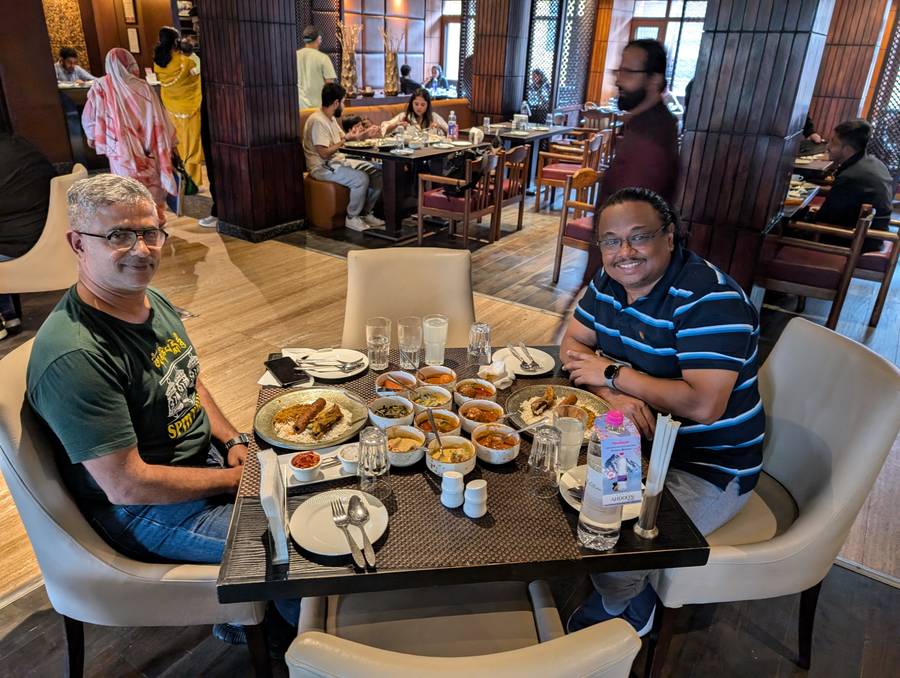
Lunch was at Ahdoos, the most famous name in Srinagar for Kashmiri food, and we had the full wazwan. It was lip-smacking, fabulous food: bowl after bowl of slow-cooked mutton in different gravies, kebabs, and meatballs around a mound of rice. Wazwan does not ask whether you would like more; it simply keeps arriving.
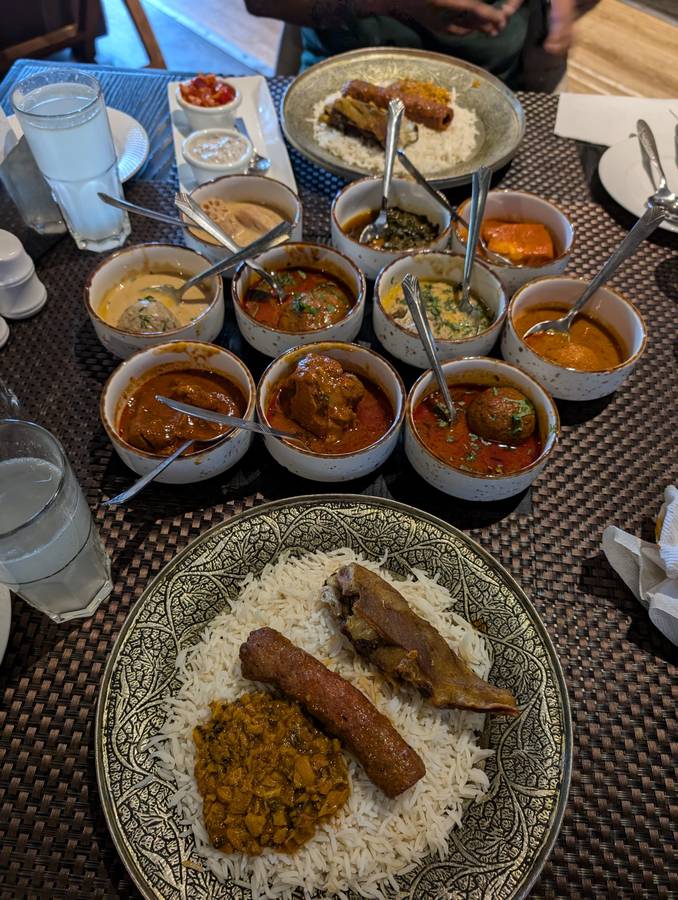
Wazwan is Kashmir's traditional multi-course feast, served at weddings and big occasions: anywhere from 14 to 36 dishes, most of them meat. It is cooked by a master chef, the waza, and his team, and traditionally served on a large copper plate, the trami, that a small group shares by hand. The signatures are rista, saffron-scented mutton meatballs in red gravy, and gushtaba, mutton pounded smooth with a wooden mallet and simmered in yoghurt. The tradition is usually traced to cooks from Central Asia who settled in Kashmir.
Ahdoos began in 1918 as a bakery on Residency Road in the middle of Srinagar and grew into a hotel and restaurant best known for its wazwan. It stayed open through the troubled 1990s, when many hotels in the city shut, and became the place where journalists covering Kashmir ate and filed their stories.
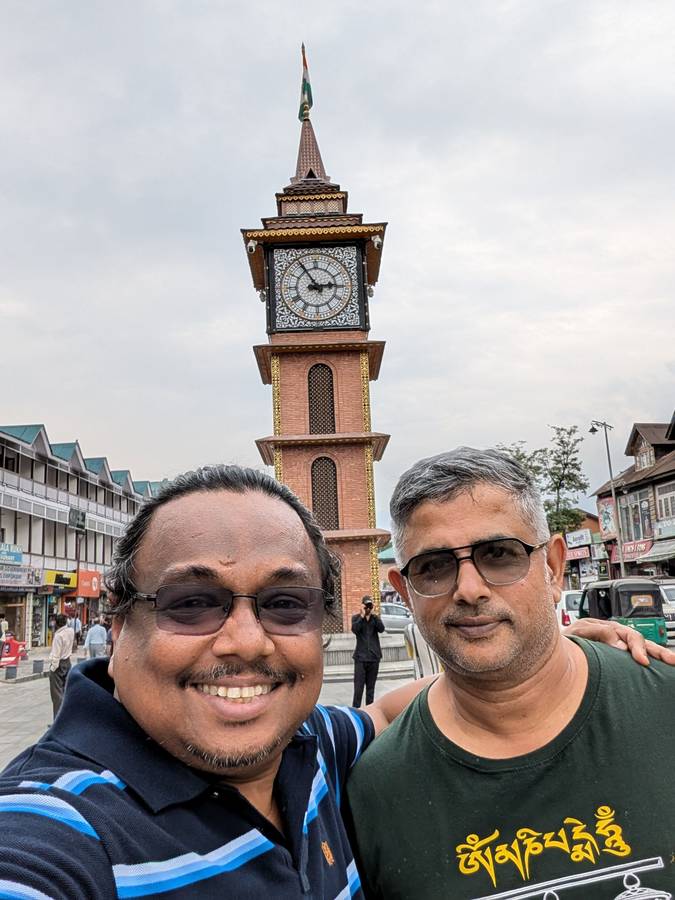
A walk to the clock tower at Lal Chowk followed, and then the obligatory shikara ride on Dal Lake, reclining on cushions in the way only men of a certain age can recline.
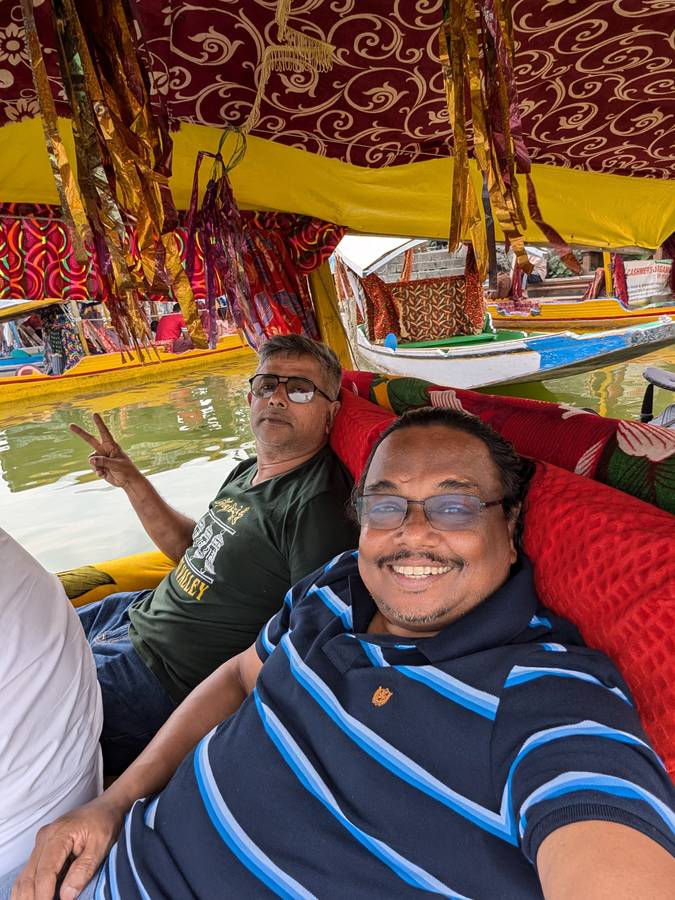
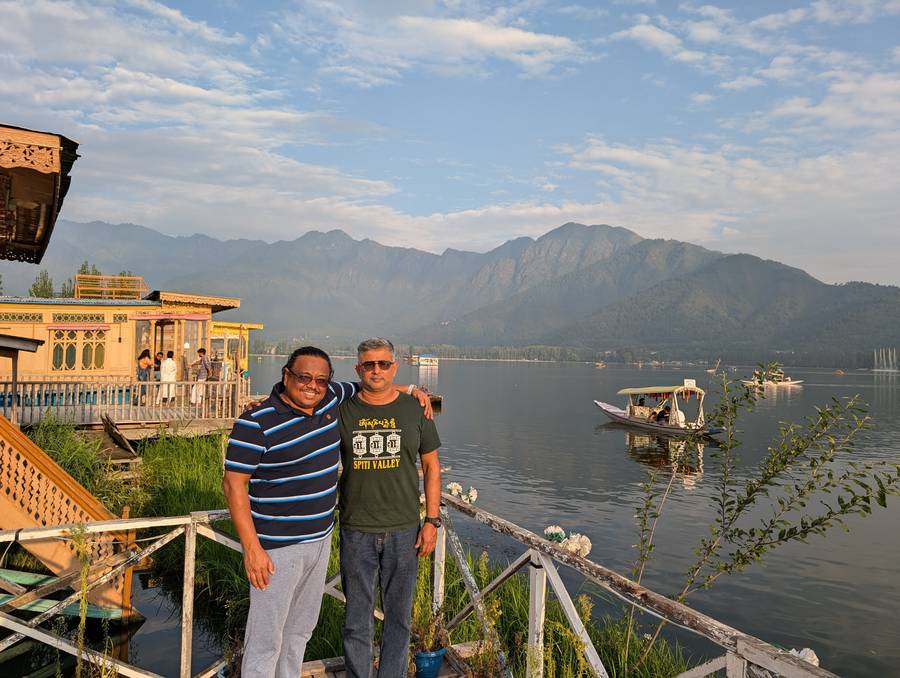
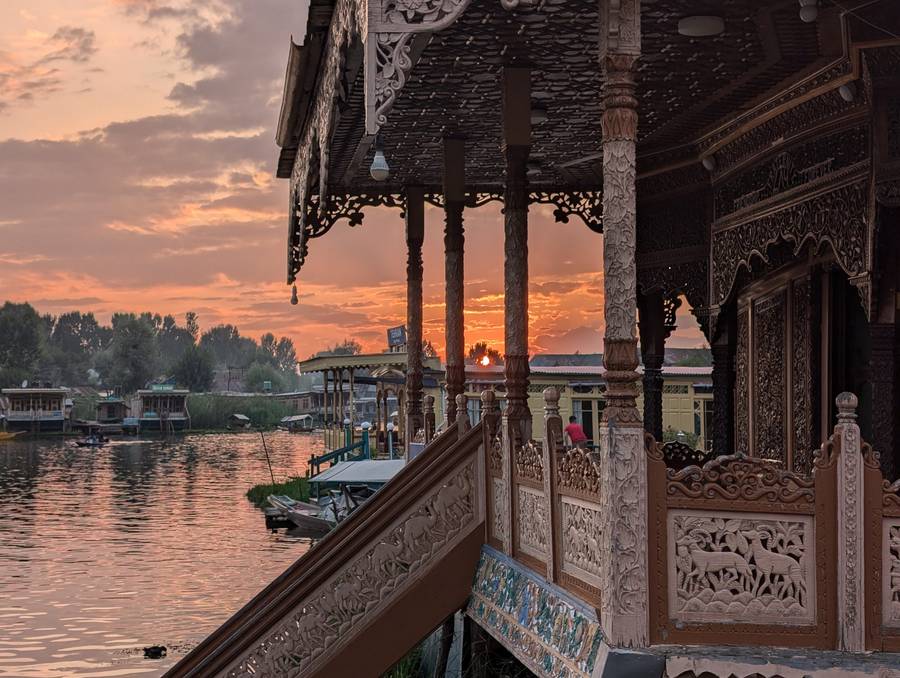
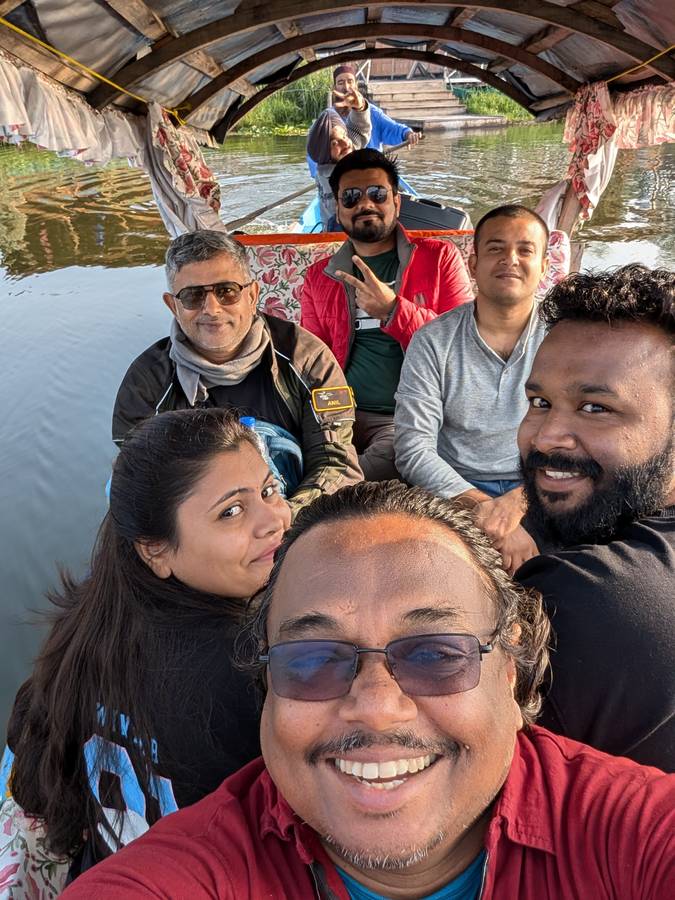
The whole group was booked on the same houseboat. The evening light over the lake, the carved verandah and the sunset behind the line of boats did their usual work, and by night the rest of the riders had arrived. We were briefed together, had dinner together and got to know each other, two Gen X uncles and a houseboat full of people the age of our nephews and nieces.
Day 2 · Srinagar to Kargil: keys, Zoji La and Drass
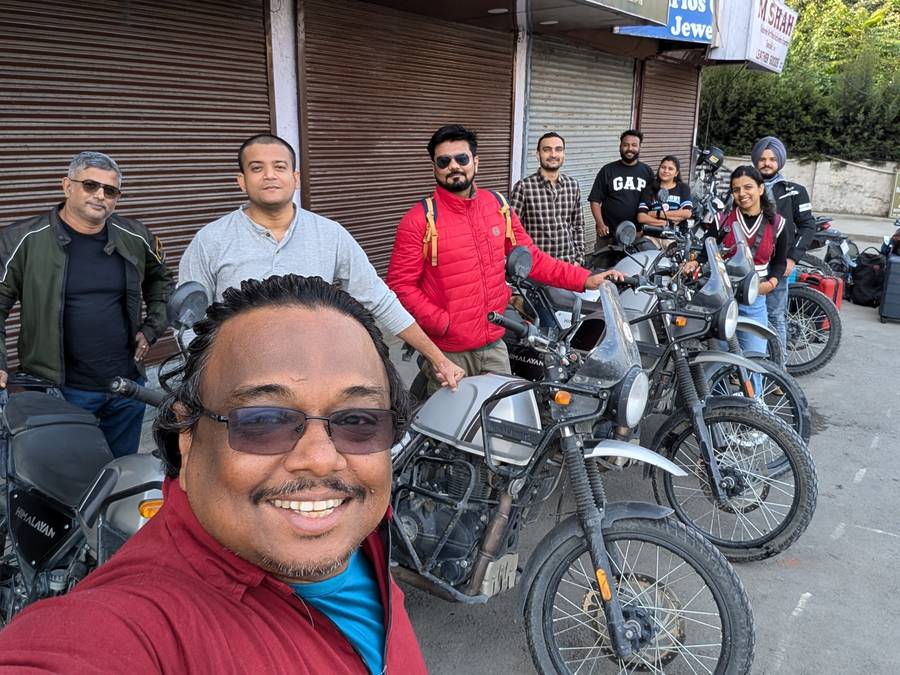
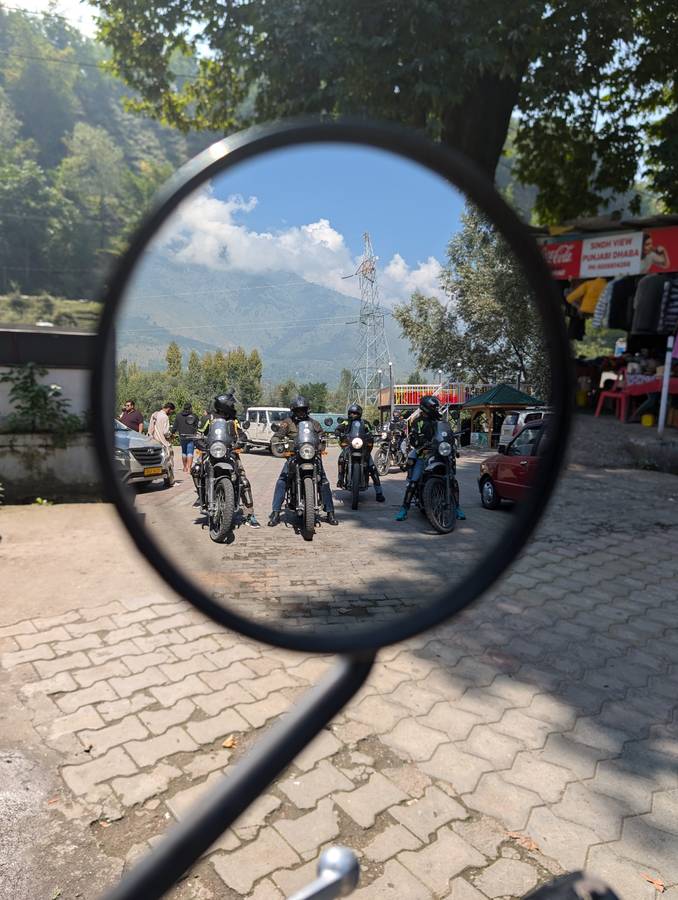
Next morning, after a group shikara selfie, it was down to business: riding gear, the bikes (a row of Royal Enfield Himalayans on a quiet street in Srinagar), a stop for fuel, and off towards Kargil. The first stop out of the city produced one of the best photos of the trip, the whole convoy lined up in a single rear-view mirror.
A JustWravel convoy runs on rules, and they are good ones:
- The lead bike is the convoy captain, an experienced rider from the company.
- At the back is the support vehicle, with spares and a mechanic.
- Everyone else rides in a single line between the two.
- Nobody overtakes the captain.
- If anyone stops, the support vehicle stops with them.
For two Gen X riders this was familiar territory: rules, a chain of command, and someone else in charge at the front. The roads were smooth, empty and fabulous to ride on.
This was my second time on a Himalayan. The first time, in Spiti, I fell three times, and every single fall was from a standing start. Not one at speed, not one on a hairpin: three times the bike and I simply tipped over while stationary, which is the motorcycling equivalent of falling off a chair. This time I came prepared, with proper gloves, proper shoes and gear for the cold and the ride, and I stayed upright. In my opinion the Himalayan is the best bike there is for the mountains: very stable and very comfortable.
The Srinagar start has one more advantage. You climb gradually, from Srinagar at about 1,600 m to Kargil at about 2,700 m and Leh at about 3,500 m, so the body gets time to adjust. Neither of us had any altitude sickness on the whole trip.
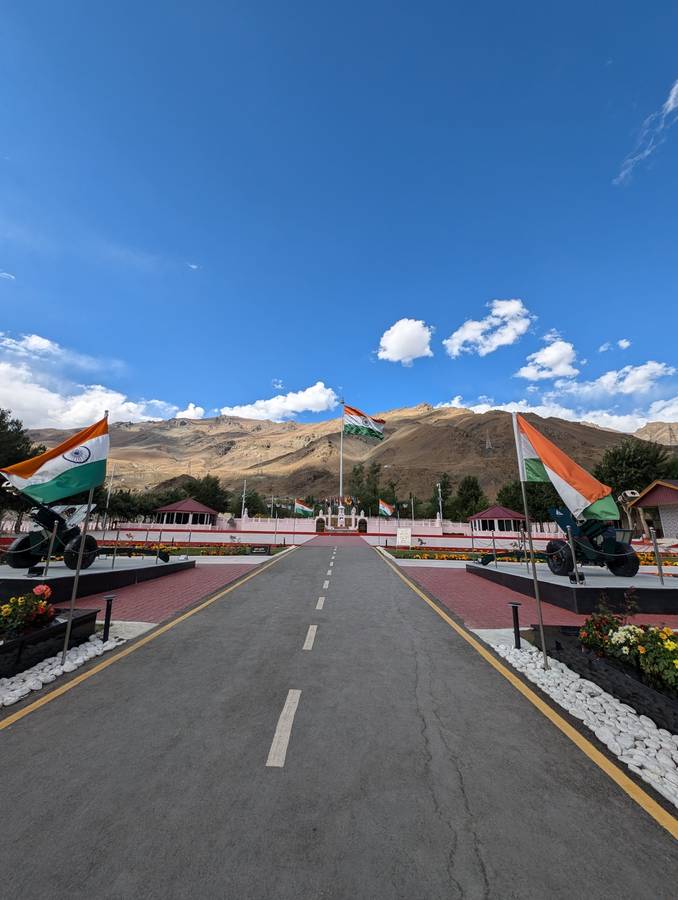
By early afternoon we were at Zoji La, the gateway between the Kashmir valley and Ladakh, posing at the Border Roads Organisation's "Zero Point" board. Green slopes behind us, bare brown mountains ahead. Mid-afternoon we stopped at the Kargil War Memorial at Drass, a quiet, well-kept place. We reached Kargil by early evening.
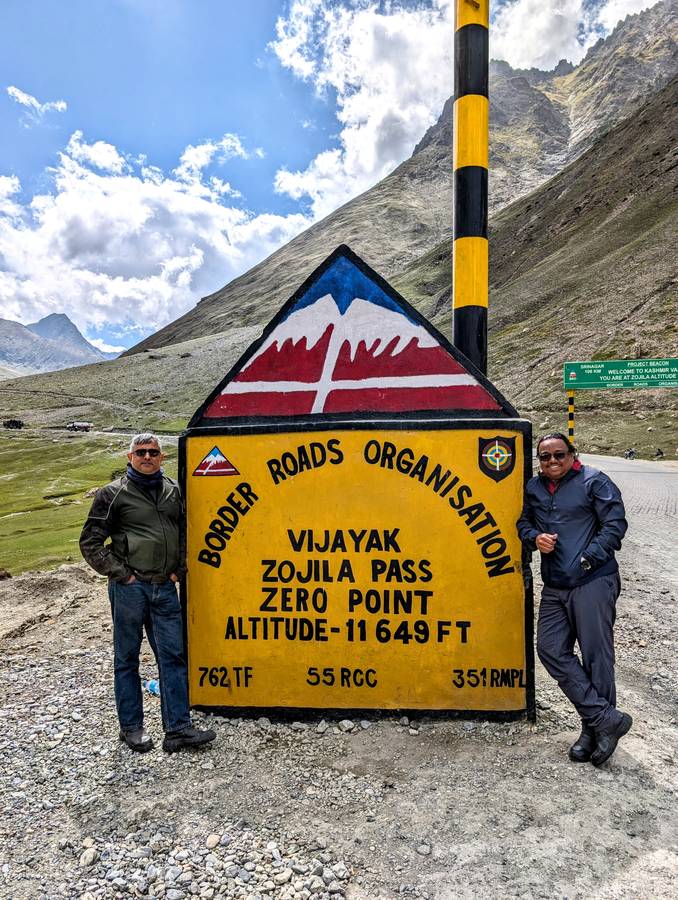
The pass links Sonamarg in the Kashmir valley with Drass in Ladakh. In November 1948, in Operation Bison, the Indian Army took tanks over it to retake the pass, which was then the highest altitude at which tanks had fought anywhere in the world. A 14 km tunnel under the pass has been under construction since 2018.
Day 3 · Kargil to Leh: moonland and the confluence
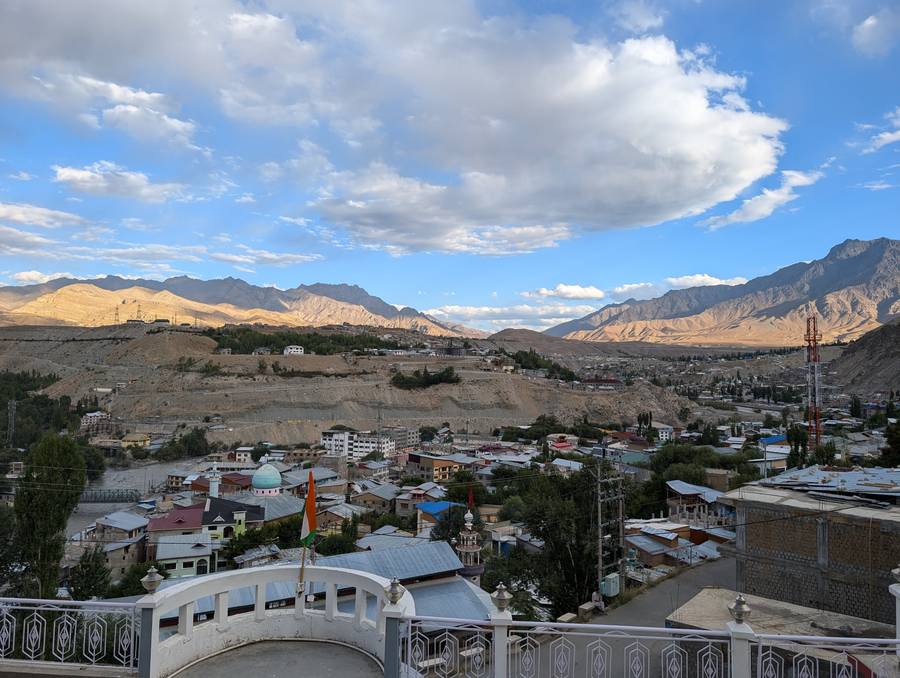
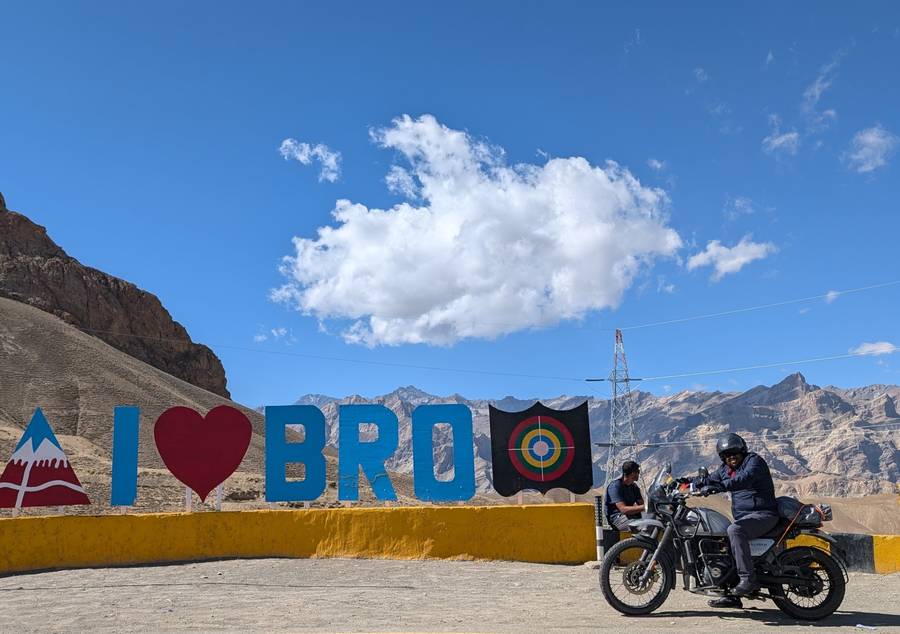
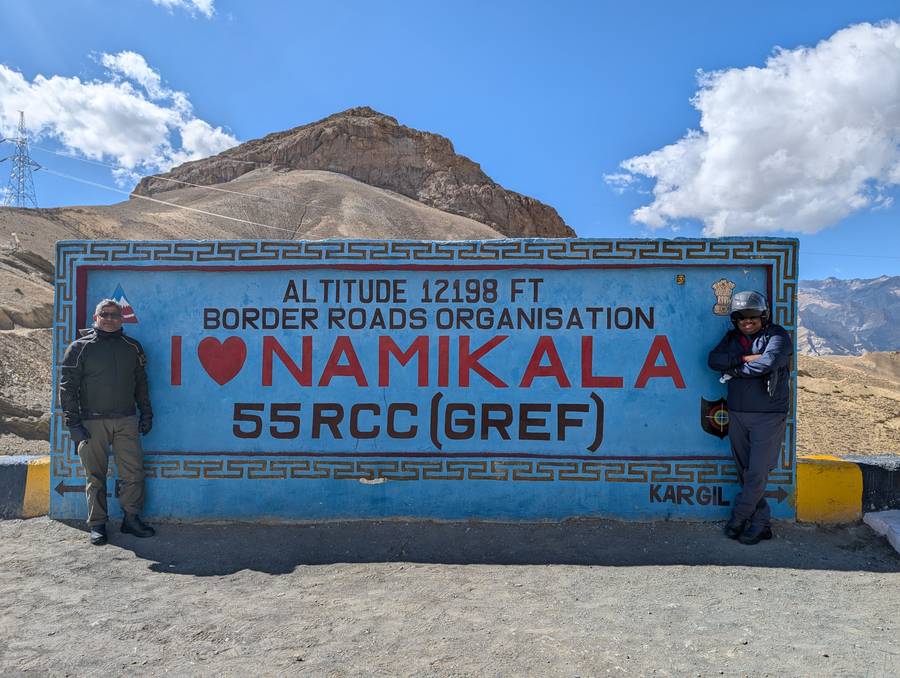
Day three was all landscape. The "I ♥ BRO" board and Namika La (board: 12,198 ft) came mid-morning, then Fotu La and the view over the eroded, crumpled country around Lamayuru that everyone calls moonland. Sunny, blue sky, jackets zipped up. This is where the group selfie got properly crowded.
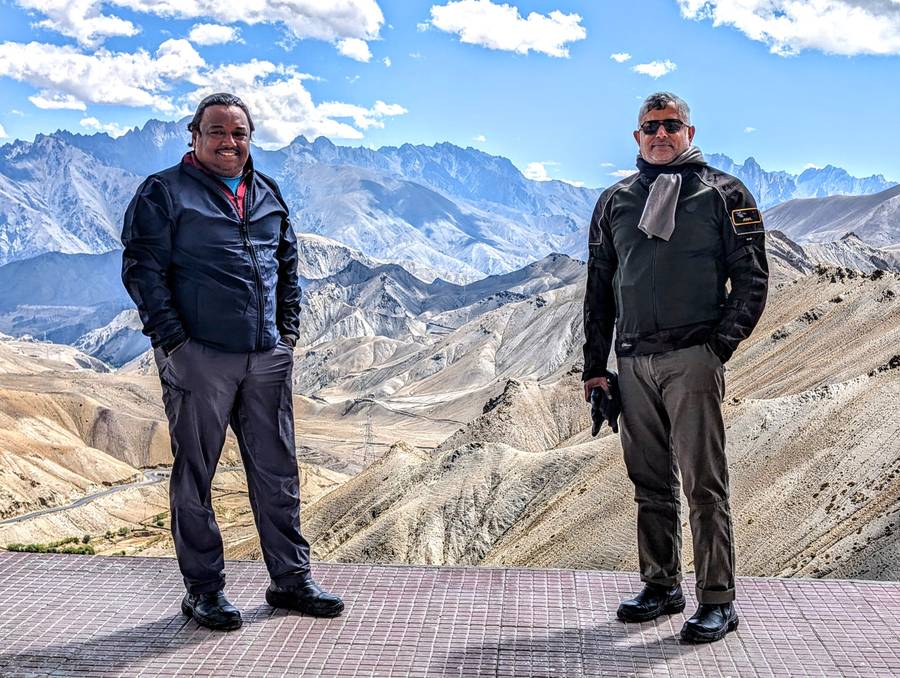
At 4,108 m (13,478 ft), Fotu La is the highest point on the Srinagar–Leh highway, higher than Zoji La. The road drops from it towards Lamayuru and its badlands.
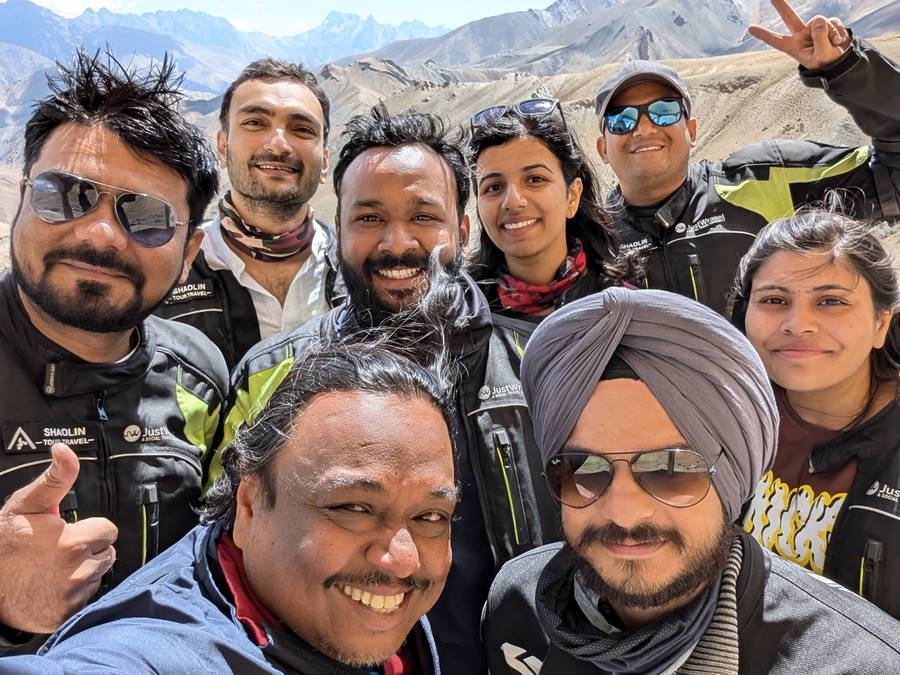
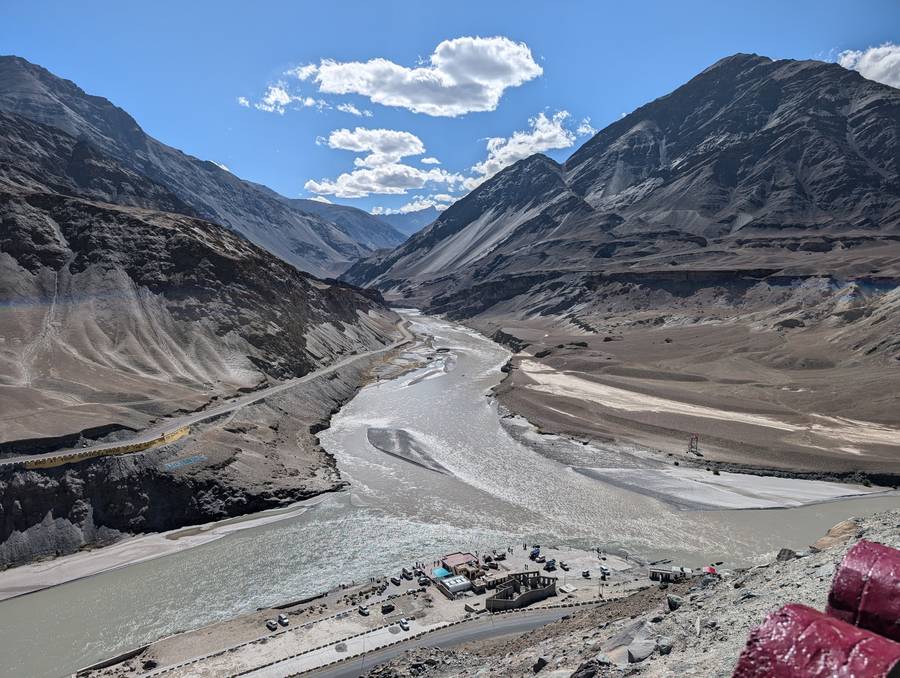
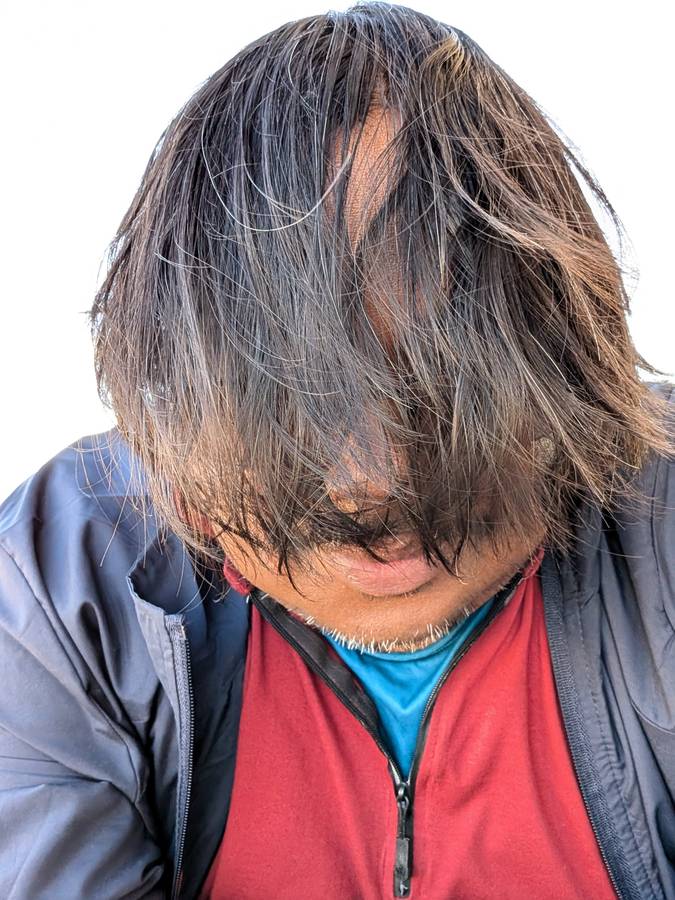
In the afternoon we followed the Indus and stopped above Sangam, where the grey-green Zanskar meets the Indus near Nimmoo. By late afternoon we were in Leh. Exhibit A for what a full day under a helmet does to Gen X hair is below. I offer it without comment.
Day 4 · Leh to Nubra over Khardung La
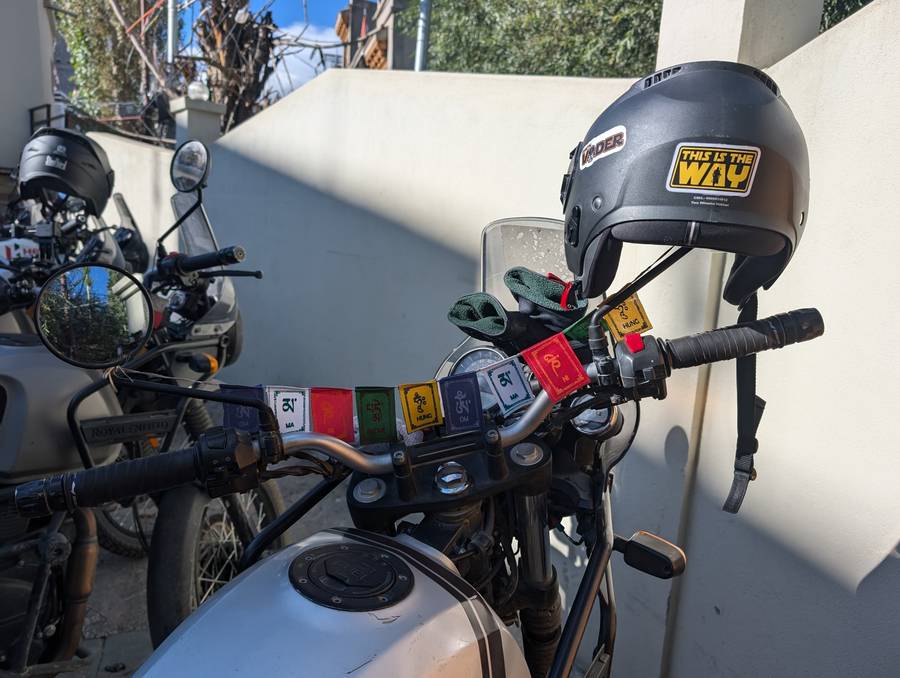
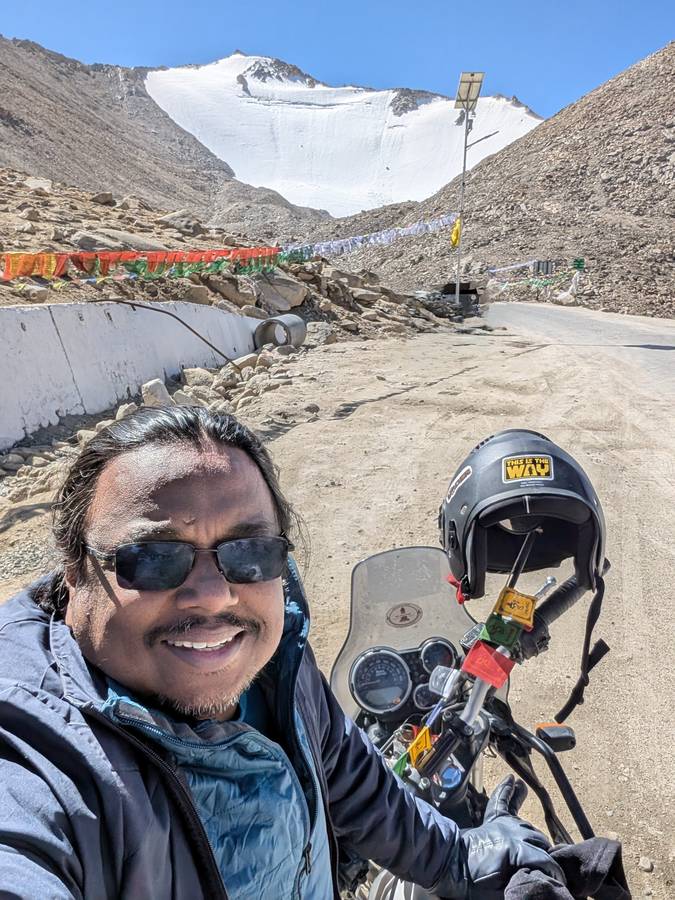
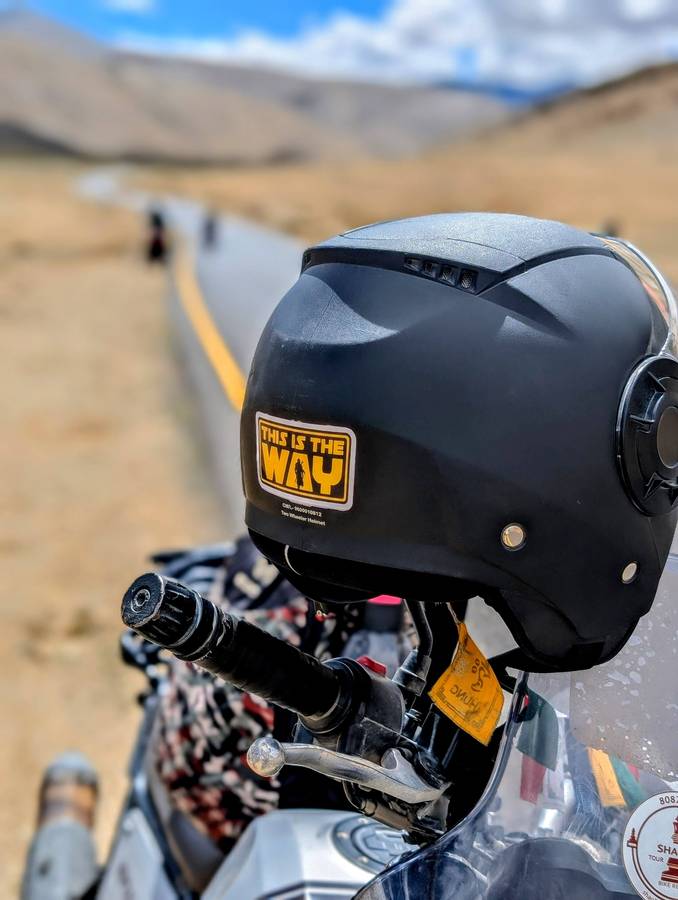
My helmet carried a "This is the Way" sticker, and my handlebars had prayer flags tied to them. Between the two I felt spiritually covered. The sticker needs explaining for anyone who does not live in the Star Wars universe. "This is the Way" is the creed of the Mandalorians in The Mandalorian, the Star Wars series that began in 2019, about a bounty hunter who has sworn never to take his helmet off in front of anyone. Gen X has had Star Wars since the first film in 1977, so the sticker is a generational right. Unlike the Mandalorian, I did take my helmet off; the helmet-hair photo from Leh shows why he may have a point. By mid-morning we were at the top of Khardung La, which has the most confident signboard in Ladakh.
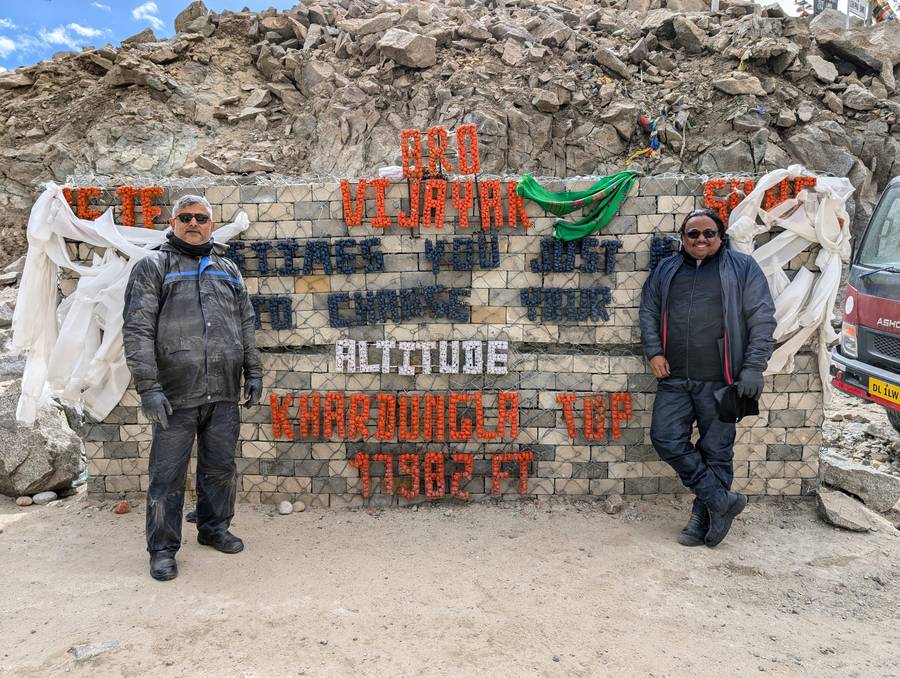
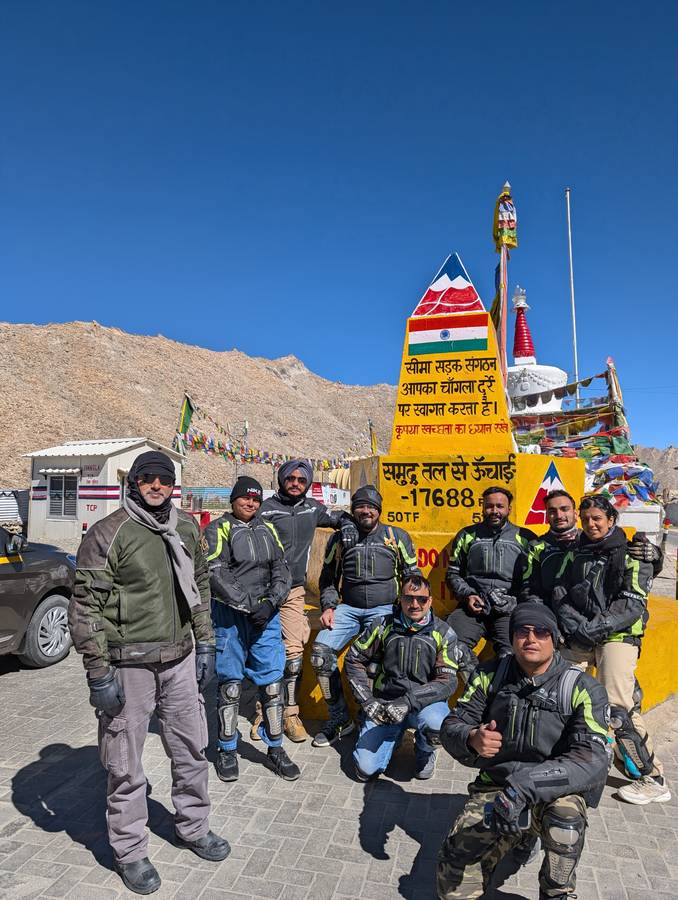
The board at the top reads 17,982 ft. Surveyors put the pass at 5,359 m, which is 17,582 ft. So the board adds 400 feet, which is about what I add when I tell people how far I rode in a day. Older boards claimed 18,380 ft. The pass is about 40 km from Leh by road.
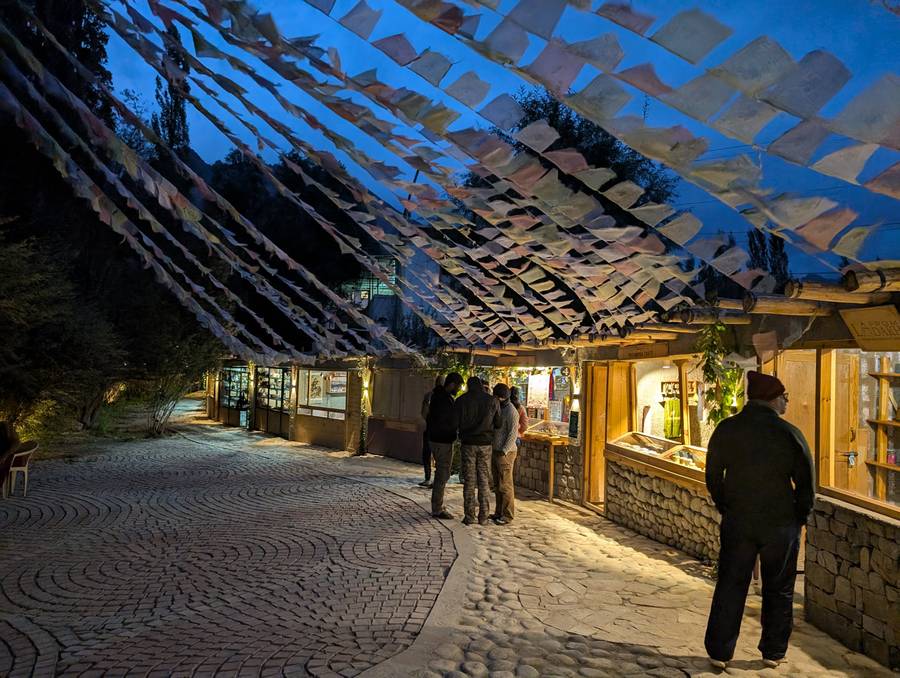
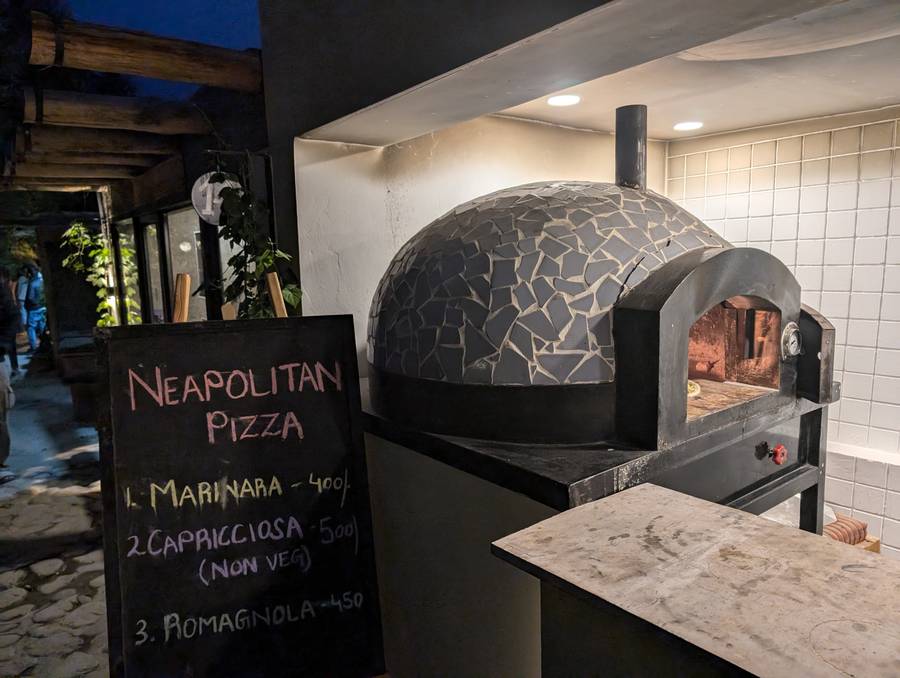
On the Nubra side the sky clouded over. Mid-afternoon we climbed to Diskit Monastery and the giant Maitreya Buddha looking down the Shyok valley. Then on to Hunder, where the camp was a surprise: prayer flags strung over a cobbled path, lit garden seating, and a wood-fired Neapolitan pizza oven with a chalkboard menu. This is the natural habitat of the millennial. In 1992, a pizza oven in Nubra would have been science fiction.
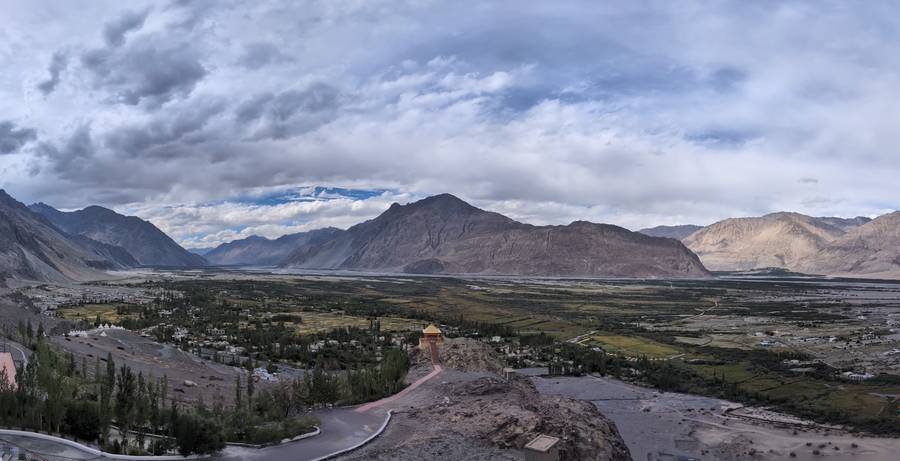
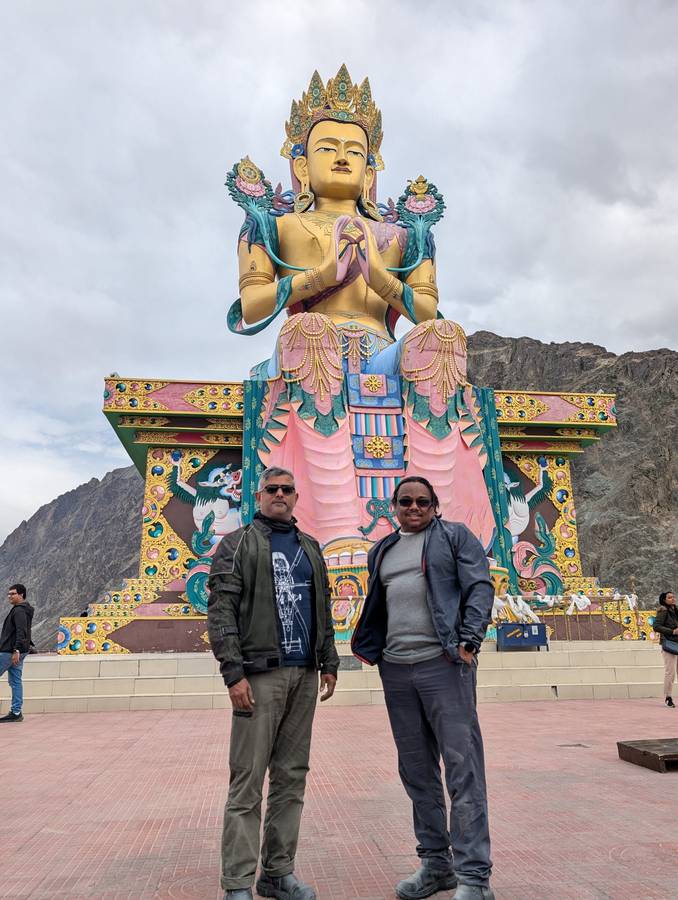
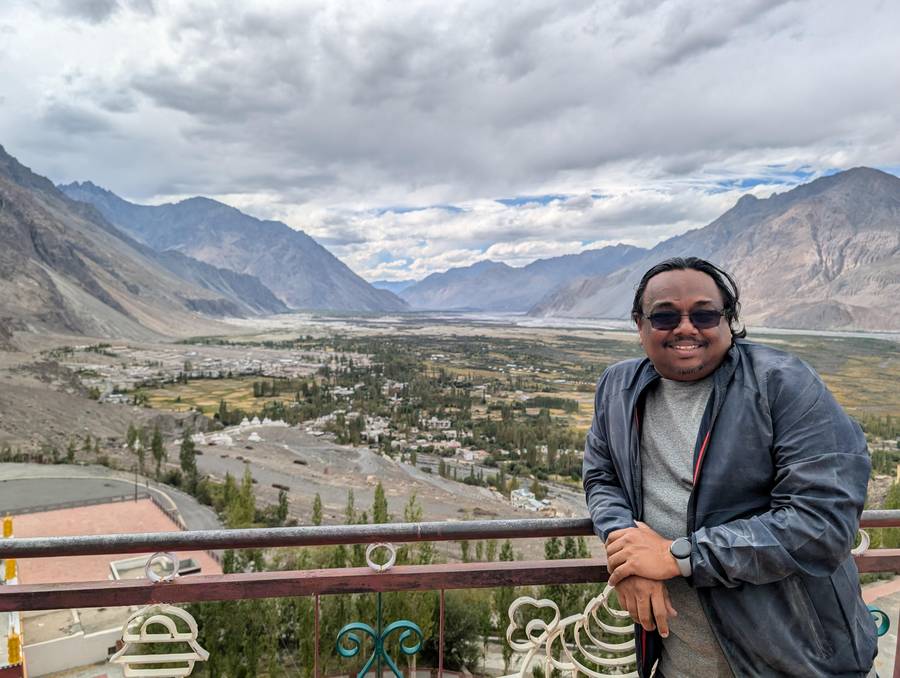
The statue of the future Buddha stands on a hill below Diskit Monastery, facing down the Shyok valley. It is about 100 feet tall and was consecrated by the Dalai Lama in July 2010.
Day 5 · Hunder: the Gen X rest day
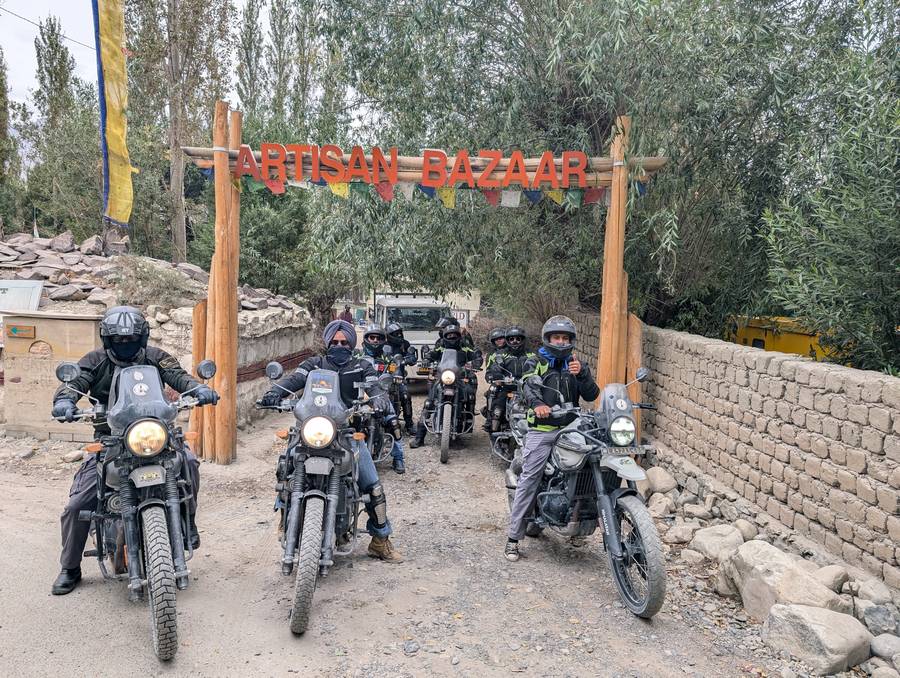
On day five the convoy rode out for the day trip to Turtuk, and I did the most Gen X thing possible. I stayed back. I had already been to Turtuk on an earlier trip, so I photographed them at the gate, went out for lunch, and lazed around all day. Anil, on his first visit to Nubra, sensibly went with the group. There is a lesson here for the young: the best way to enjoy a mountain is sometimes to sit and look at it.
Day 6 · Nubra to Pangong
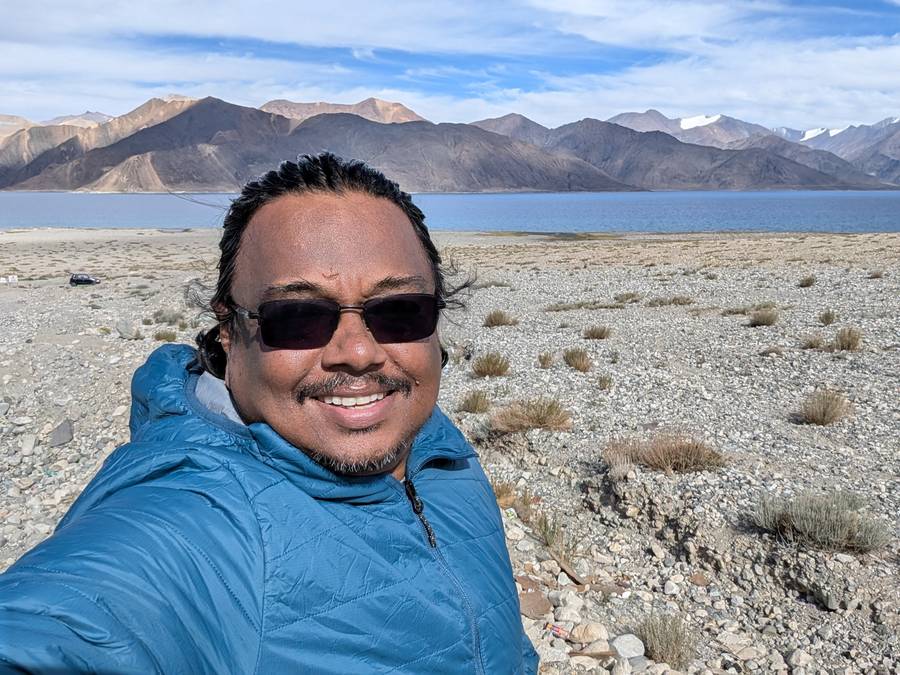
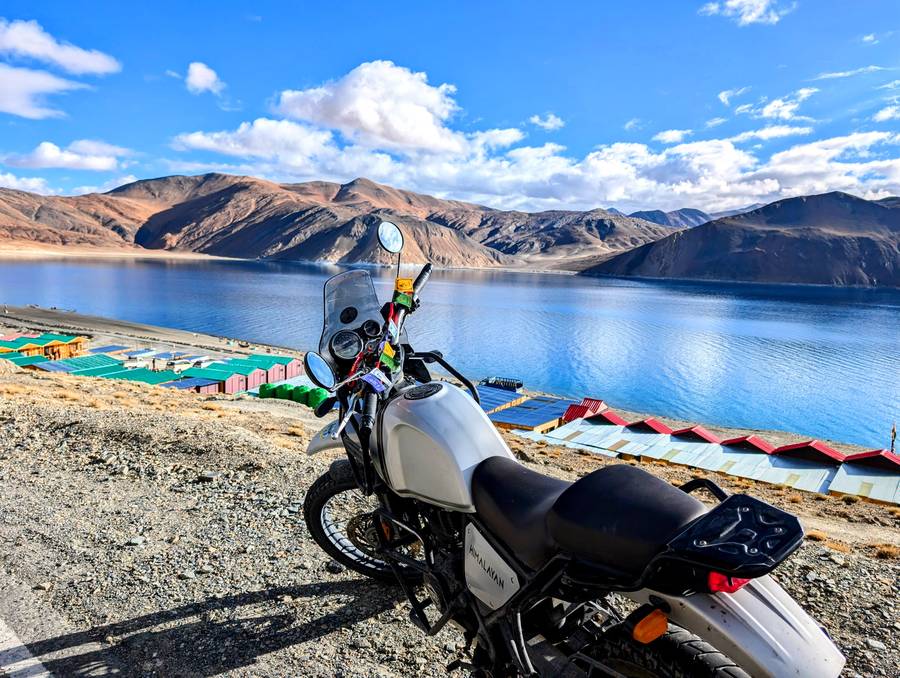
We left Hunder early and were at Pangong by early afternoon. The lake did what it does to everyone: that impossible blue, brown mountains in stripes on the far side. I swapped the riding jacket for a blue puffer and took a selfie that looks like a tourism advertisement.
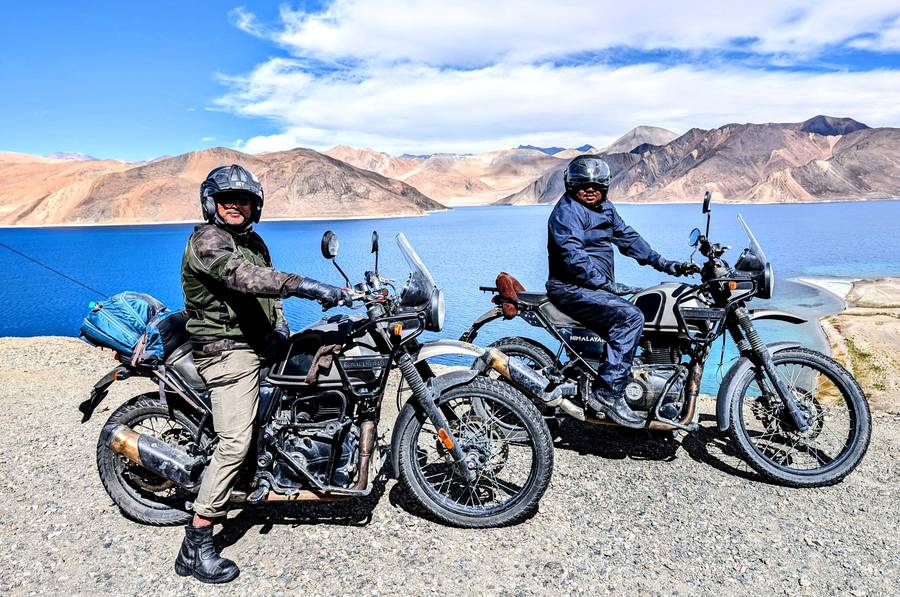
The lake is about 134 km long and sits at roughly 14,270 ft. Only about a third of it is in India; the rest runs into Tibet. The water is brackish, which makes it one of the highest brackish lakes in the world.
Day 7 · Pangong to Leh over Chang La
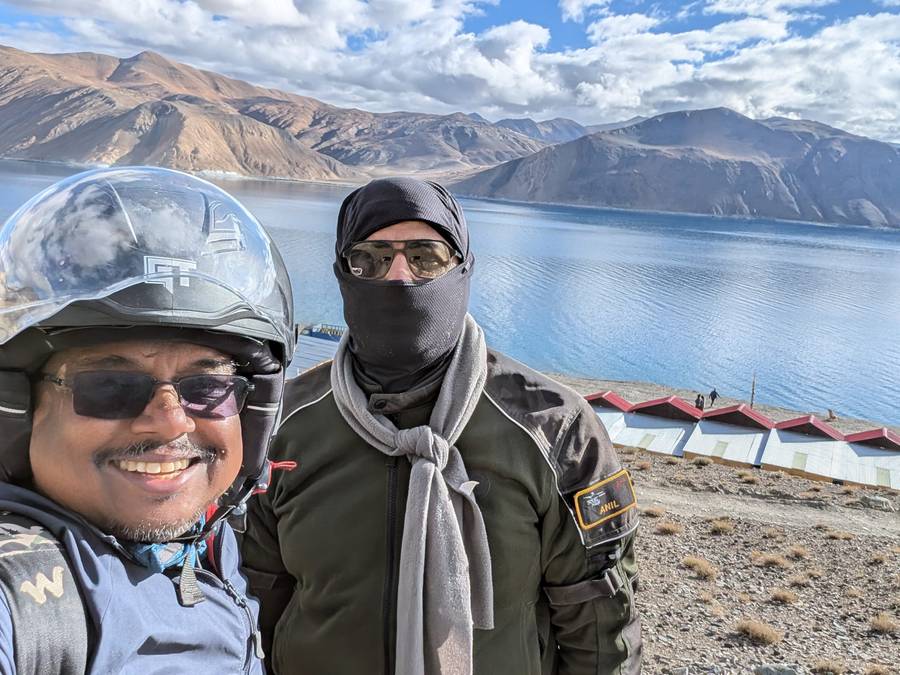
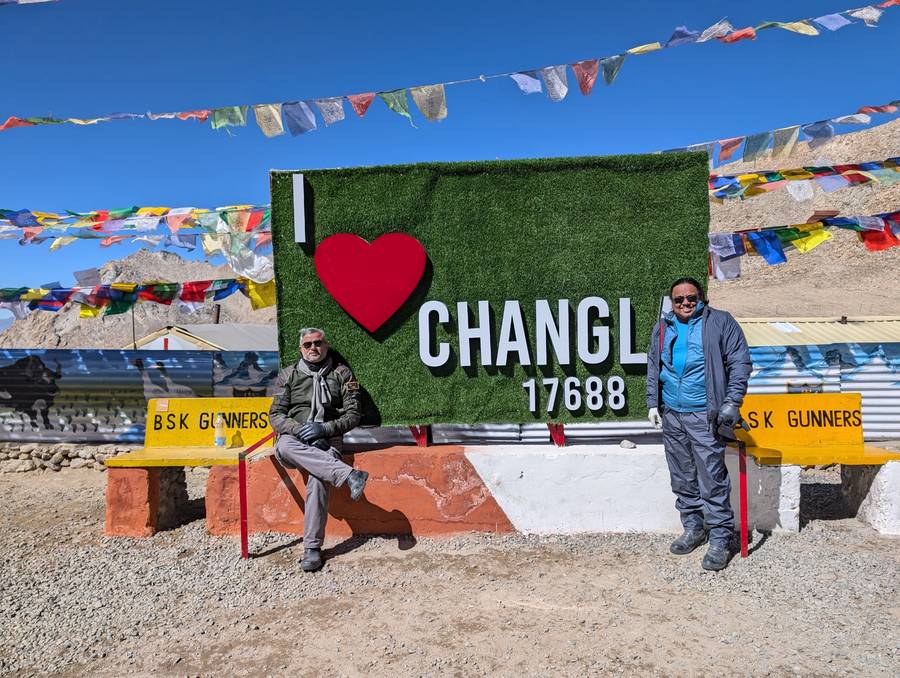
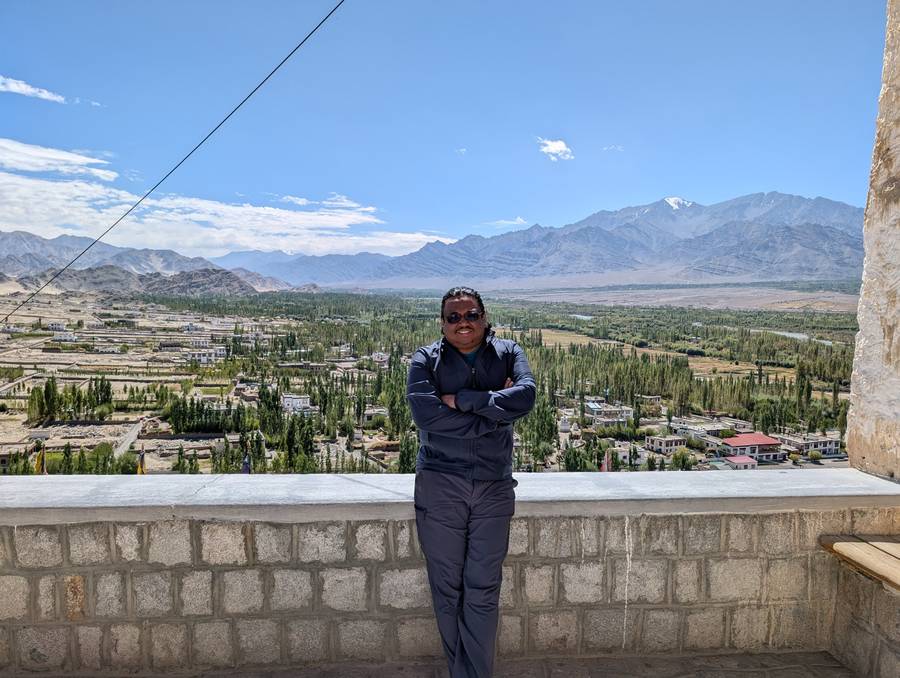
Morning at the lake was clear and cold, with Anil wrapped up like a man expecting a blizzard. Then back west over Chang La, where there was snow on the slope behind the board, and down to Thiksey Monastery before noon, with the whole Indus valley laid out below the terrace.
Day 8 · Leh to Sarchu: the long one
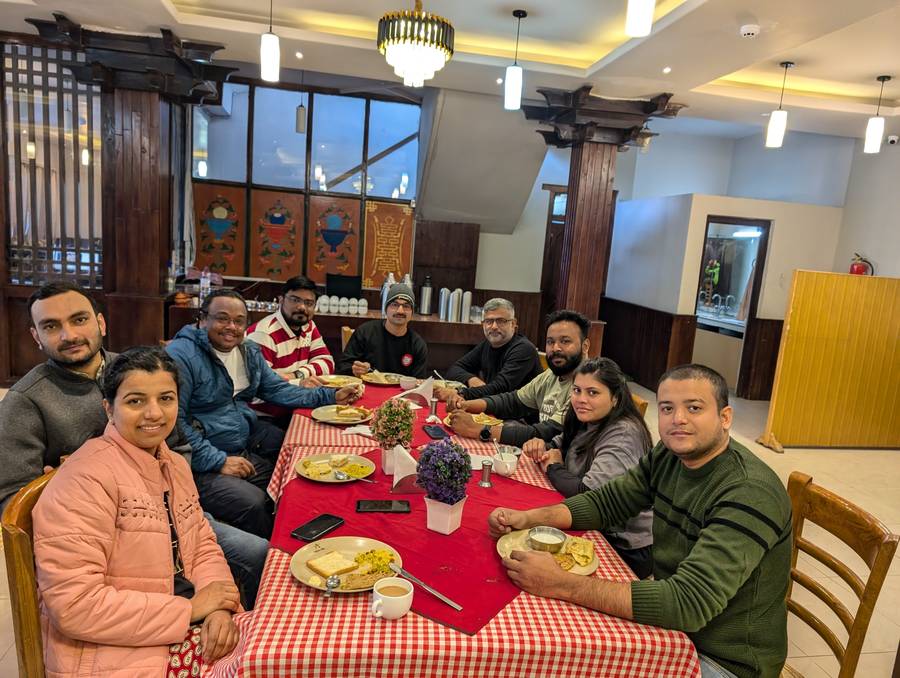
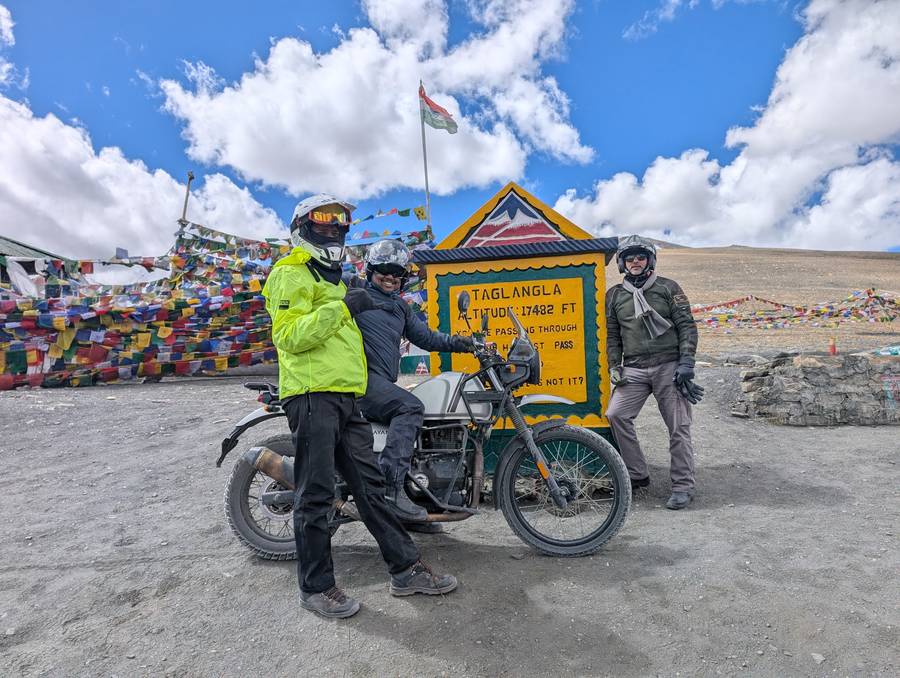
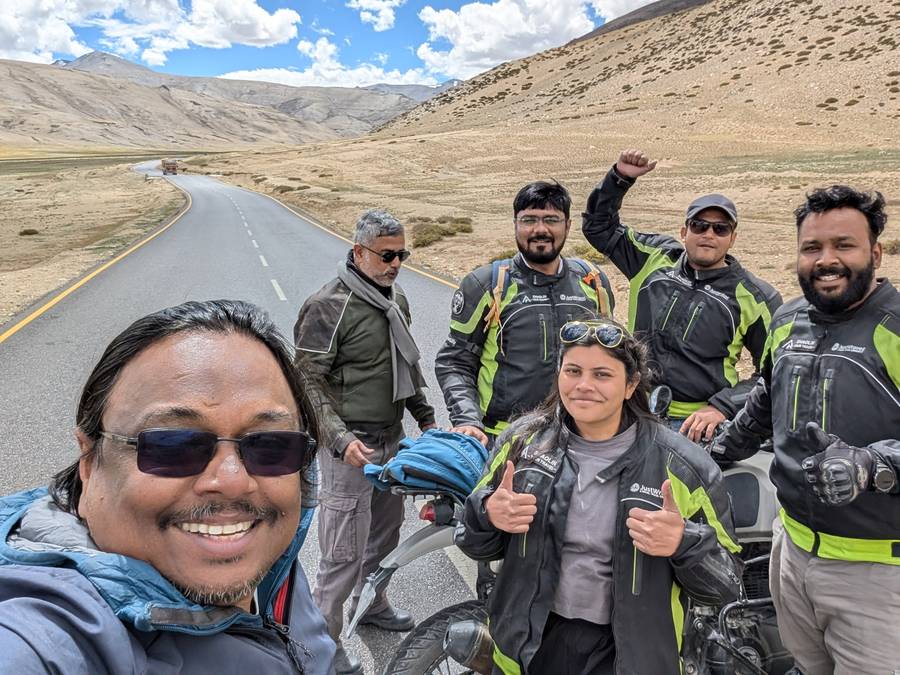
This was the big day, the Leh–Manali highway from Leh to the tent camps at Sarchu, and it started with a group breakfast that looked suspiciously like a family wedding. By late morning we were at Taglang La, the highest pass of the day, under huge clouds.
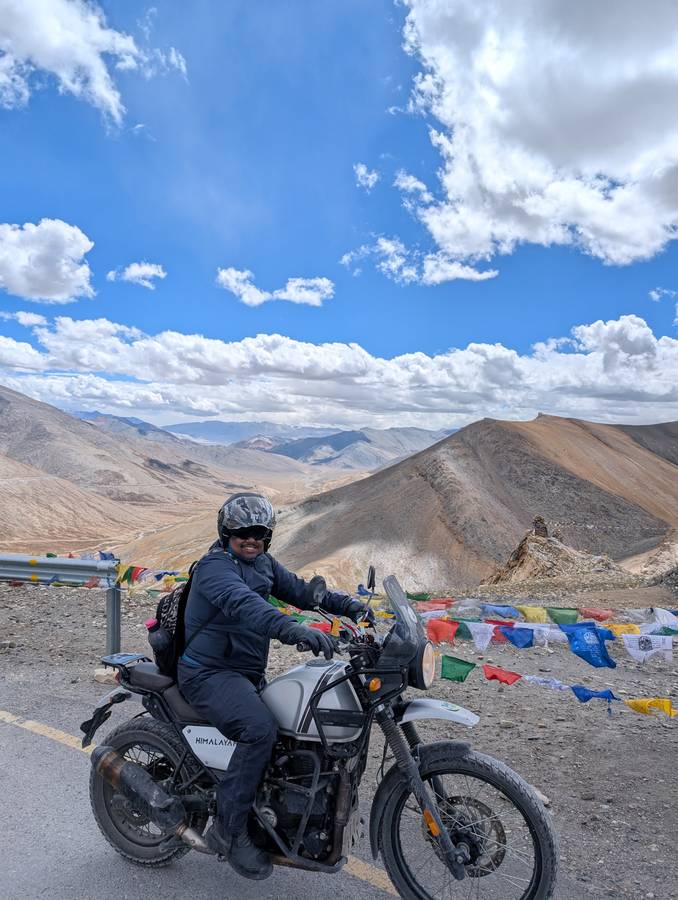
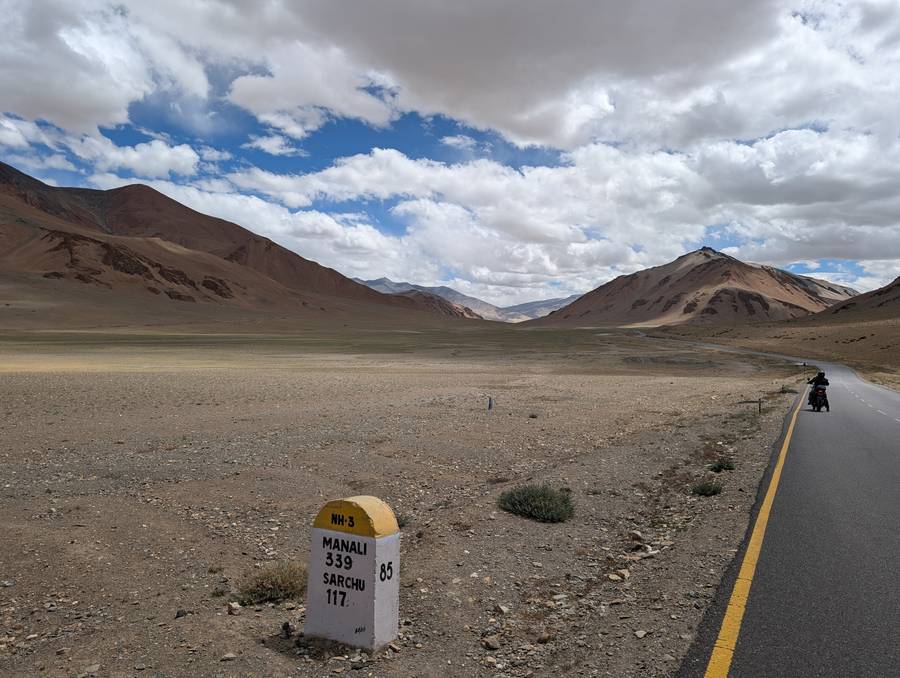
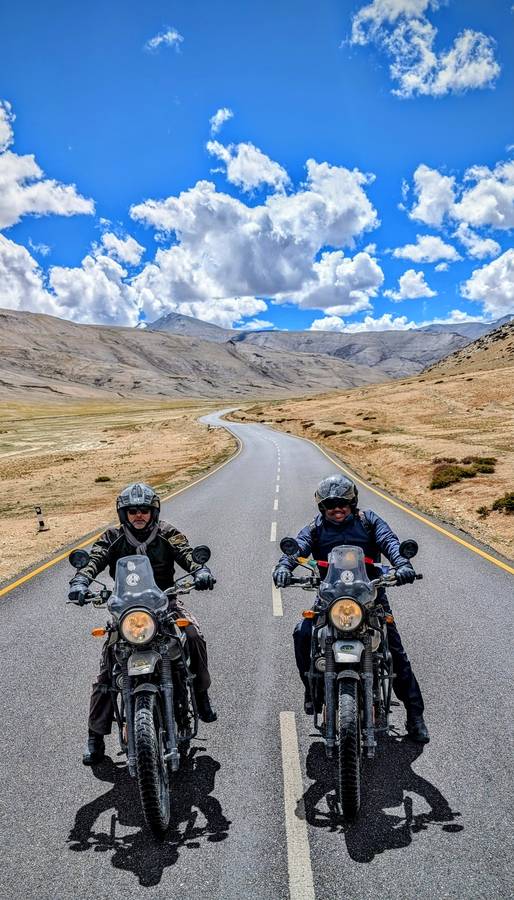
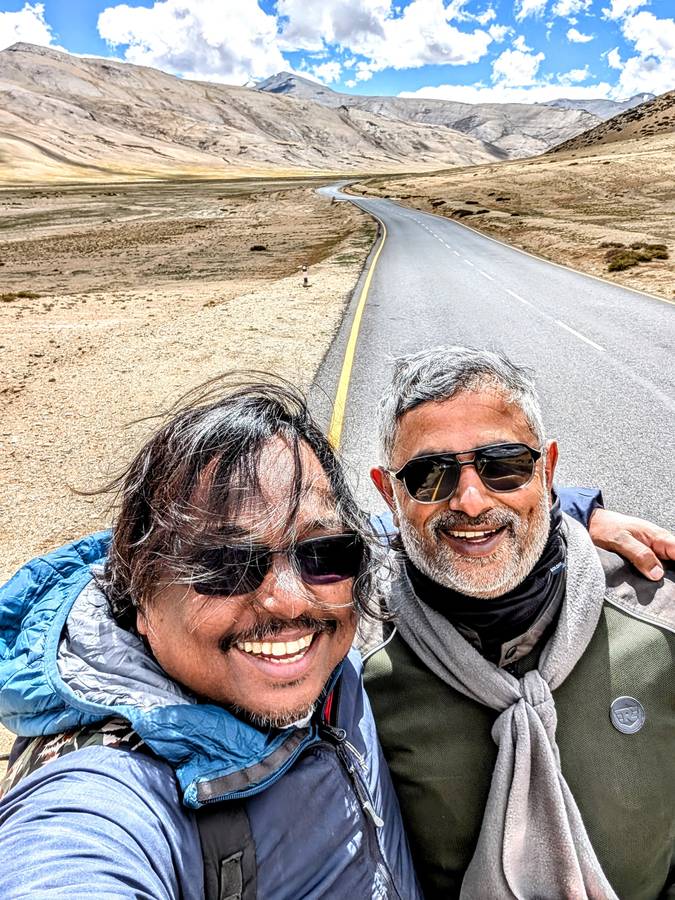
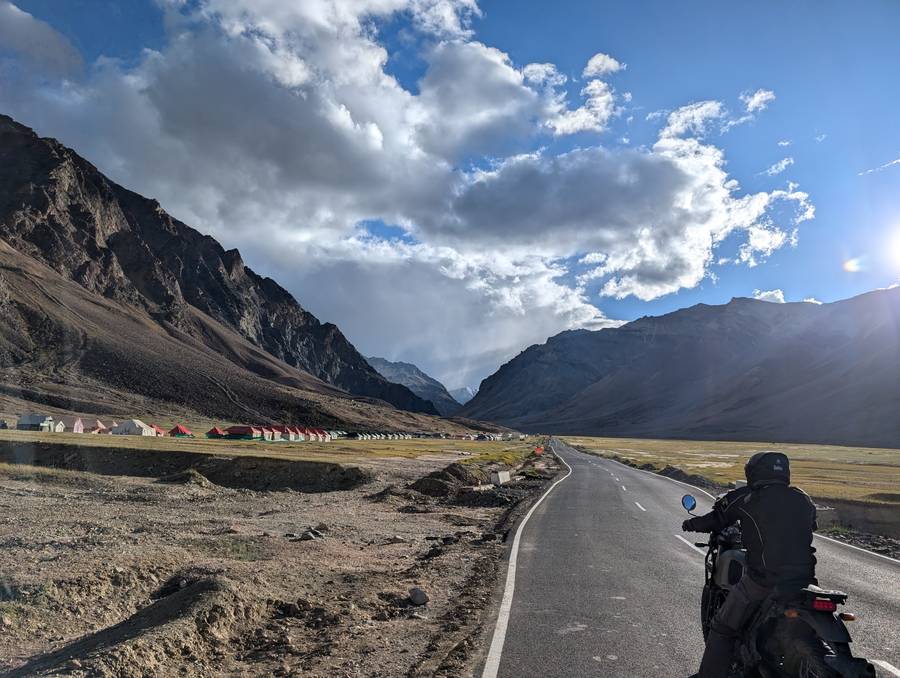
South of Taglang La the road runs across the More Plains, and this is where most of my photos from the trip come from. It is by far the most scenic road I have ever ridden: a wide, flat valley at around 4,800 m, endless visibility, a perfect two-lane road and a cold wind coming across the grass. It could not have been better. A milestone told us Manali was 339 km away. It is the kind of road where two uncles can line up side by side for a photo and pretend they are in a film.
For about 40 km between Taglang La and Pang, the Leh–Manali highway runs across a high plateau averaging about 4,800 m, part of the Changthang. For some 35 km it stays almost flat. Its local name, Kiang Chu Thang, is usually translated as the plain where the kiang, the Tibetan wild ass, finds no water. Peaks above 6,000 m ring the plain, and nearby wetlands are one of India's breeding grounds for the black-necked crane. The Border Roads Organisation has widened the road to two lanes, which is why it rides like a runway.
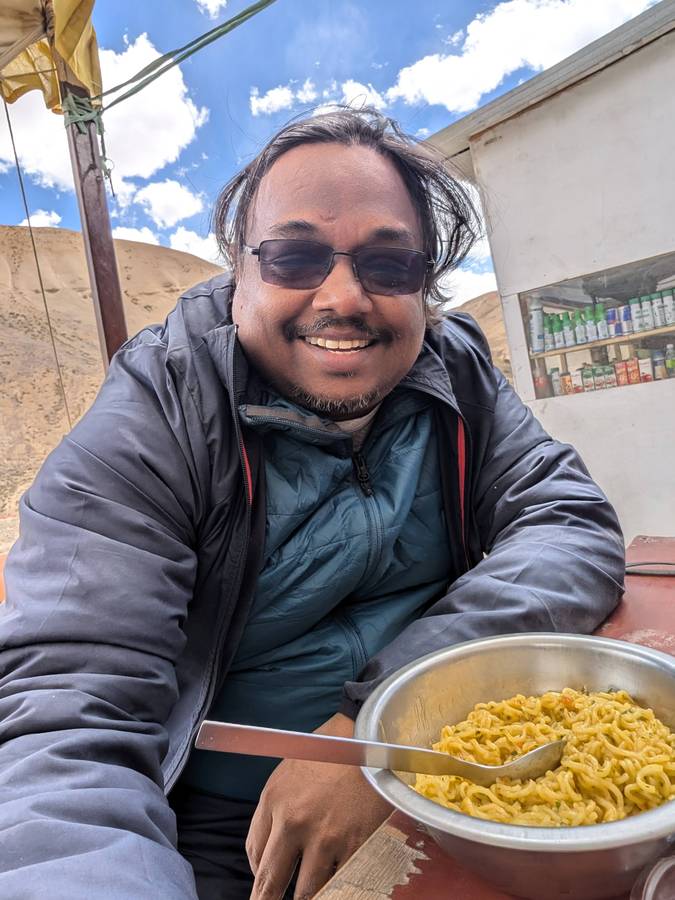
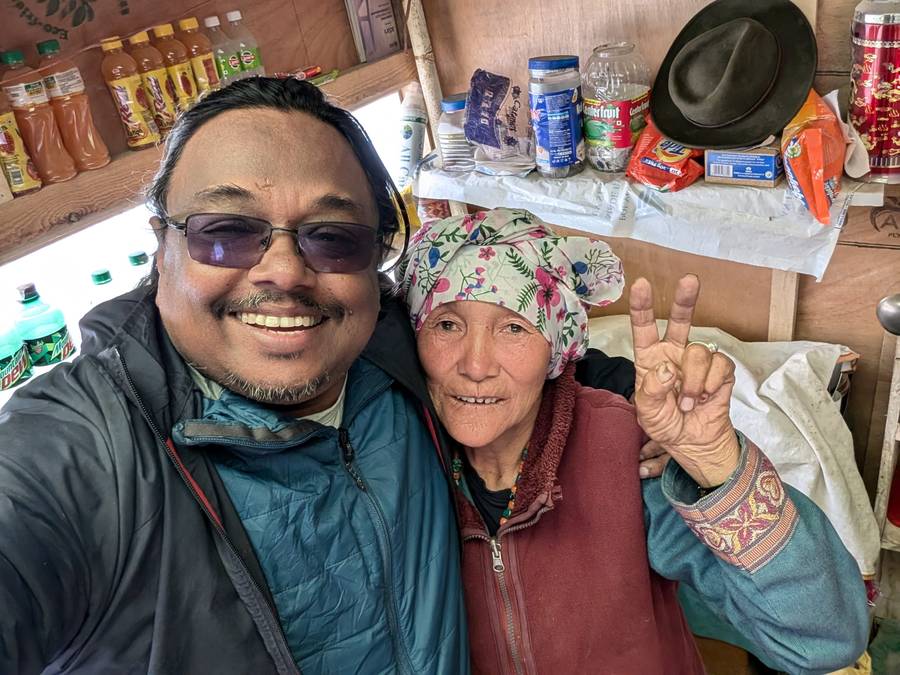
At Pang we stopped for the national dish of the Leh–Manali highway, a bowl of Maggi at a roadside dhaba. The woman who ran it posed for a selfie and outdid every millennial in the group at the peace sign.
In the afternoon came Lachulung La and Nakee La, and then the Gata Loops, the hairpins that take the road down towards Sarchu. We rolled into the Sarchu tent camp in the late-afternoon sun, for the last night with the bikes. Sarchu was bone-chilling. The camp sits on a wide-open plain with nothing to stop the wind, we slept in tents, and it was really, really cold.
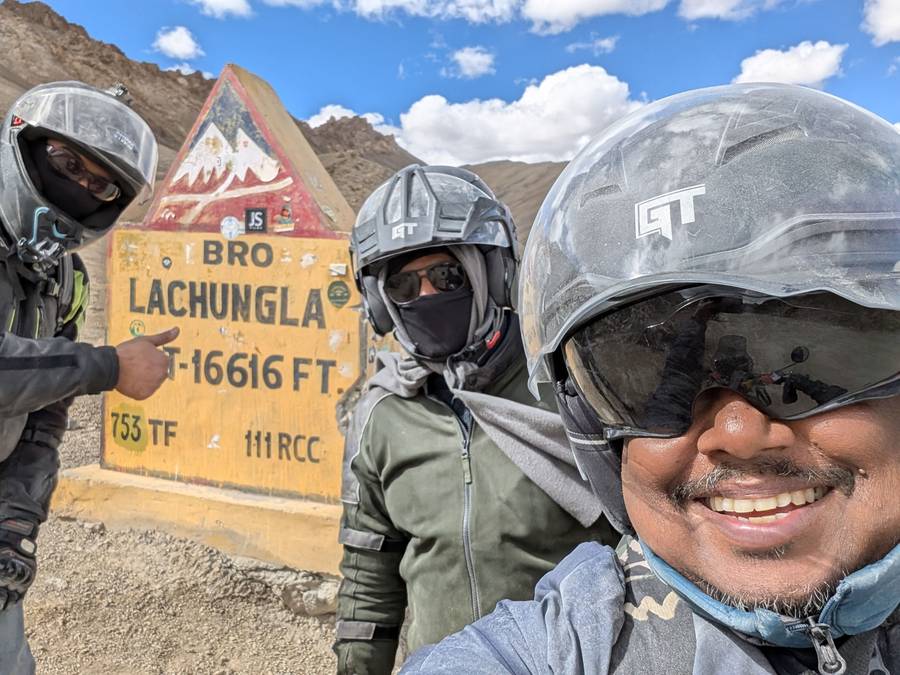
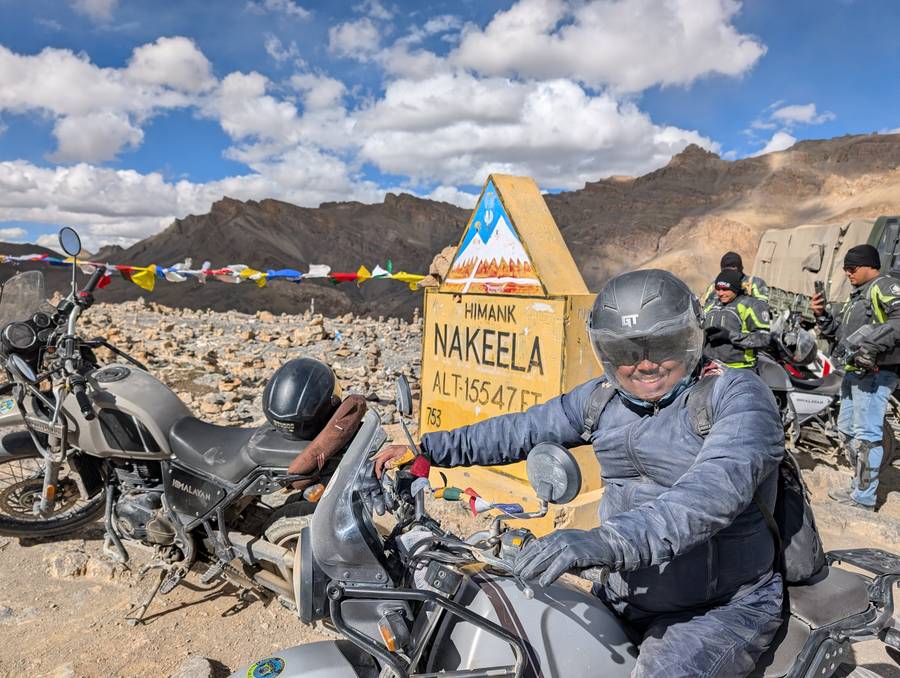
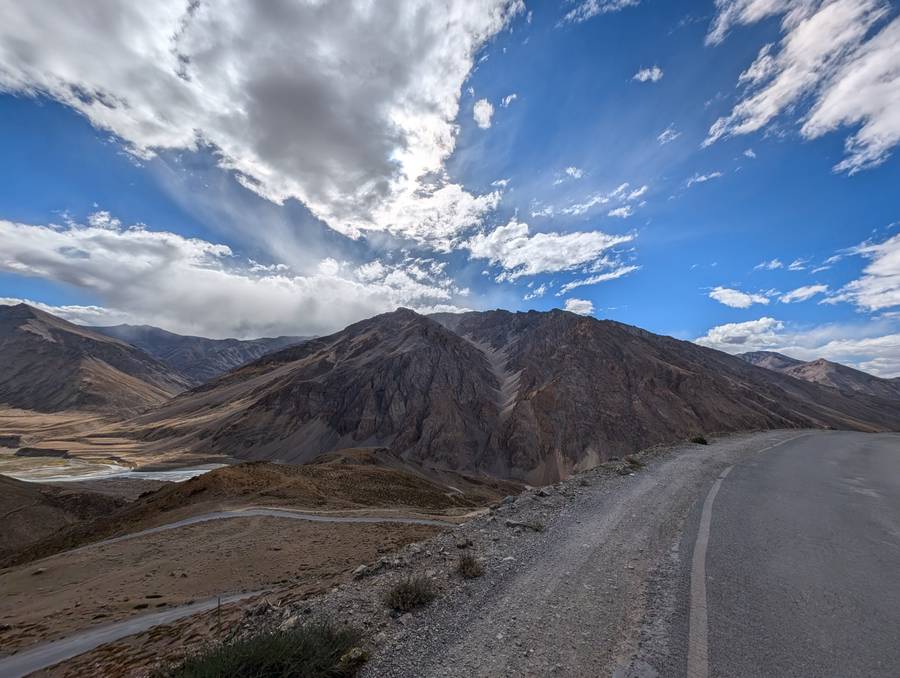
From Leh the road crosses Taglang La (5,328 m), Lachulung La (5,059 m), Nakee La (4,739 m) and Baralacha La (4,890 m). Between Nakee La and the valley floor are the Gata Loops, 21 hairpin bends.
Day 9 · Sarchu to Manali: the border, the bus and the snow
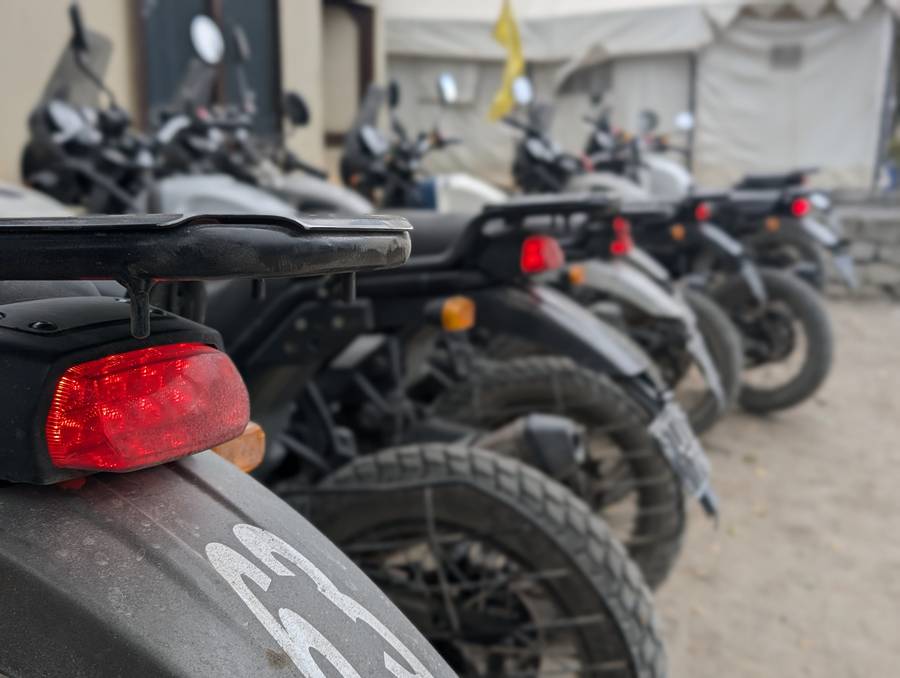
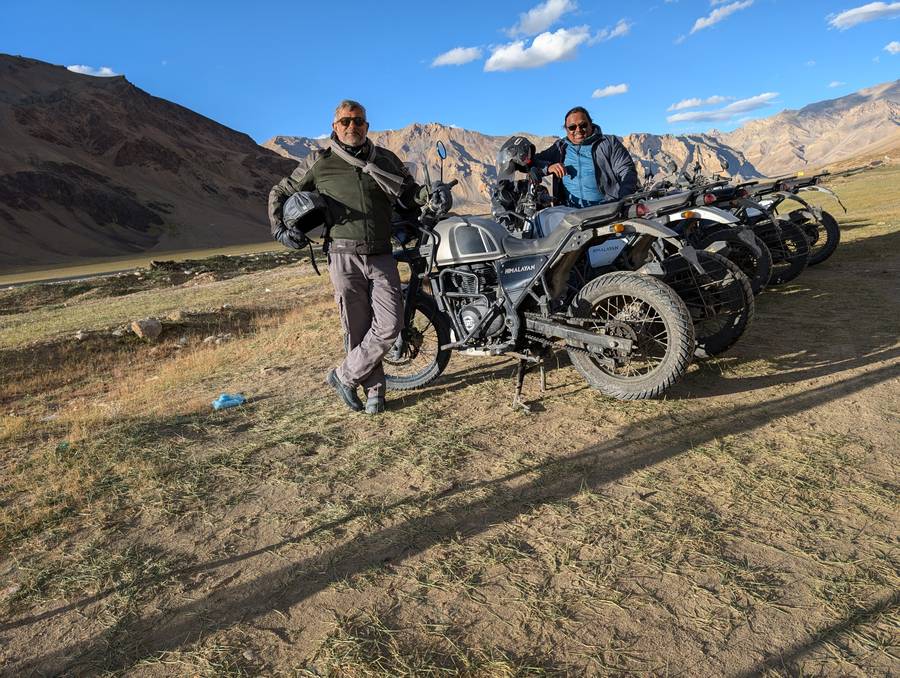
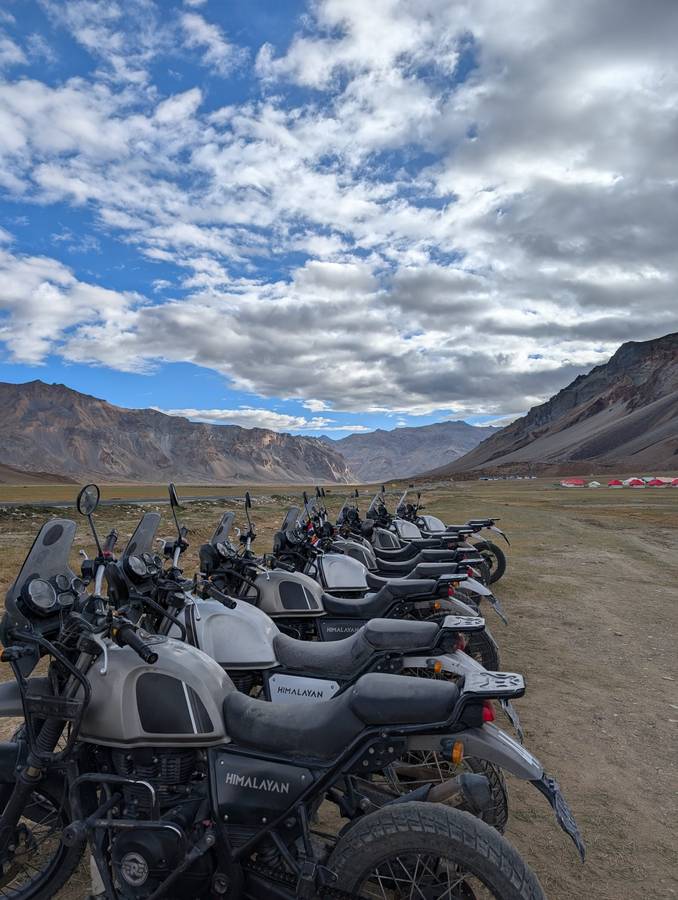
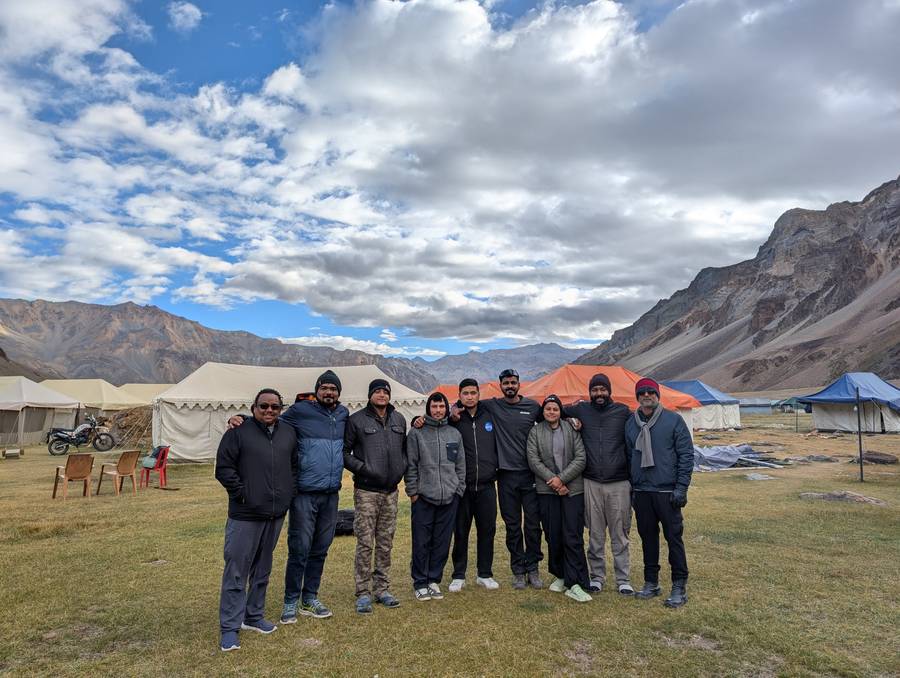
Here is the twist. Ladakh's and Himachal's taxi and bike-rental operators have been feuding for years over whose vehicles may run in whose territory, and in 2024 the upshot was simple: bikes from Ladakh do not cross into Himachal. JustWravel handles this neatly. It runs a bike trip and a bus trip together: the two groups meet and stay at the same place, then travel on independently. The evening before, a bus had brought another group up from Manali to Sarchu. In the morning they took our bikes and headed for Srinagar, and we took their bus down to Manali. Small world: in that group was a girl who had done the Spiti trip with us, and there she was in the bus group. So the morning began with a clear sky, a group photo by the tents and a last look at the line of Himalayans, and then the convoy climbed into a bus.
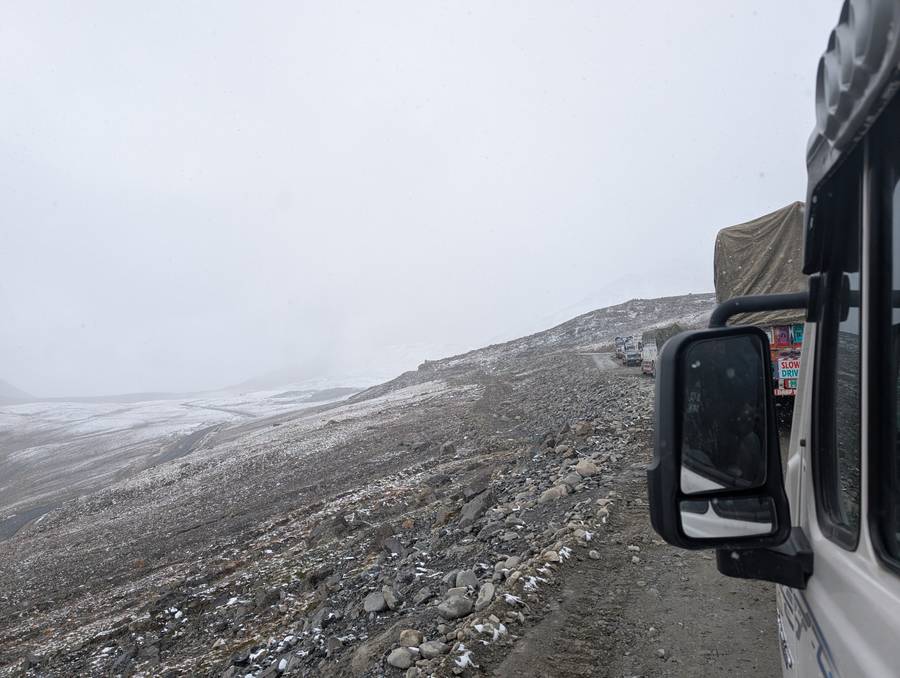
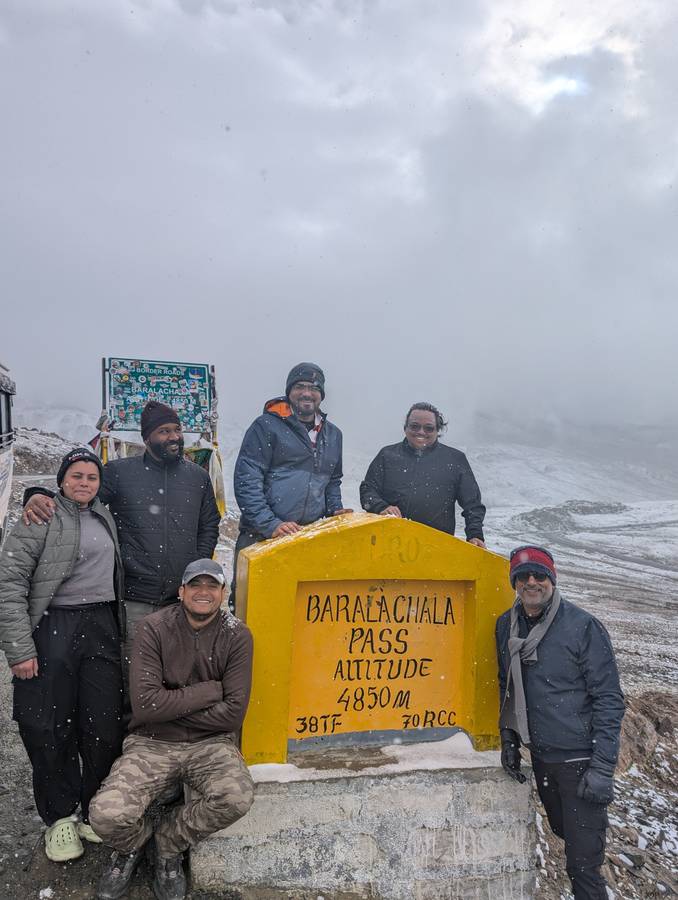
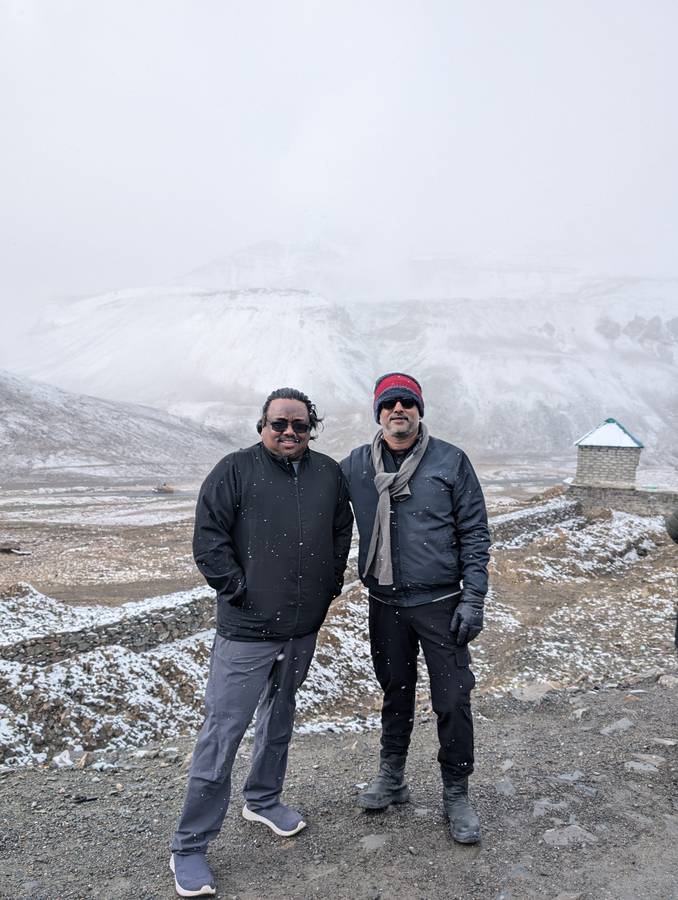
The one morning we were not riding turned out to be the morning it snowed, and it was the icing on the cake of the whole trip. By the time we reached Baralacha La it was coming down properly and the board was dusted white. Suraj Tal, just below the pass, was grey under the falling snow.
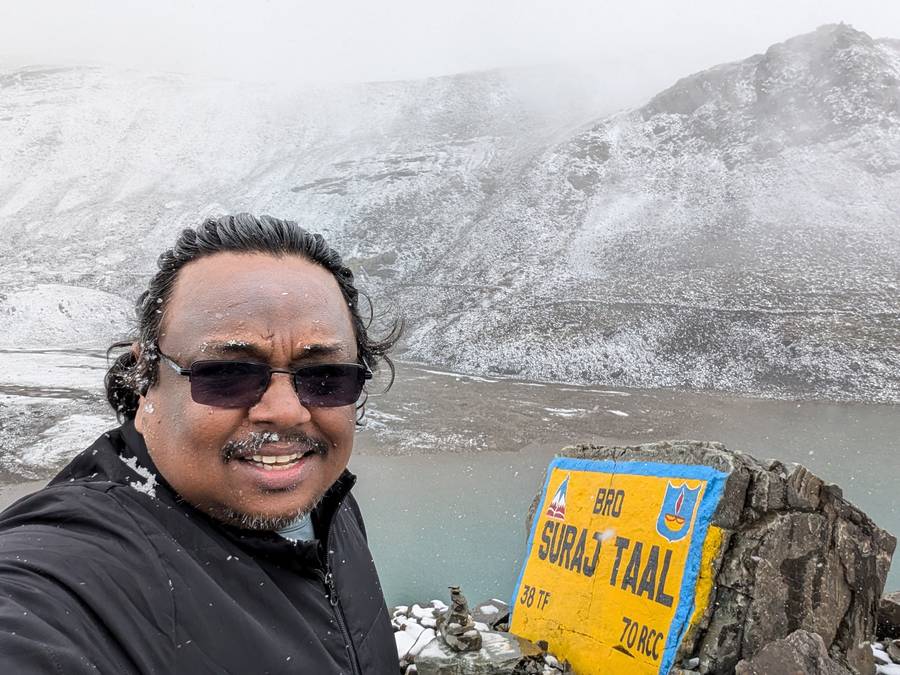
The lake sits just below Baralacha La, at about 4,766 m. It feeds the Bhaga river, which joins the Chandra at Tandi to become the Chandrabhaga, known further downstream as the Chenab.
Around noon we went through the Atal Tunnel, and came out on the Manali side under low cloud and green slopes, a different world from the brown plains of the day before. We spent the afternoon in Manali.
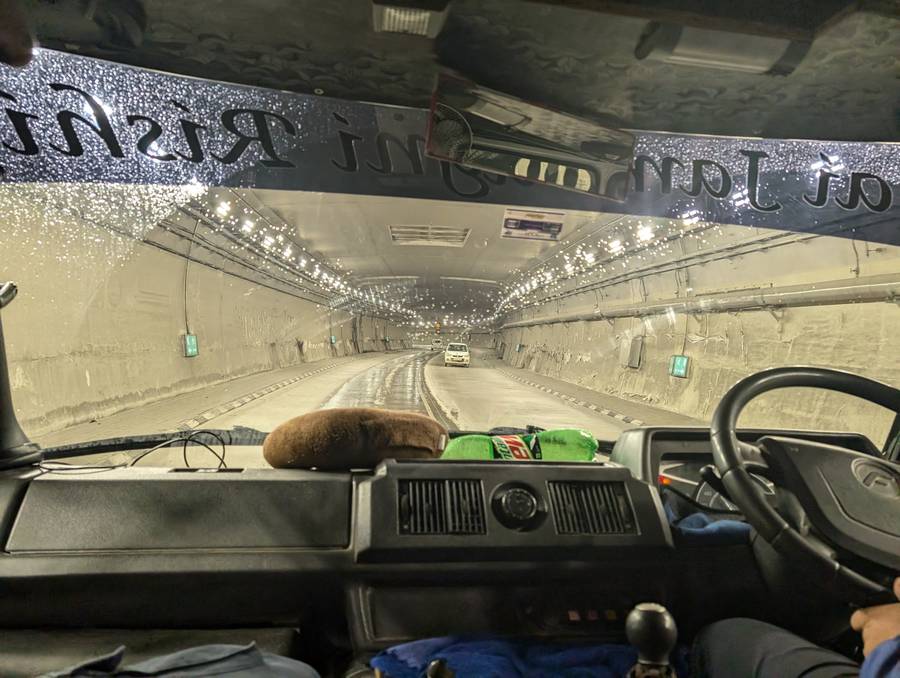
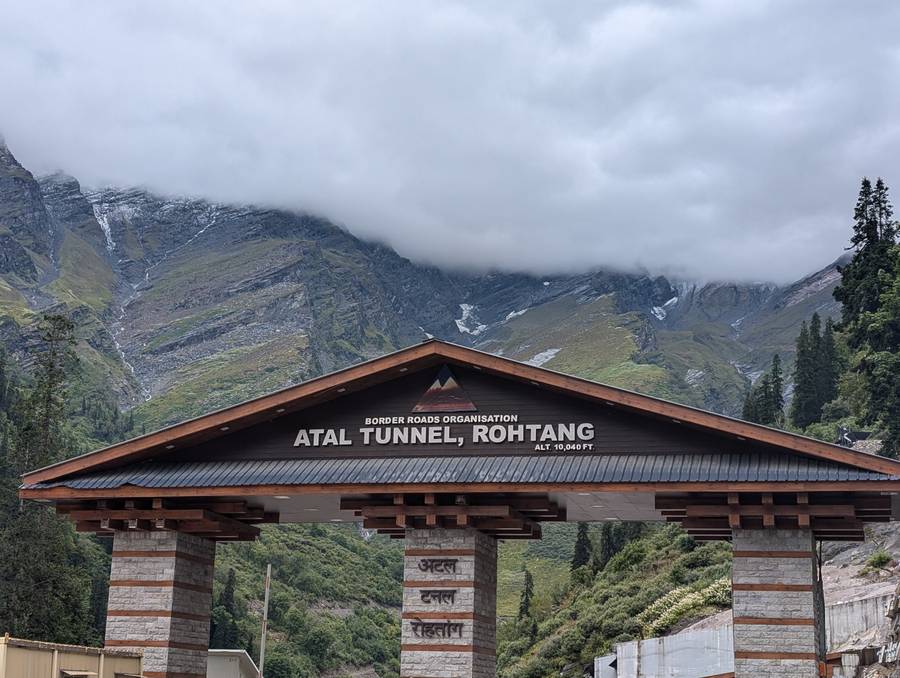
The tunnel is 9.02 km long and runs at about 3,000 m under the Rohtang ridge. It opened in October 2020 and takes the Manali–Keylong road off the old route over Rohtang Pass, cutting about 45 km and several hours from the journey.
Day 10 · The overnight Volvo home
From Manali we caught the overnight Volvo bus to Delhi, a vehicle Gen X knows intimately. We reached Delhi around dawn on the sixteenth, and I was home by early morning.
The signboard audit
Every pass on this route has a yellow Border Roads board with its height painted on it. Being Gen X, I checked them against the survey figures.
| Pass | Board says | Survey says | Verdict |
|---|---|---|---|
| Khardung La | 17,982 ft | 5,359 m (17,582 ft) | 400 ft of optimism |
| Chang La | 17,688 ft | 5,360 m (17,590 ft) | About 100 ft keen |
| Taglang La | 17,482 ft | 5,328 m (17,480 ft) | Honest to two feet |
| Lachulung La | 16,616 ft | 5,059 m (16,598 ft) | Close enough |
| Nakee La | 15,547 ft | 4,739 m (15,547 ft) | Spot on |
| Baralacha La | 4,850 m | 4,890 m | The only modest board |
Two uncles and a convoy
When Anil and I started our adult lives in the Navy, cars were out of our reach. We had bikes, and we did trip after trip on them. Bikes were our first love. For years we had cherished one hope: to ride two trips together, one in Spiti and one in Ladakh. Spiti came first. This ride from Srinagar to Manali completed that lifelong bucket list. It is difficult to explain the joy it gave us.
We will forever be thankful to JustWravel and to our convoy for a lifetime of memories. JustWravel is a fantastic adventure travel company: very professional, with excellent tie-ups for stays, great food and capable teams. Our trip was led by Arvind, a young, talented and avid biker with great skill and maturity, and he added five stars to it. If you have a passion for riding, I highly recommend this trip.
Ten days, nine passes, one rest day, one snowfall seen through a bus window, and two coursemates from 1992 who finally rode Ladakh together. This is the Way.