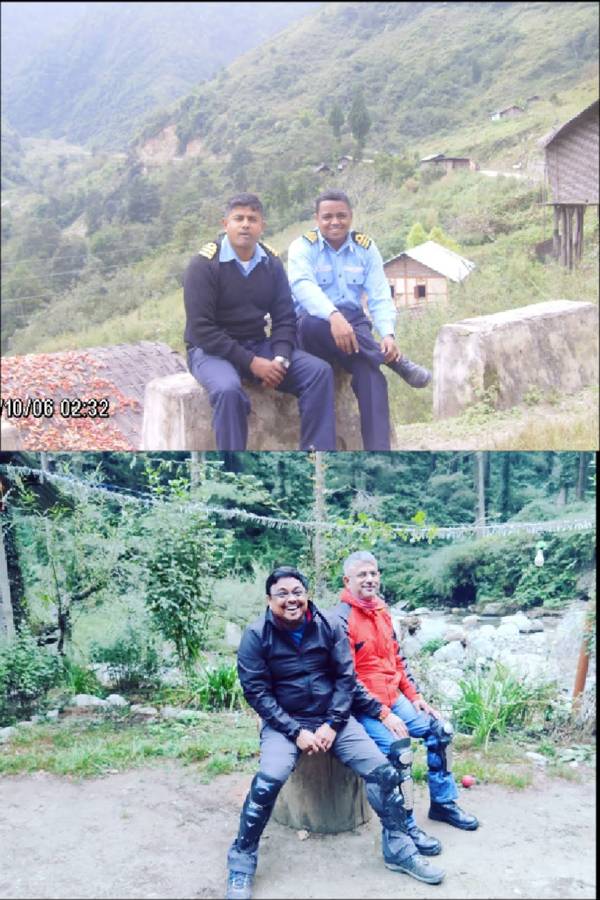
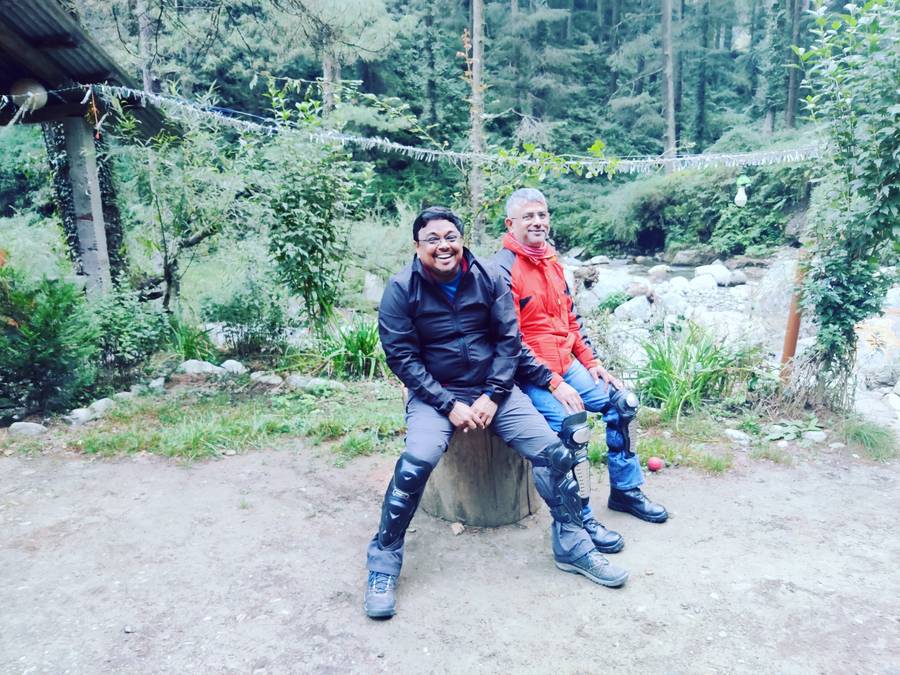
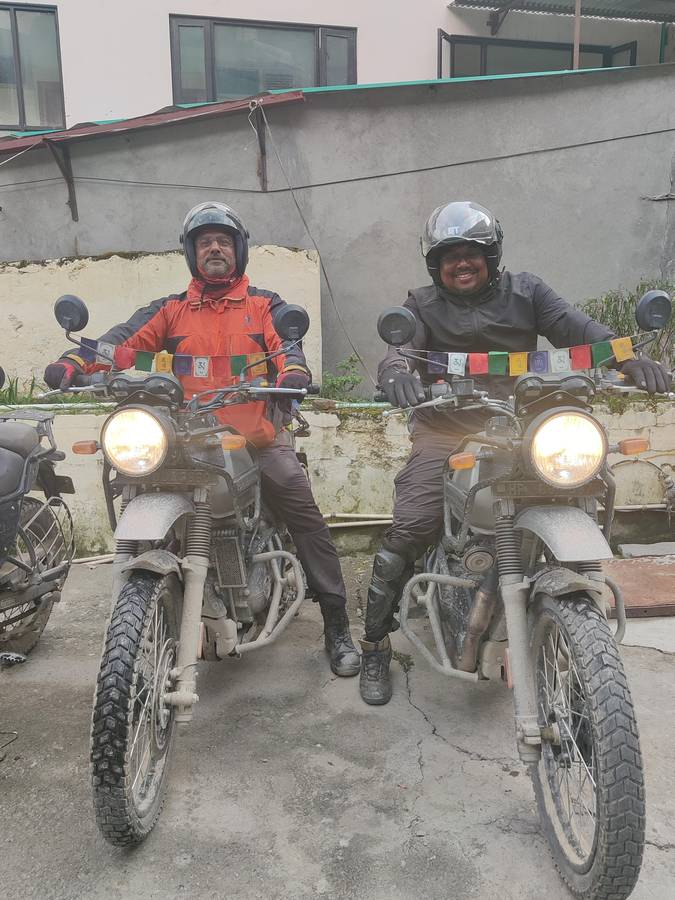
In 2010 Anil and I went to the North East together, two young men in sensible trousers sitting on a wall. Thirteen years later we sat on a tree stump in Jibhi in riding boots and armour and recreated the photo. The trousers have changed. The friendship has not. We have been friends since 1992, when we were coursemates in the Navy, and for years we had talked about riding two great Himalayan routes together on motorcycles: Spiti and Ladakh. In September 2023 we did the first one, with a JustWravel group, out of Manali and round through Kinnaur and Spiti. (The second one, Ladakh, came a year later and has its own story.)
There was a small detail. This was my first time on a Royal Enfield Himalayan, and my first time on any motorcycle in at least fifteen years. What could possibly go wrong?
The ride at a glance
| Day | Route | Km | Night |
|---|---|---|---|
| 1 · 24 Sep | Manali, down the Kullu valley to Aut, Tirthan valley to Jibhi | 100 | Lato the Hut, Jibhi |
| 2 · 25 Sep | Jalori Pass, Ani, the Sutlej, Rampur, Karcham, Sangla, Chitkul | 220 | Hotel Shahenshah, Chitkul |
| 3 · 26 Sep | Chitkul to Reckong Peo and Kalpa | 75 | Kalpa Regency, Kalpa |
| 4 · 27 Sep | Khab, Nako, Tabo, Dhankar | 200 | Zeevaling, Dhankar |
| 5 · 28 Sep | Pin Valley and Kungri, then Kaza | 70 | Old Monk, Kaza |
| 6 · 29 Sep | Langza, Komic and Hikkim loop | 50 | Old Monk, Kaza |
| 7 · 30 Sep | Chicham, Key, then back down to Kalpa | 270 | Kalpa Regency, Kalpa |
| 8 · 1 Oct | Kalpa, the Sutlej, Jalori, Aut, Manali | 300 | Overnight Volvo |
That adds up to about 1,300 km. In Manali, the Oberoi Chandertaal was our base at the start and the finish.
Day 1 · The Volvo, the keys and the long way to Jibhi
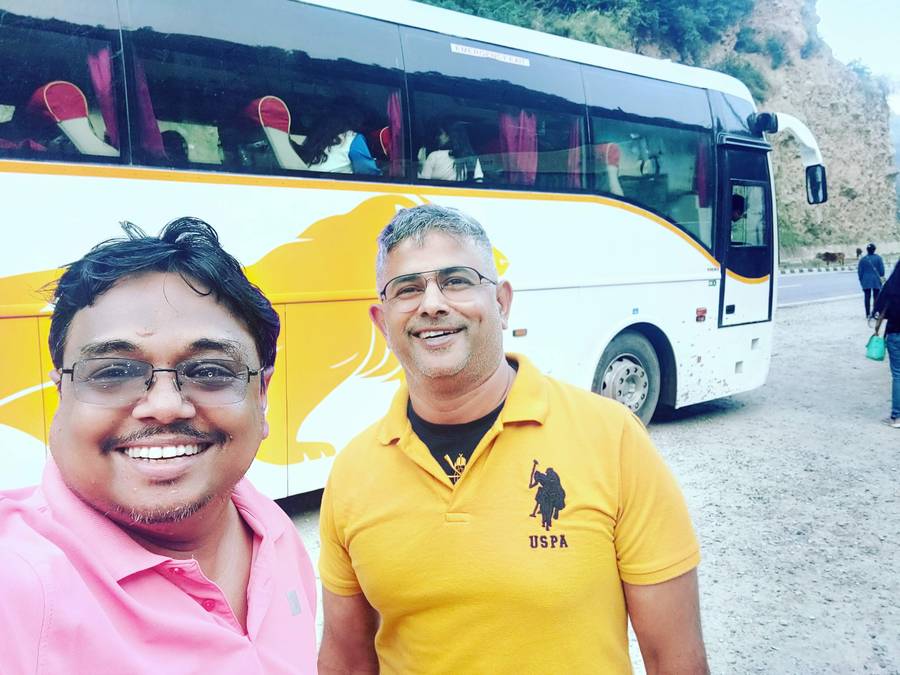
Every Himachal adventure for Gen X begins in the same place: the evening crowd at Majnu ka Tilla in Delhi, waiting for an overnight Volvo to Manali. We were in our seats by mid-evening, and by first light the bus was crawling along the Beas past Mandi. At a tea stop near Aut, Anil and I took the first selfie of the trip, looking like two men who had slept upright, because we had.
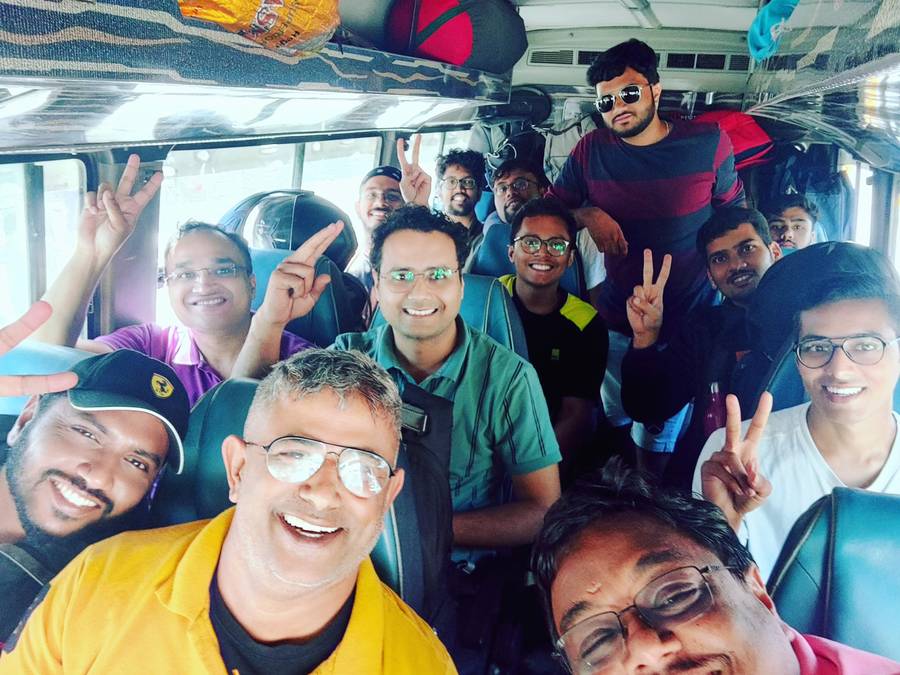
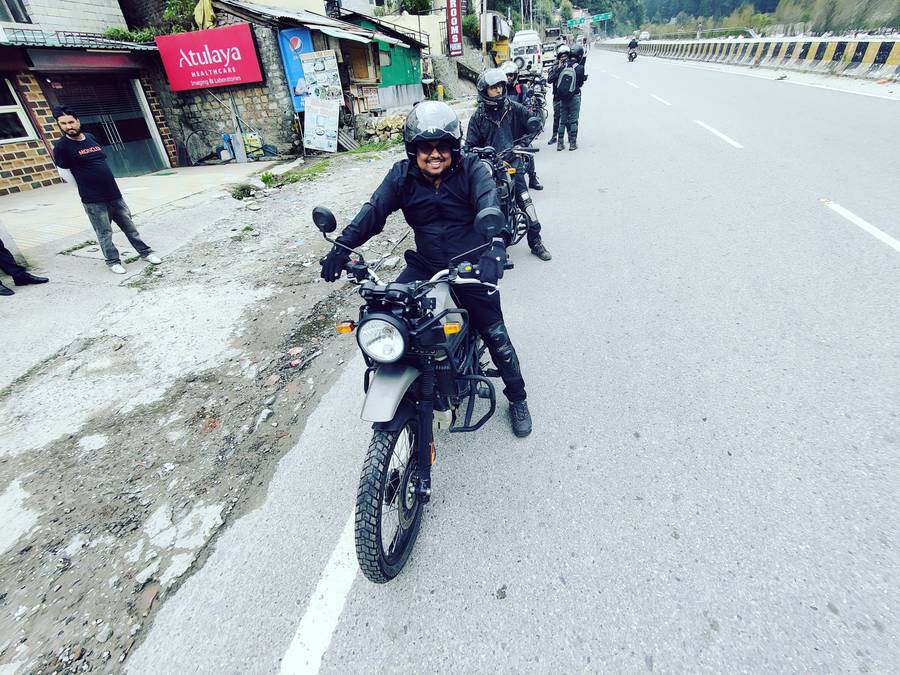
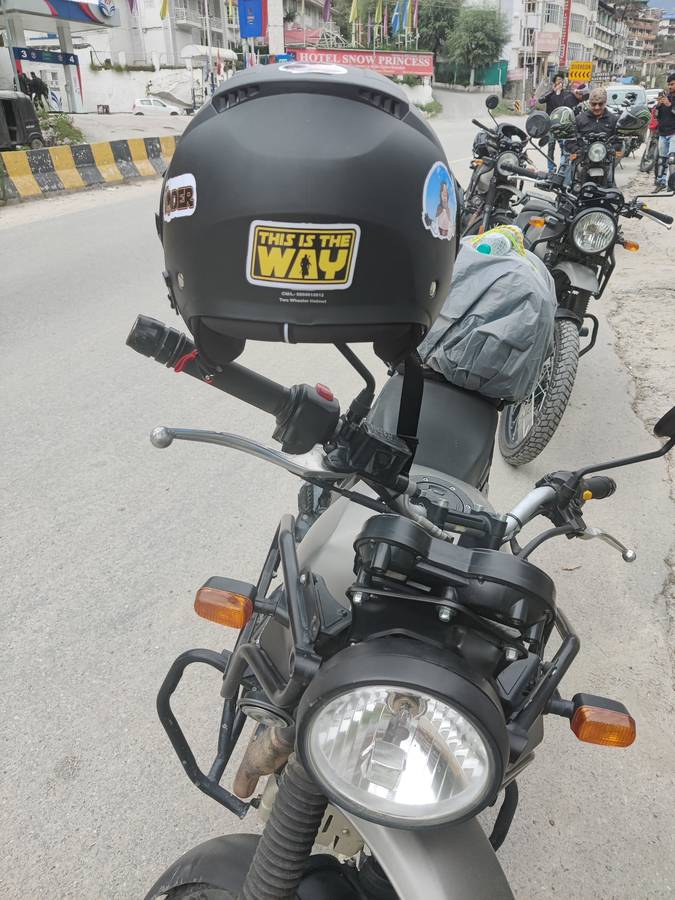
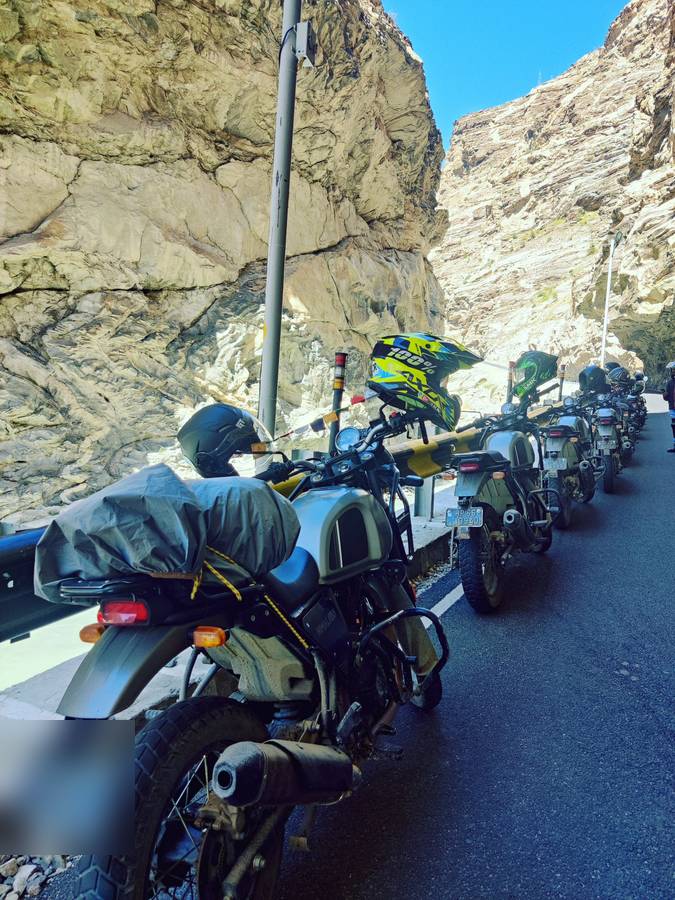
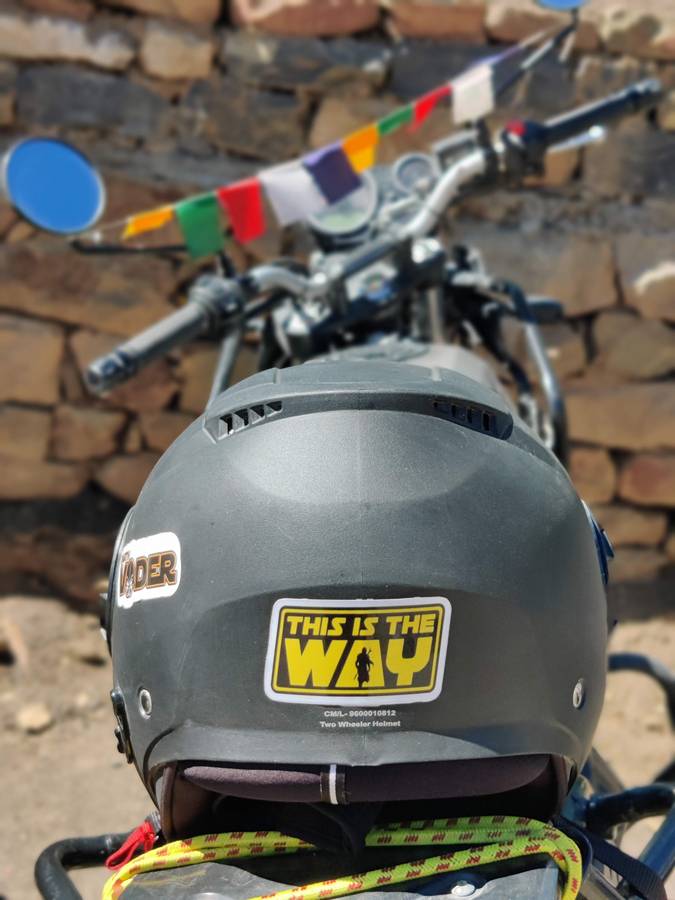
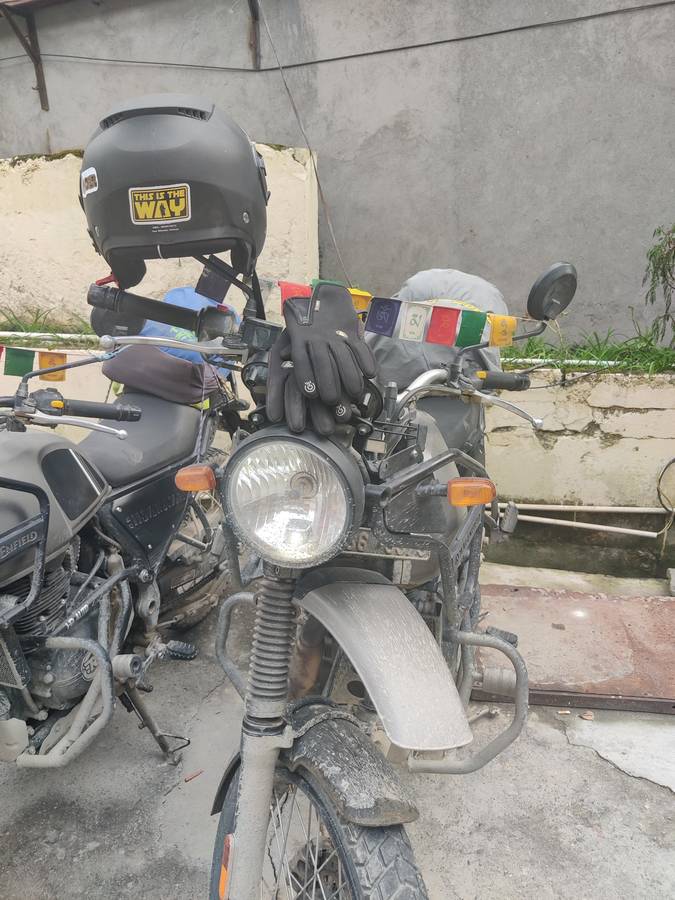
We reached Manali by late morning, where the Himalayans were waiting in a row on the roadside, matte grey and enormous. My helmet already carried a "This is the Way" sticker. For the uninitiated, that is the creed of the Mandalorians, from The Mandalorian, the Star Wars series about a helmeted bounty hunter who lives by a strict code. I am a very big Star Wars fan, so at least the paperwork was in order. Mine was handed over, I swung a leg over it for the first time in fifteen years, and nothing fell. A promising start.
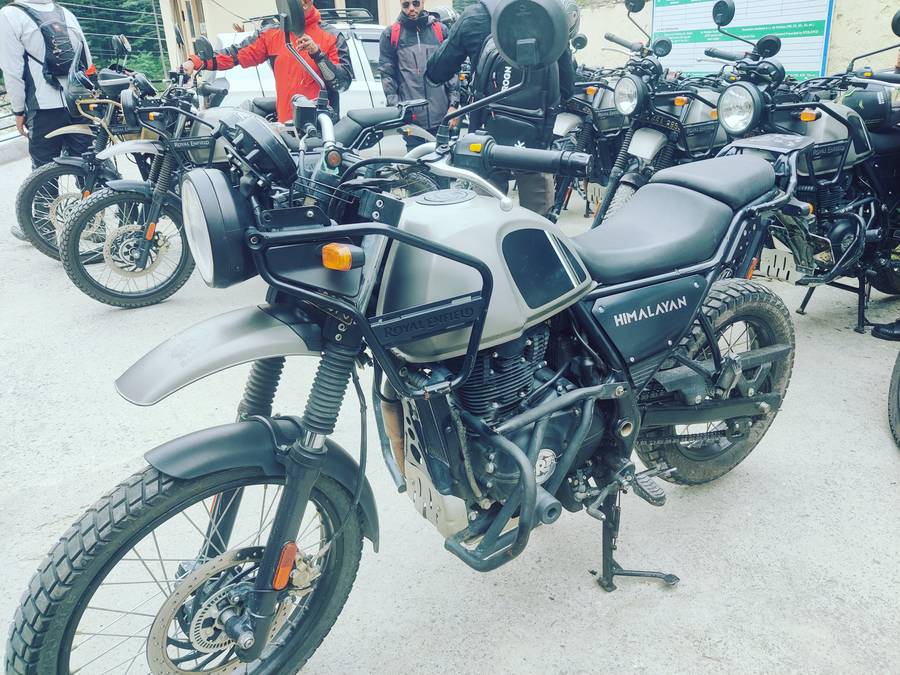
JustWravel runs its convoys on a short set of rules, the same ones that served us in Ladakh a year later:
- At the front rides the road marshal, an experienced rider from the company.
- At the back rides the rear man, so nobody gets left behind.
- Behind him is the support vehicle, with the luggage, the spares and a mechanic.
- Everyone else rides in a single line in between.
- Nobody overtakes the marshal.
- If anyone stops, the support vehicle stops with them.
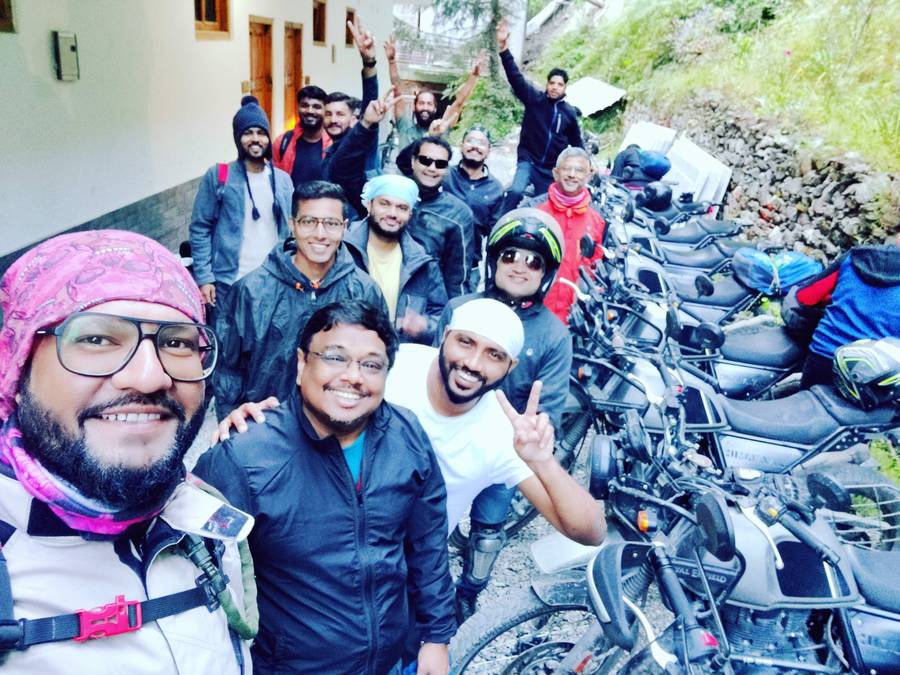
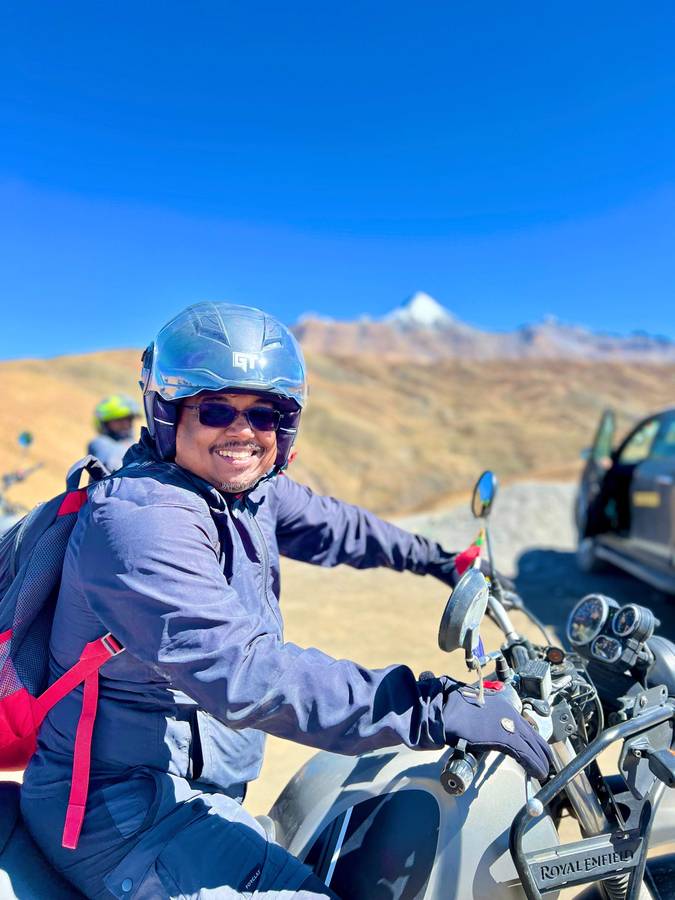
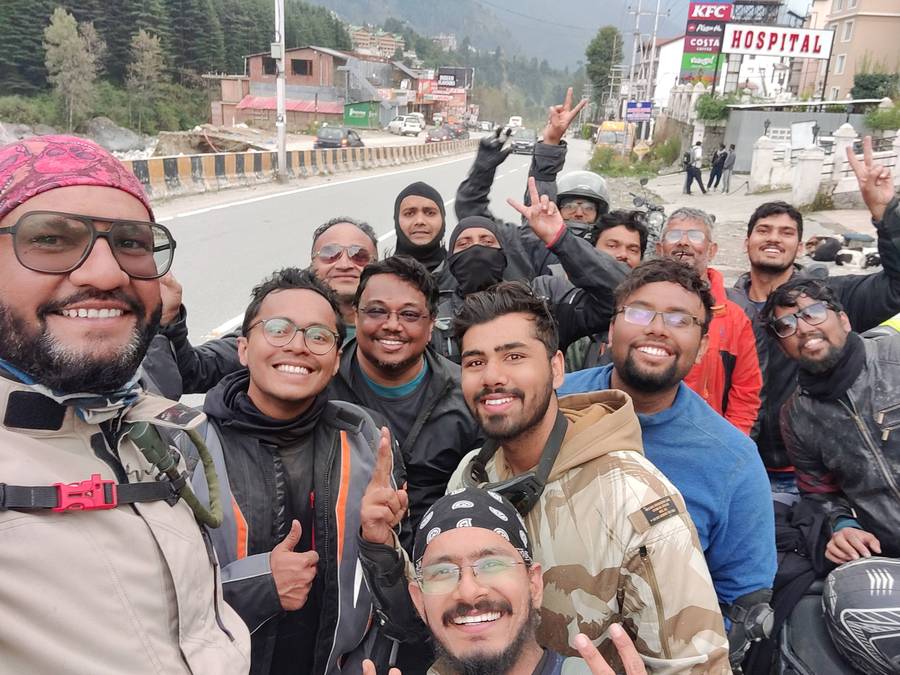
There were thirteen of us on eleven bikes, with Deval, our marshal, at the front and Anshul at the back: thirteen bikes in all. Deval has a commanding presence on the road, knows the terrain intimately and makes his intentions clear, and under his command we felt safe enough to enjoy every single minute. Anshul, young and lively, was a very capable rear man and the perfect complement to him. Behind them, Aman and Rakesh followed us everywhere like a shadow in the backup vehicle. Every evening Rakesh cleaned and serviced our bikes; he was the man to see about anything mechanical. Off the bikes, our trip captain Namit met us at the bus stand, ran everything through the group's WhatsApp, kept every event on time and stayed cheerful throughout, which makes a world of difference on the road.
A tempo traveller group was doing the same route on four wheels, and every evening the two groups met at the same stay. For two Navy coursemates this was a comfortable arrangement: rules, a chain of command and someone else responsible for navigation.
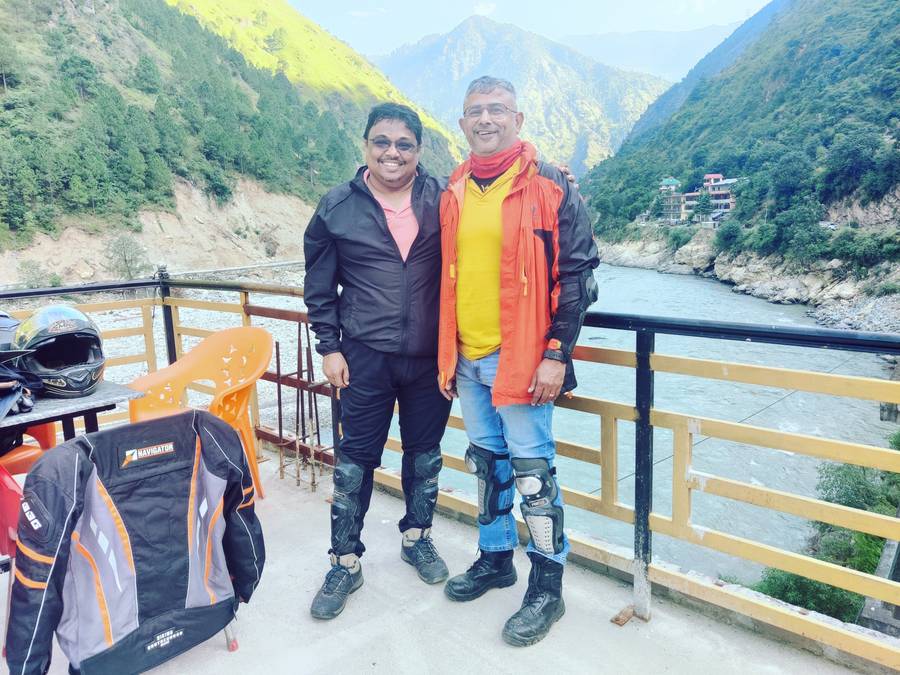
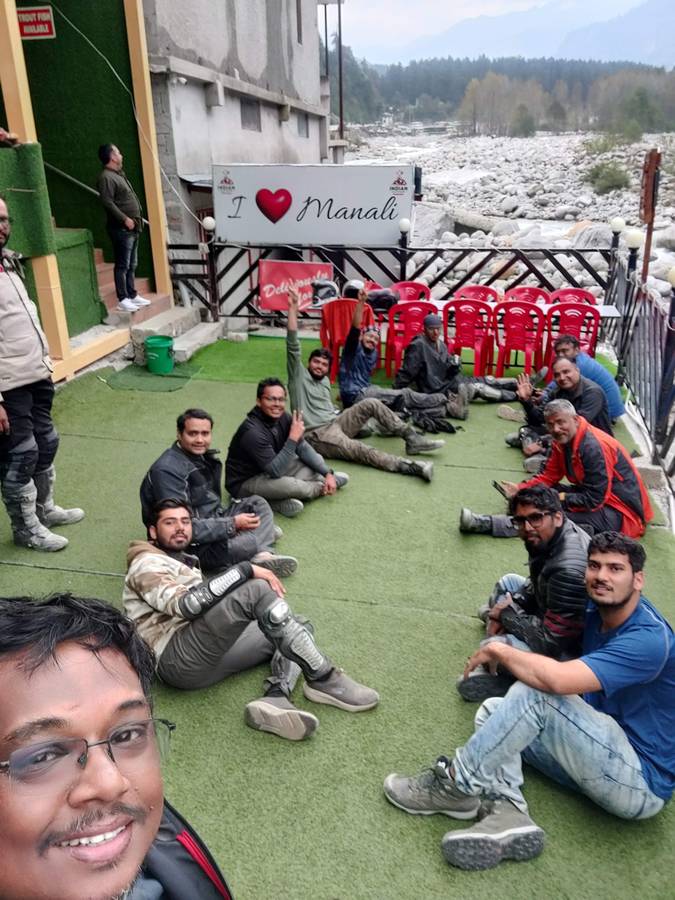
Then we rode out, and here the route does something odd. Manali to Spiti is shortest over Kunzum, but the plan was to do the big loop the other way round: back down the Kullu valley, over Jalori, along the Sutlej through Kinnaur, into Spiti from the south, and finally home over Kunzum to Manali. So the first afternoon was spent riding back down the valley the bus had brought us up that morning. By mid-afternoon we were drinking tea on a terrace above the Beas near Aut, with helmets on the plastic chairs and the river roaring below.
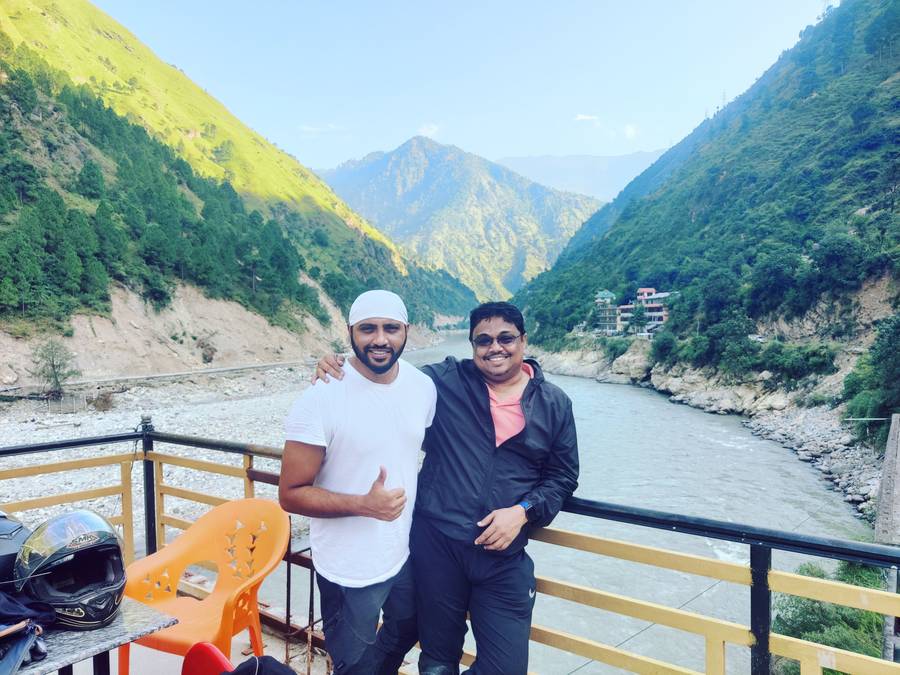
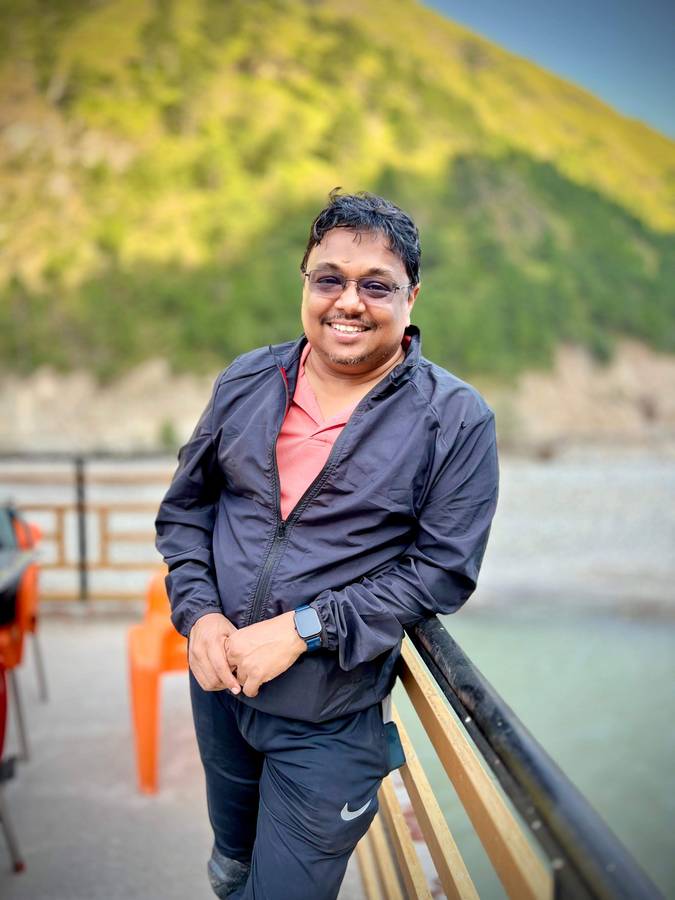
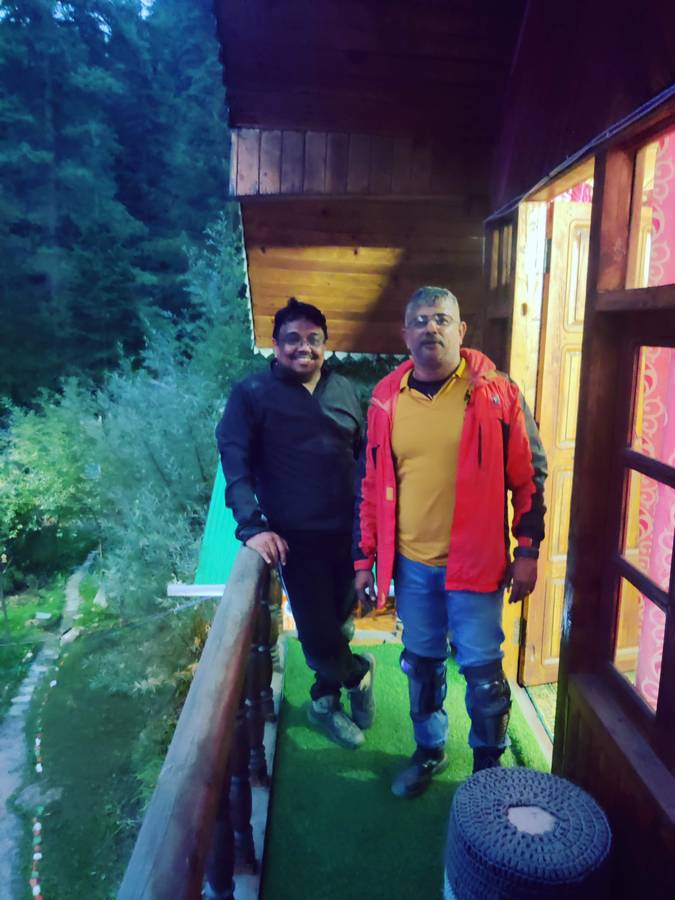
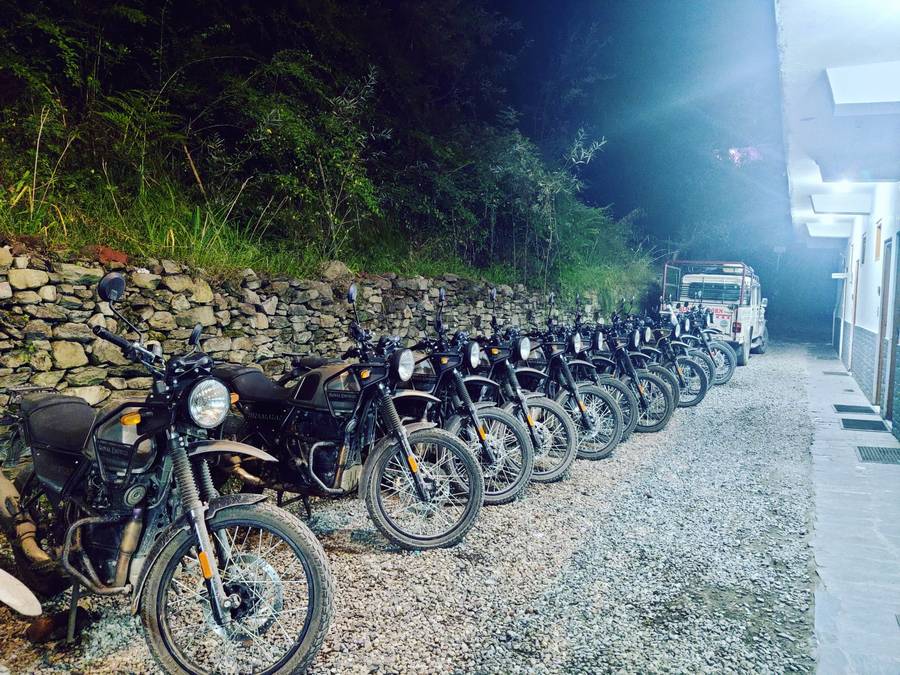
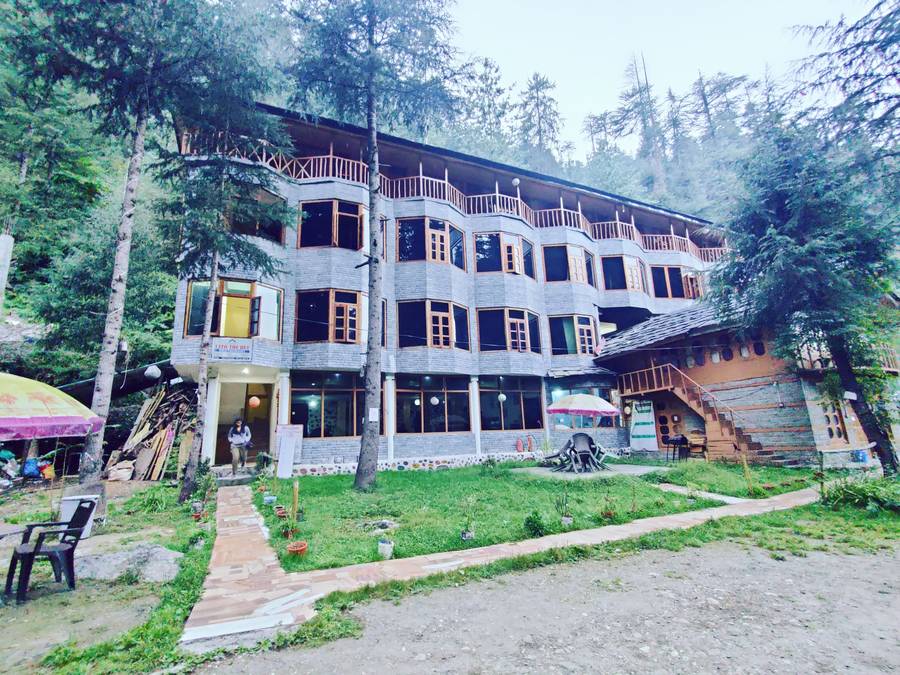
By evening we had turned off into the Tirthan valley and climbed to Jibhi, a village of wooden guesthouses, pine forest and a loud mountain stream. We stayed in a wooden cottage that looked like something from a storybook. And it was here, at the end of a very long first day, that I recorded Fall Number One: in the parking area, on loose stones, at a speed of exactly zero. The Himalayan, I learned, is a beautifully stable machine right up to the moment you ask it to stand still on gravel. A true Mandalorian, I am fairly sure, does not fall over in a car park. I had some work to do on the Way.
Day 2 · Jalori, the Sutlej, and the day my body filed a complaint
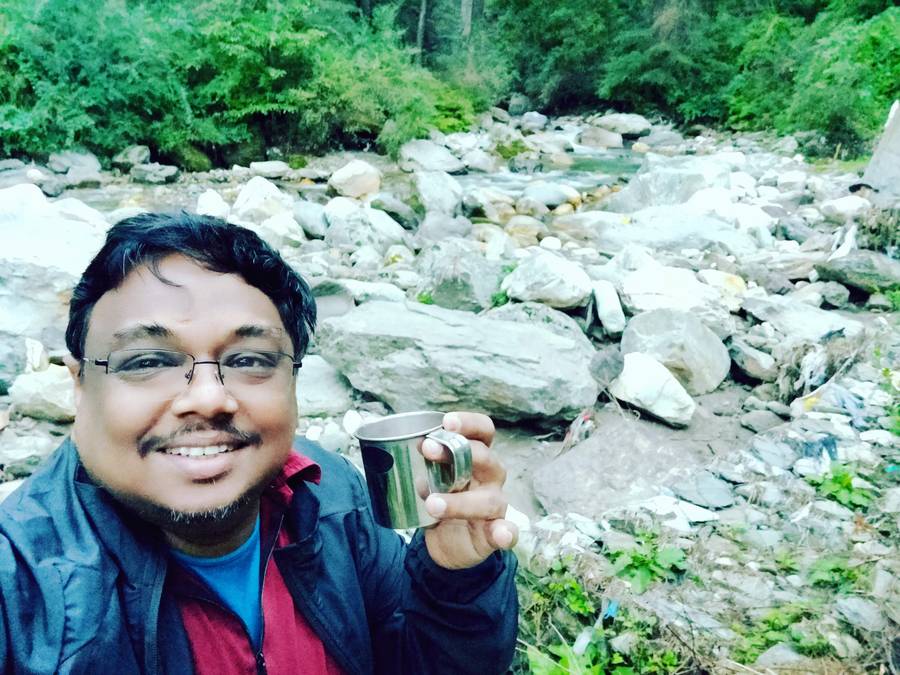
Jibhi at dawn was green, cold and noisy with water. I took my tea down to the stream, and Anil and I recreated the 2010 photo on a tree stump, as you saw at the top. Then a group selfie with the bikes, and we were off early, because day two was the big one.
The road out of Jibhi climbs through forest to Jalori Pass, and we were over the top early in the morning. Then it drops through Ani to the Sutlej at Luhri, and from there we followed the Sutlej upstream for hour after hour, past Rampur and into Kinnaur.
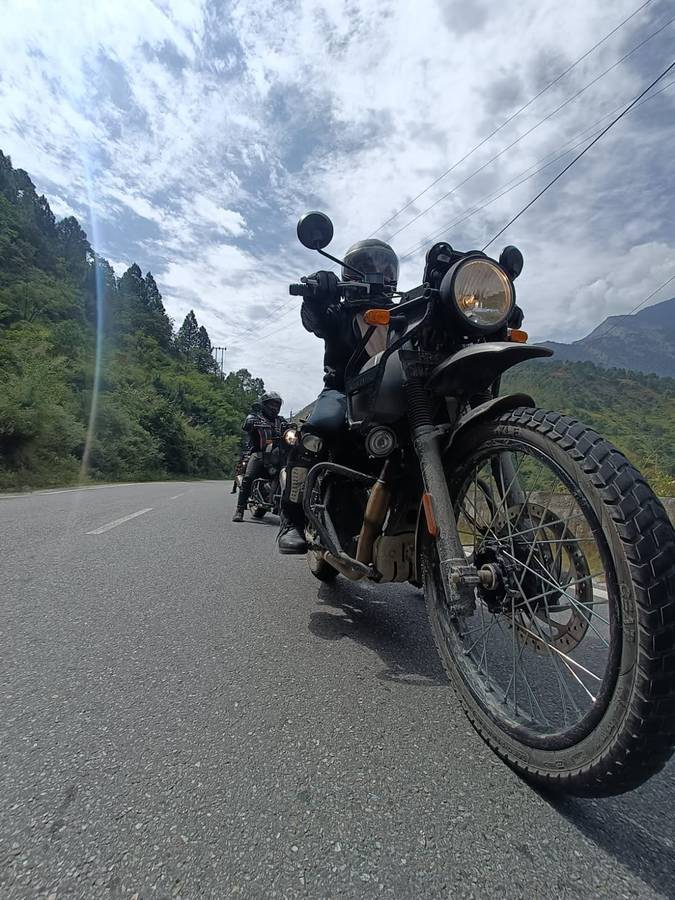
Jalori Pass sits at about 3,130 m (roughly 10,300 ft) in Kullu district, between Shoja and Jibhi on one side and Ani and Khanag on the other. It links the Inner and Outer Seraj regions and was an old trade route between the Kullu and Shimla hills, used to carry salt, grain and wool. The road over it, NH 305, is narrow and steep.
Day two was also the day my body formally complained. Fifteen years off a bike is a long time, and my gloves and footwear were not up to the job. By evening I had blisters, and muscles I had forgotten I owned were registering their objections. It was, honestly, a bad day for pain and for lack of practice.
It also produced Fall Number Two. I had stopped on a narrow stretch to let a vehicle pass, and on the left the road edge dropped lower than the tarmac. My left foot went down to meet the ground, the ground was not where I expected it to be, and the bike and I lay down together. Again at zero km/h. Two falls, two days, no speed involved in either. A pattern was emerging.
We turned off the Sutlej at Karcham, climbed through Sangla and up the Baspa valley, and reached Chitkul after dark. It was a very long day.
Day 3 · Chitkul to Kalpa: the last village, and the apples
Chitkul at dawn makes up for a lot. The sun came up behind the peaks at the head of the Baspa valley, lighting the big sign that reads "I ♥ India 1 Village Chhitkul". For decades Chitkul has been known as India's last village. The sign now calls it the first. Both are true; it depends which way you are facing.
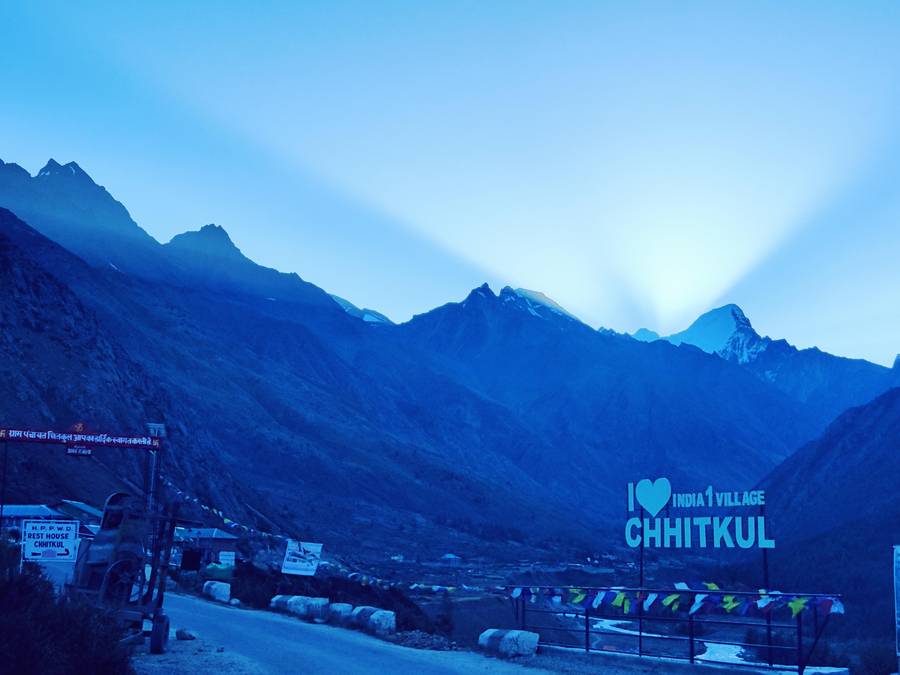
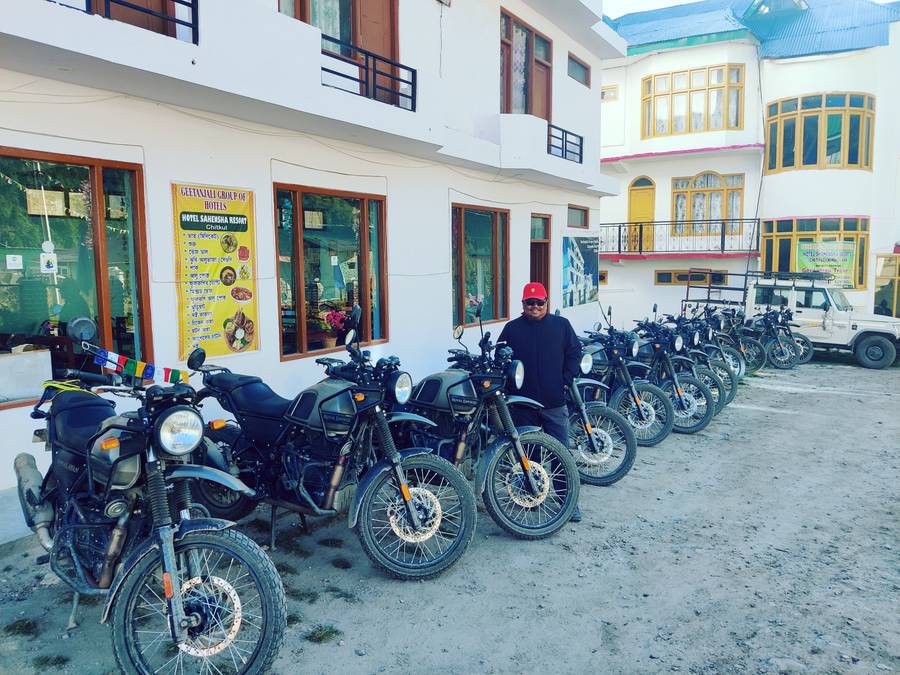
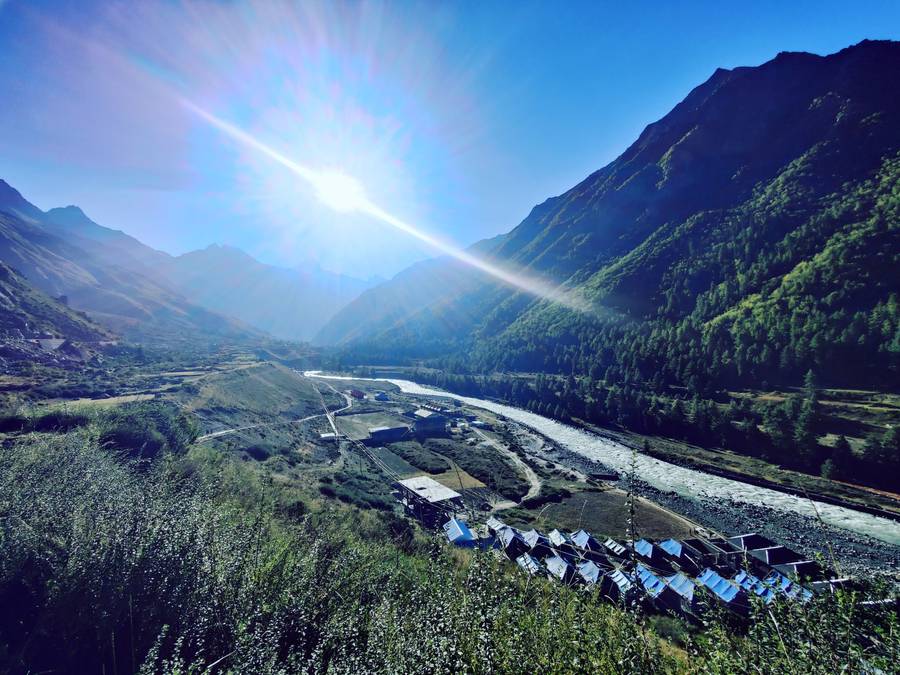
Chitkul sits on the Baspa river at about 3,450 m (11,320 ft), at the head of the Sangla valley in Kinnaur. It is the last inhabited village on the old Hindustan–Tibet road. Civilian movement beyond it is not permitted; the area further up is patrolled by the Indo-Tibetan Border Police. The village also has a dhaba that calls itself the last one in India.
I had packed my drone, a DJI Mavic, and the morning's aerial shot shows how small we were against the valley. I recorded Fall Number Three here, once again in a parking area. By now I could do it with real style.
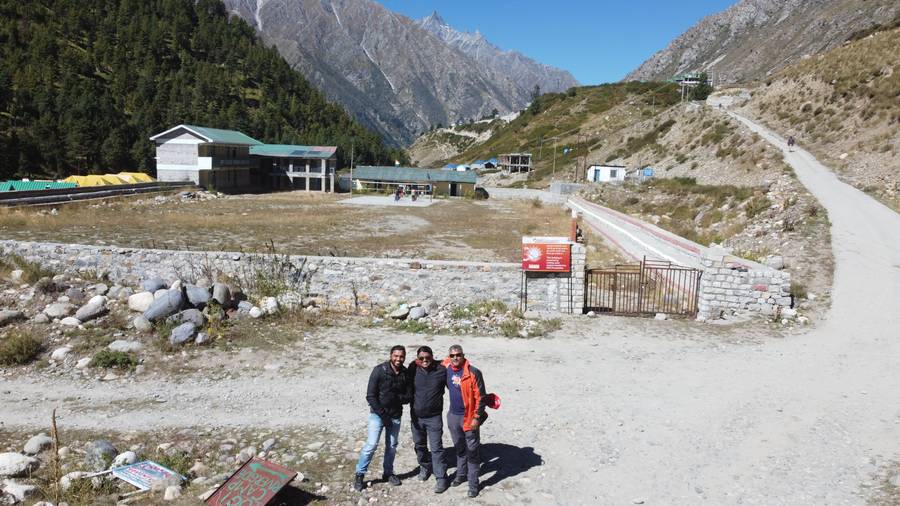
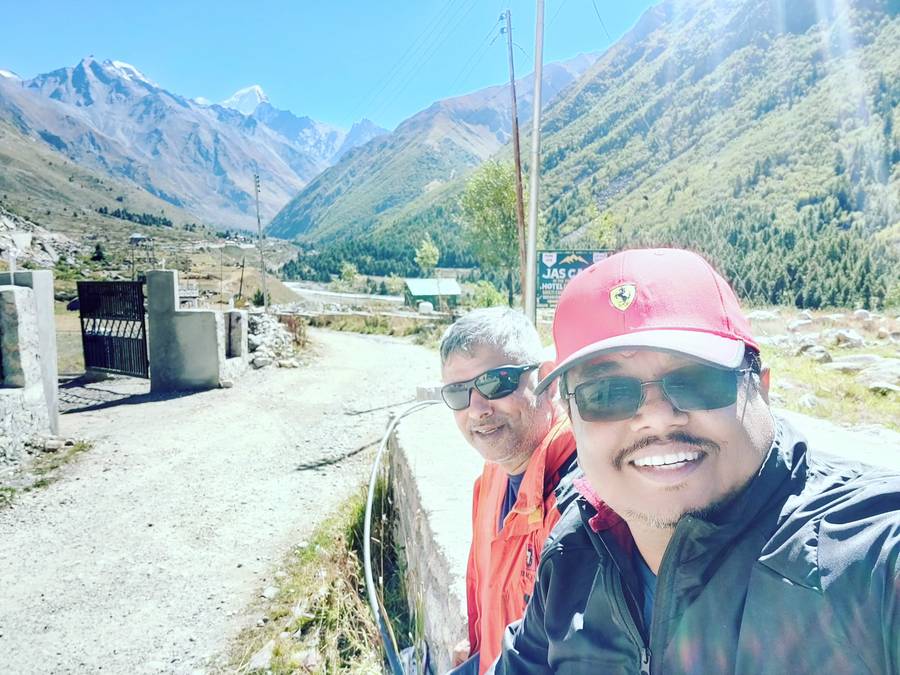
From Chitkul we rode back down the valley and on to Reckong Peo, then up the hairpins to Kalpa. September is apple season in Kinnaur, and the orchards were heavy with red fruit. The lanes between them are narrow, stone-walled and very pretty to ride.
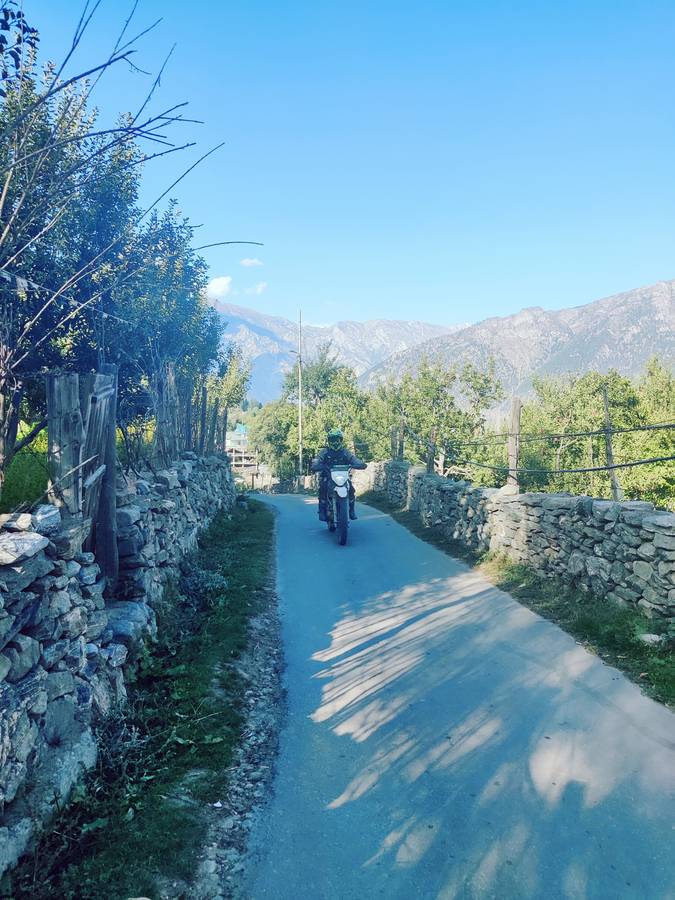
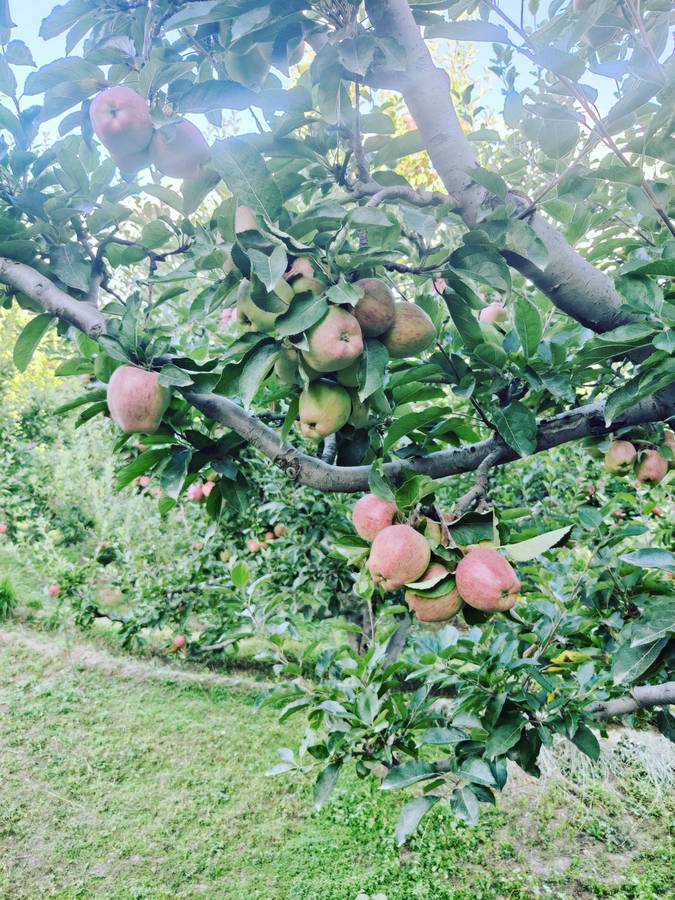
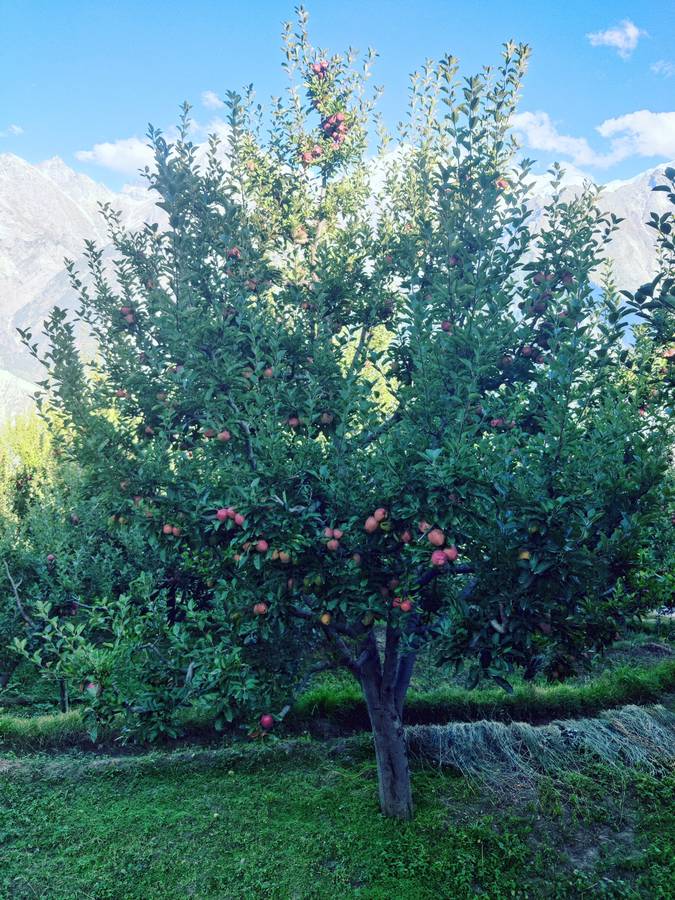
Kalpa sits at about 2,960 m (9,710 ft), above Reckong Peo in the Sutlej valley. It faces the Kinner Kailash range across the valley; the Shivling peak there is sacred to Hindus. The slopes around the village are covered with apple orchards, deodars and chilgoza pine, and in September and October the orchards turn red with the harvest.
Day 4 · Into Spiti: Khab, Nako, Tabo and Dhankar
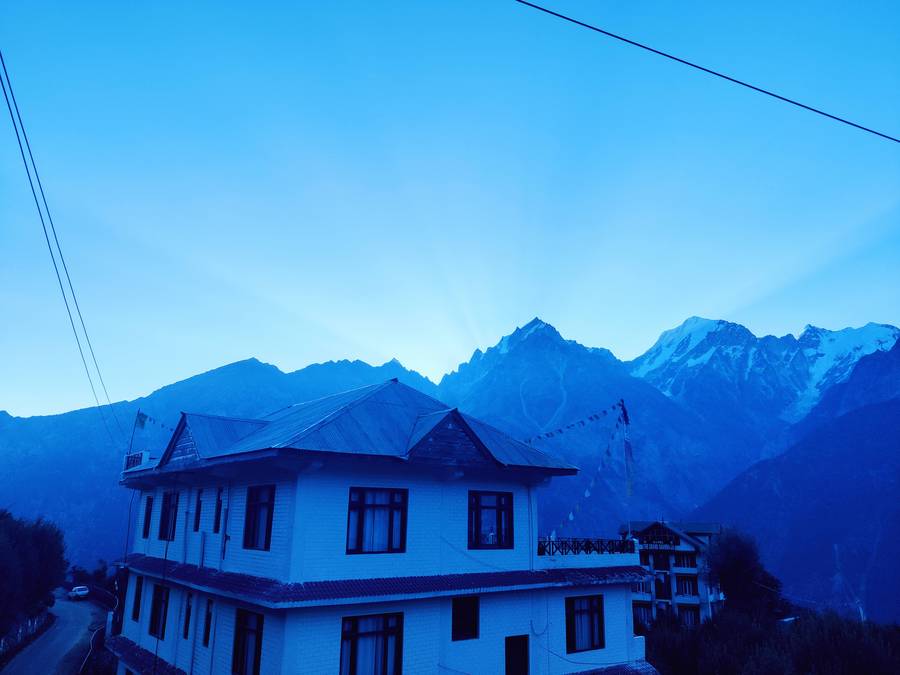
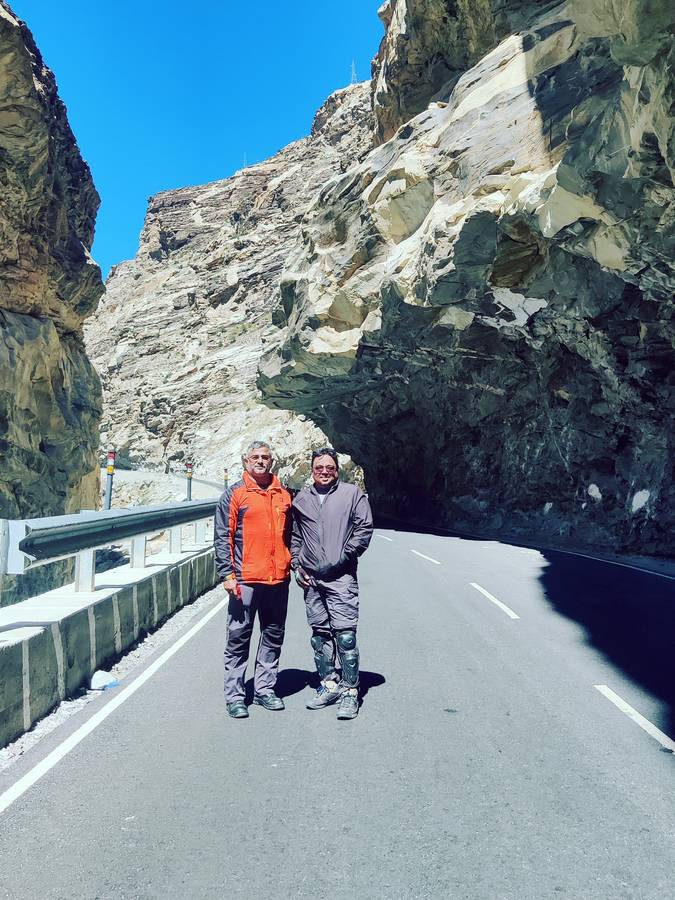
We woke in Kalpa to the sun coming up behind Kinner Kailash. Then came the most dramatic road of the trip. Beyond Peo the Sutlej runs through a gorge where the road is cut into the cliff, and in places the rock hangs over the tarmac like a roof. Anil and I stopped under one overhang for a photo, both of us standing a little closer to the barrier than to the cliff.
By late morning we reached Khab, where the Spiti river comes down from the north and meets the Sutlej. The whole group lined up on the bridge for a photo. This was where Kinnaur ended and Spiti began.
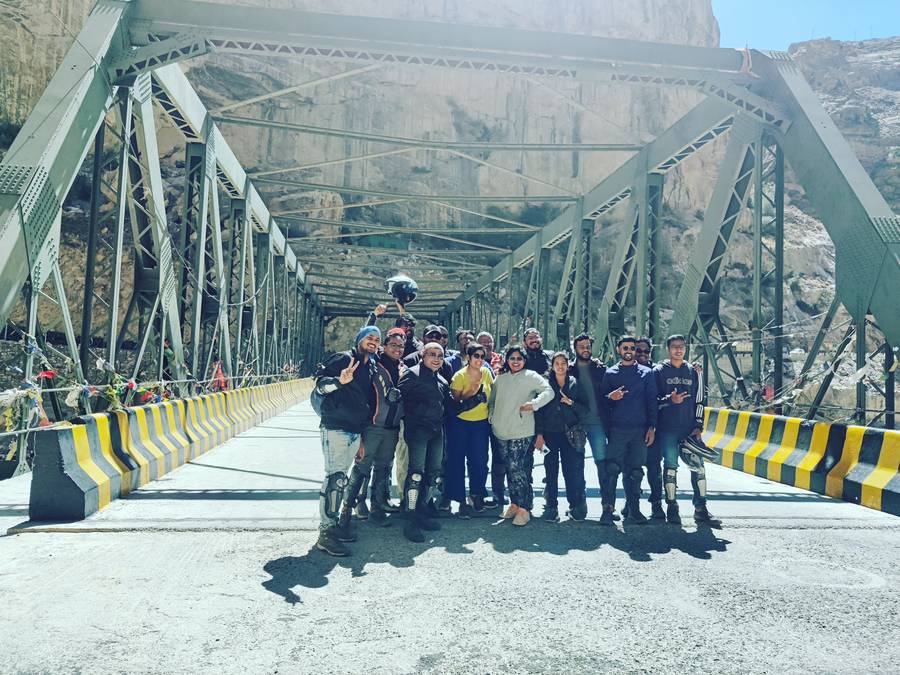
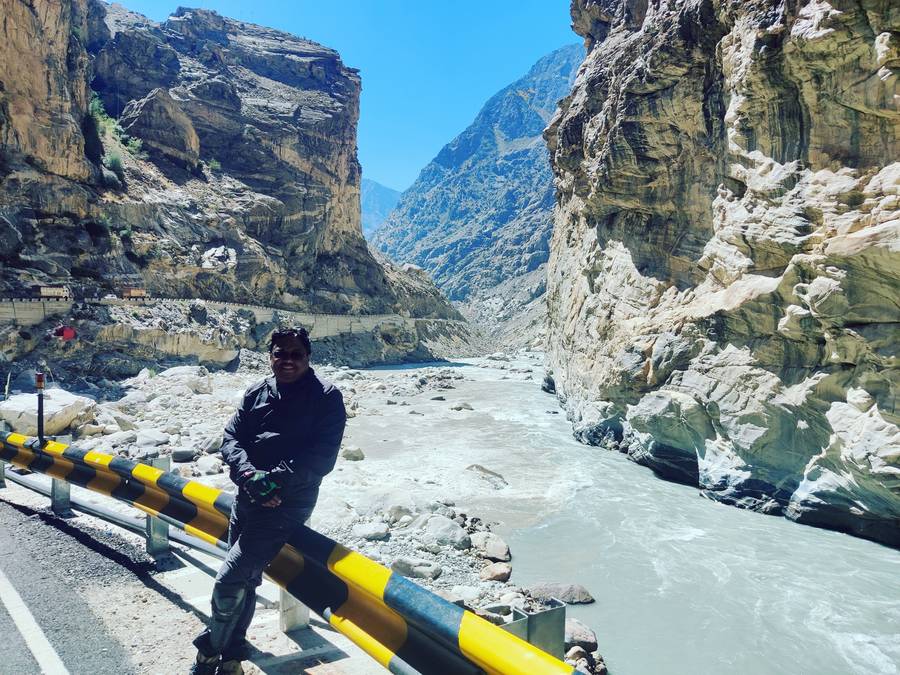
At Khab, in Kinnaur, the Spiti river ends its journey by joining the Sutlej. The Sutlej has come a long way already: it rises in Tibet near Lake Mansarovar and enters India at Shipki La. The Spiti rises near the Kunzum range and runs about 150 km through Spiti before it reaches Khab.
We climbed to Nako around midday, and by mid-afternoon we were in Tabo, where, to my surprise, there were apple trees again, sagging with fruit under a hard blue sky.
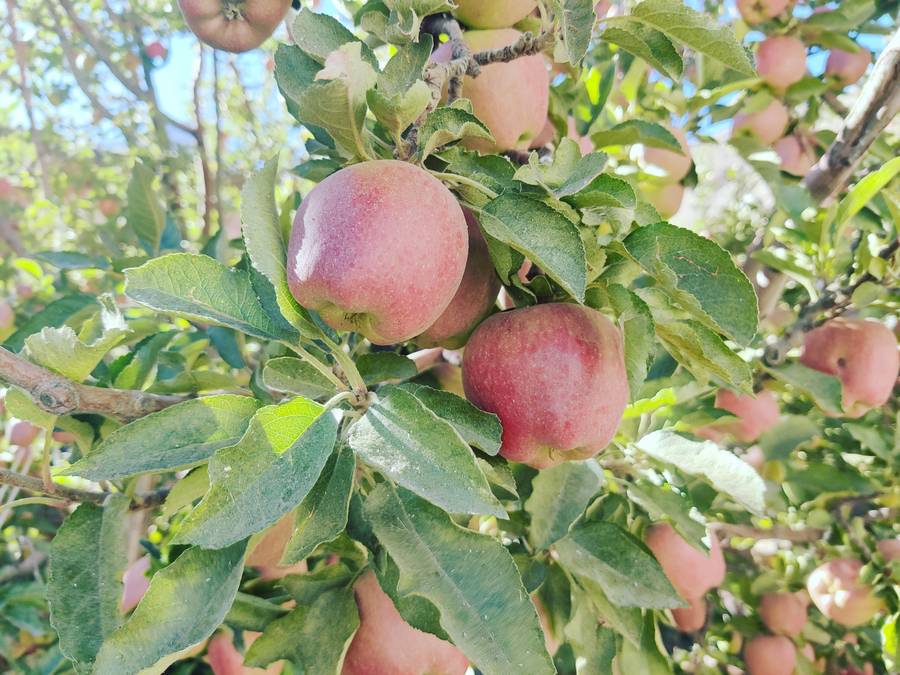
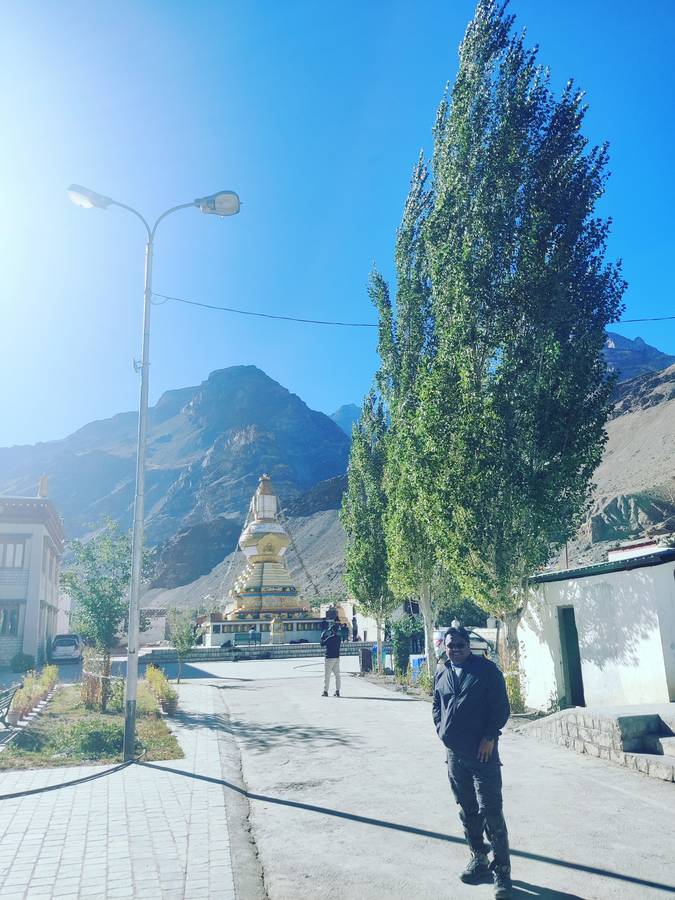
Tabo Monastery was founded in 996 CE, traditionally by the translator Rinchen Zangpo on behalf of Yeshe-Ö, king of Guge in western Tibet. It is reckoned to be the oldest continuously functioning Buddhist monastery in India. Its murals have earned it the nickname "the Ajanta of the Himalayas".
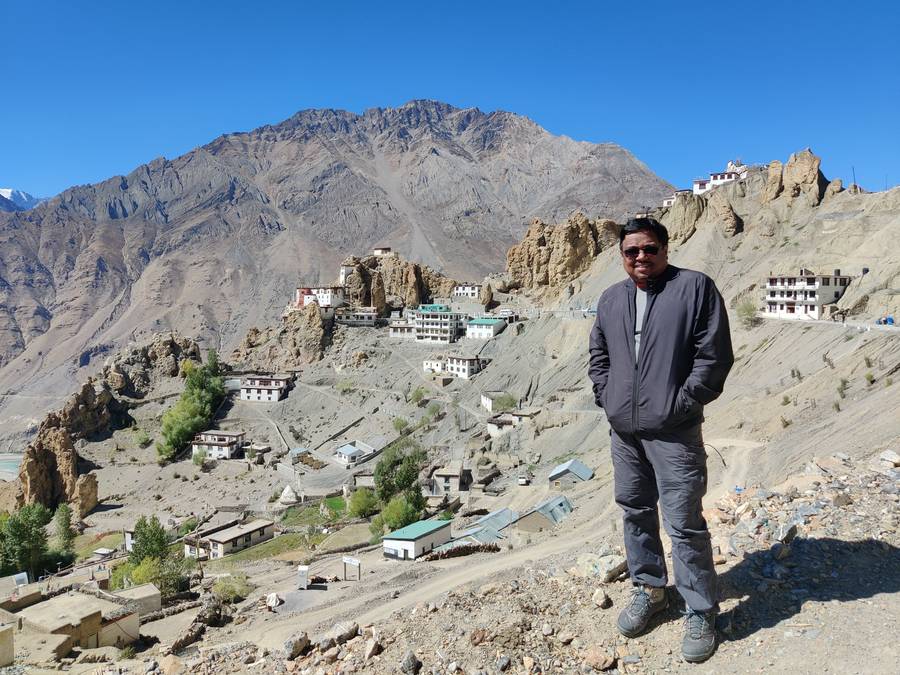
The last stretch of the day went up to Dhankar, and we arrived as the evening light hit the rock pinnacles above the village. It is one of the strangest and most beautiful places I have stood: earth towers like a row of church spires, a monastery and an old fort balanced on the ridge, and the valley floor far below.
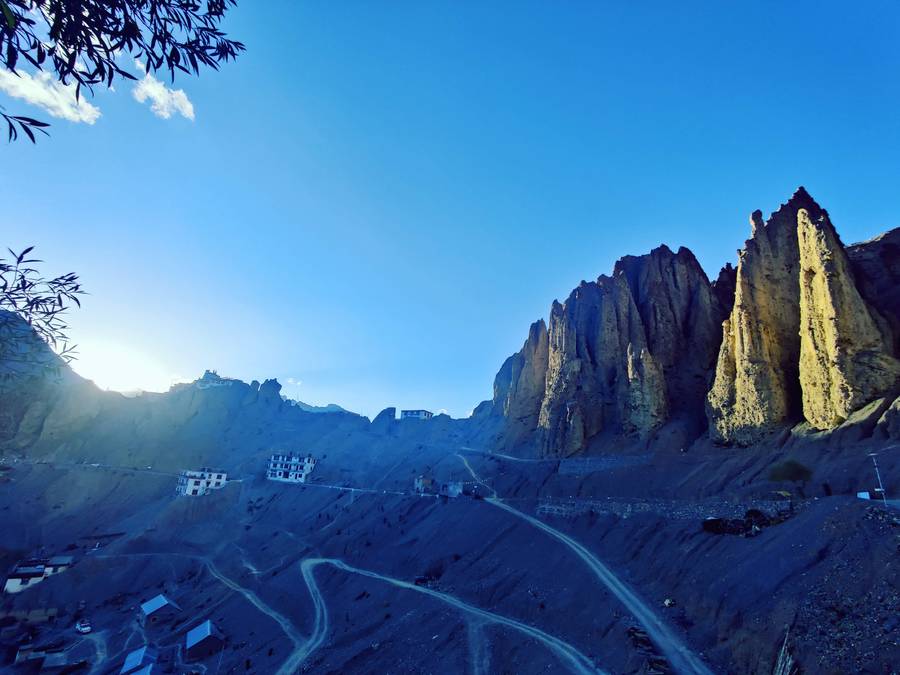
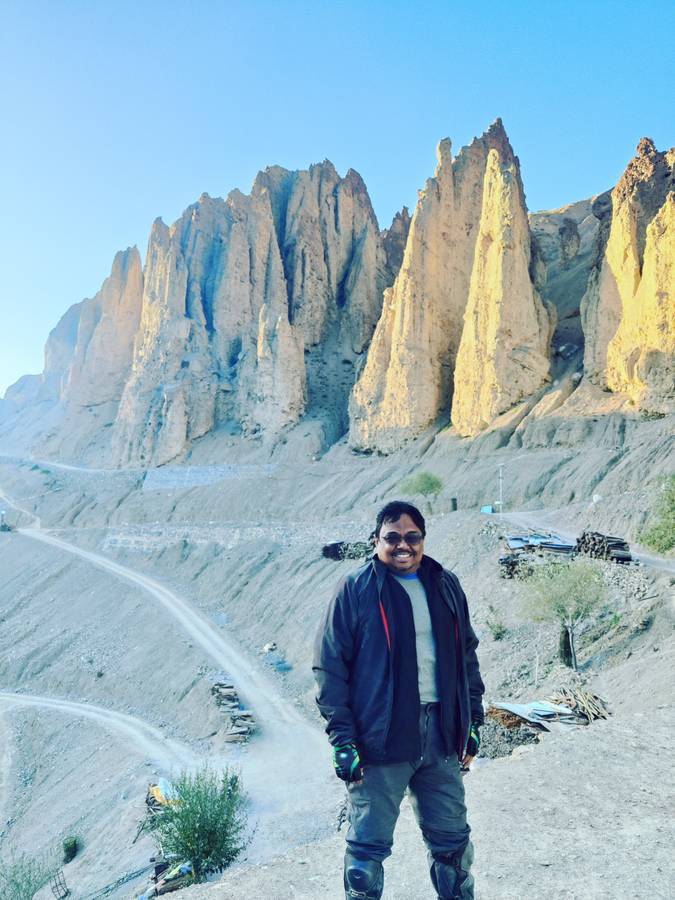
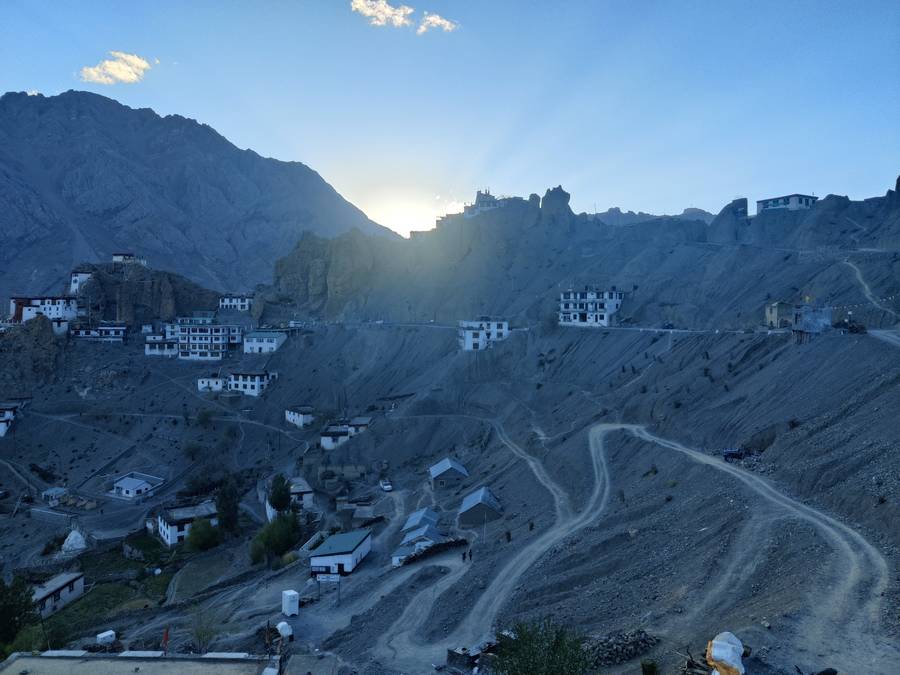
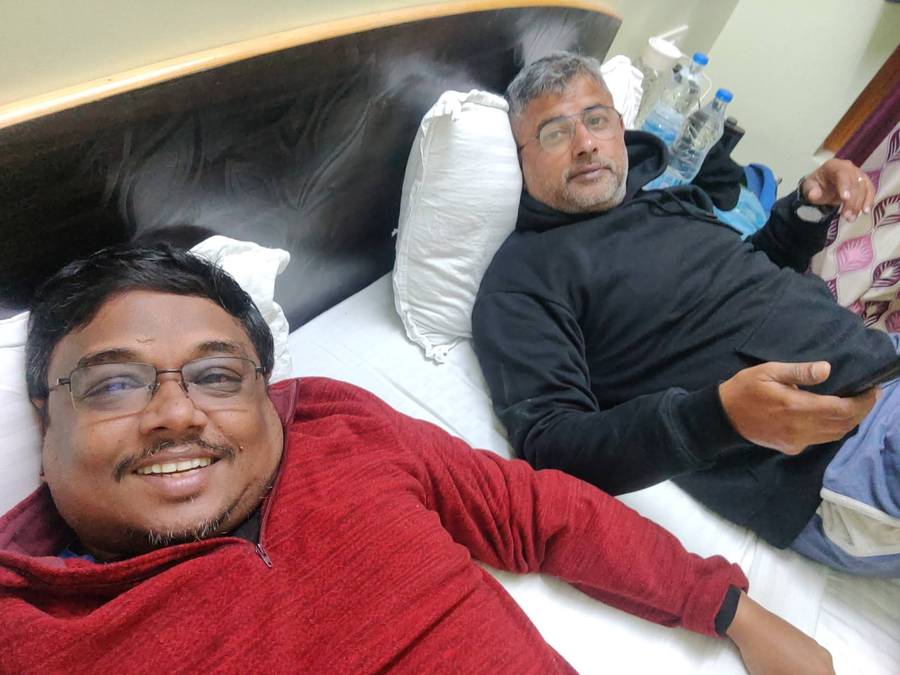
Somewhere on this day the pain finally began to ease. By the end of day three my hands and legs had stopped arguing, and from here on I could look at the scenery instead of my blisters. Dhankar also produced the most honest photo of the trip: two coursemates in their fifties, horizontal on a hotel bed, entirely spent.
Dhankar sits at about 3,894 m (12,774 ft) on a spur above the confluence of the Spiti and Pin rivers. The name means "fort on a cliff". It was the old capital of the Nono kings who ruled Spiti, and its fort-monastery was built on the Central Tibetan pattern. A newer monastery was built in the village in 2009 to take the strain off the old one.
Day 5 · Pin Valley and Kaza
The next morning we looked back at Dhankar from across the slope, in clear sun this time, and then rode down and across the Spiti into the Pin Valley. Around midday we reached Kungri, the Pin Valley's old monastery.
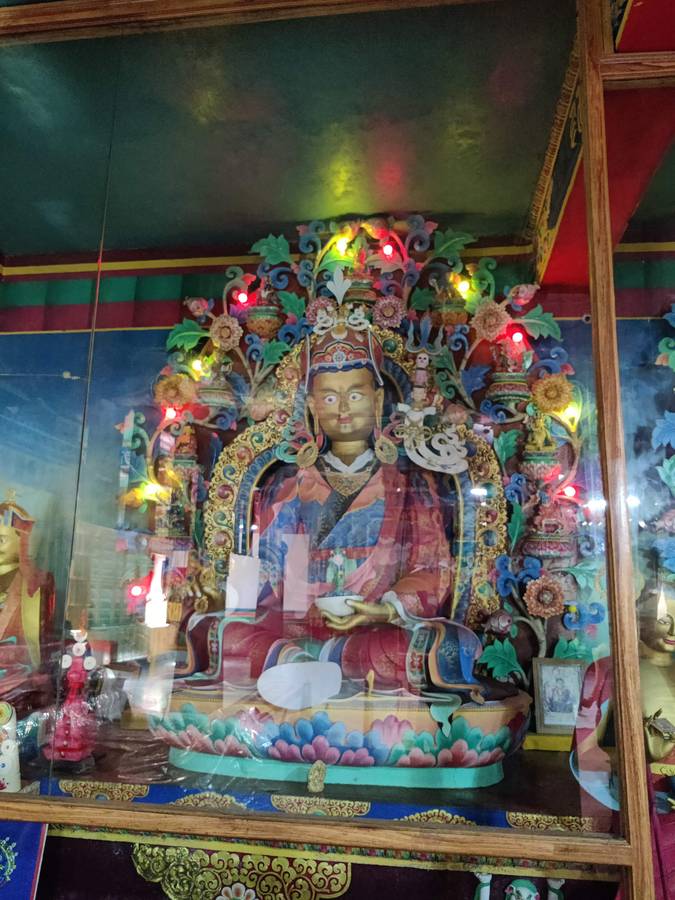
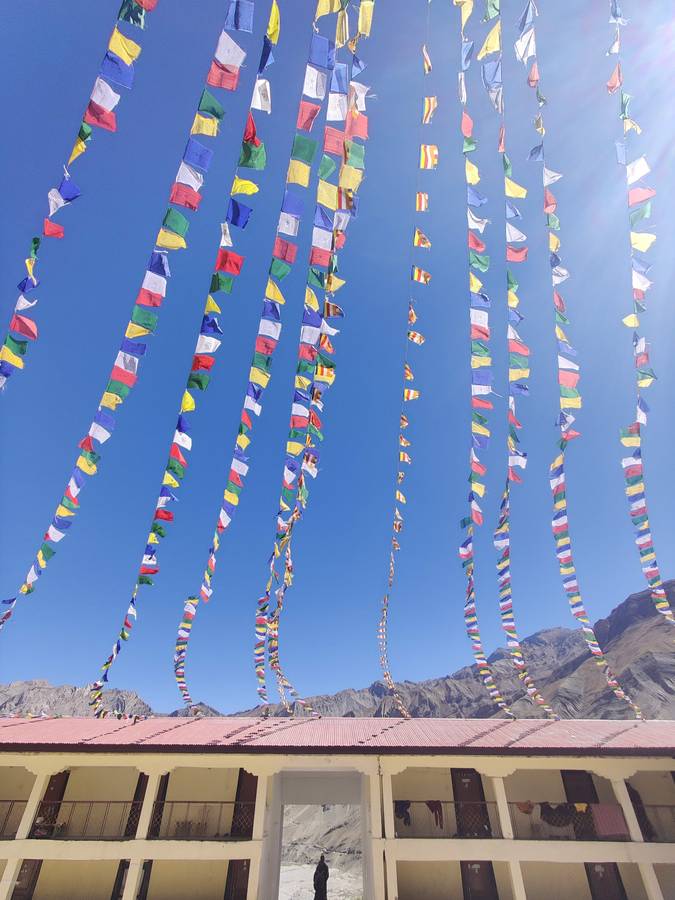
Kungri, in the Pin Valley, was built around 1330 and is usually described as the second-oldest monastery in Spiti, after Tabo. It belongs to the Nyingma school, the oldest of the four main schools of Tibetan Buddhism, and is the school's main centre in Spiti.
On the way out of the Pin Valley we stopped by the river, and the group did what every group does when it finds clear, freezing mountain water: we waded in. I stood in the Pin in my riding boots and declared it refreshing, which was a lie.
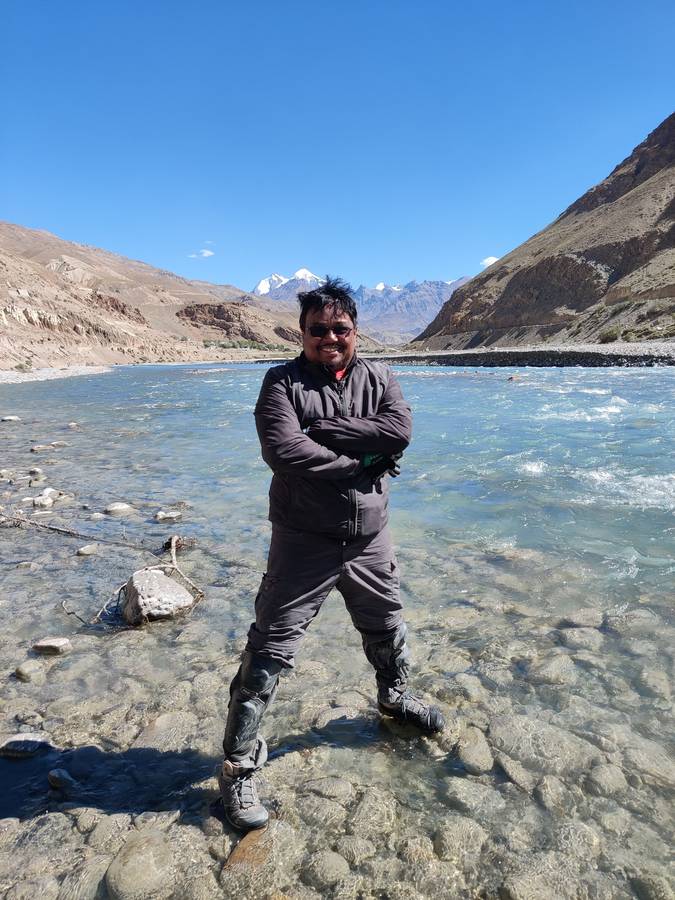
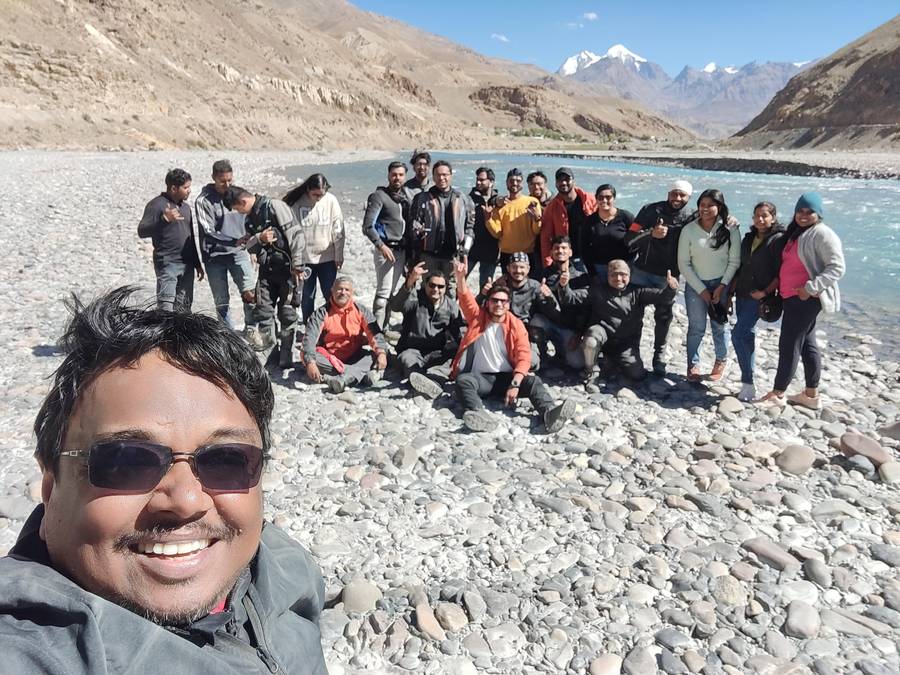
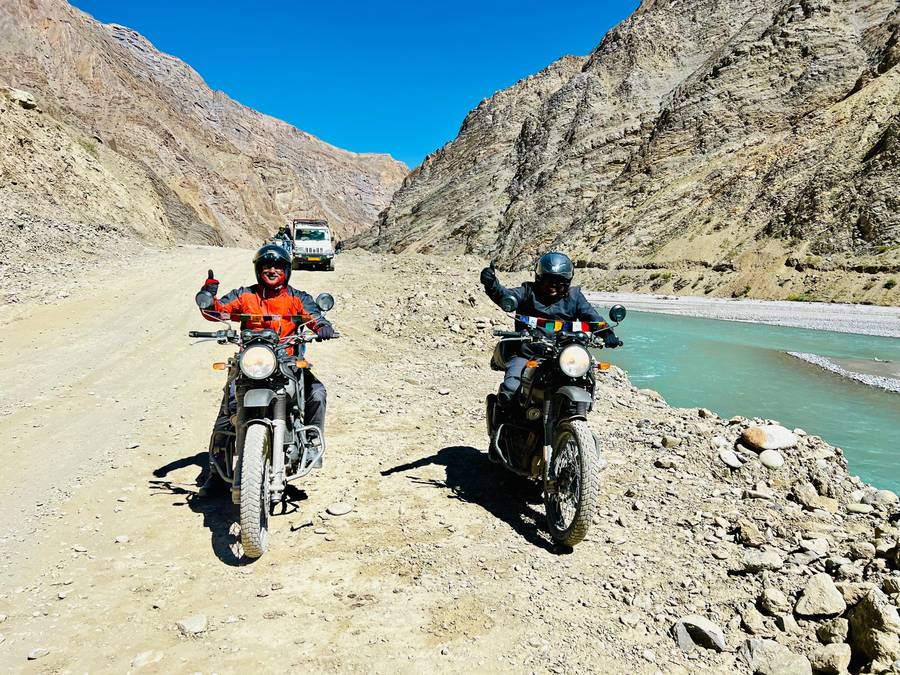
By mid-afternoon we were in Kaza, the main town of Spiti, where we spent two nights.
Day 6 · The high villages: Langza, Komic and Hikkim
Day six was the day of superlatives. Above Kaza a loop of road climbs to three villages at around 4,400 m and higher, each with a claim to fame. We started at Langza, where a huge golden Buddha sits on a hillock looking down the valley.
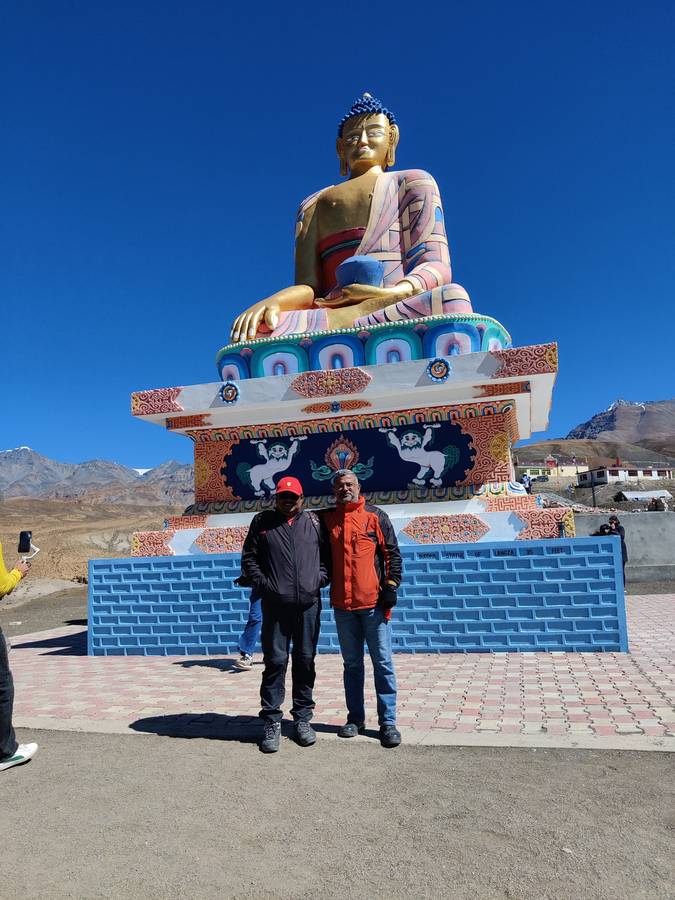
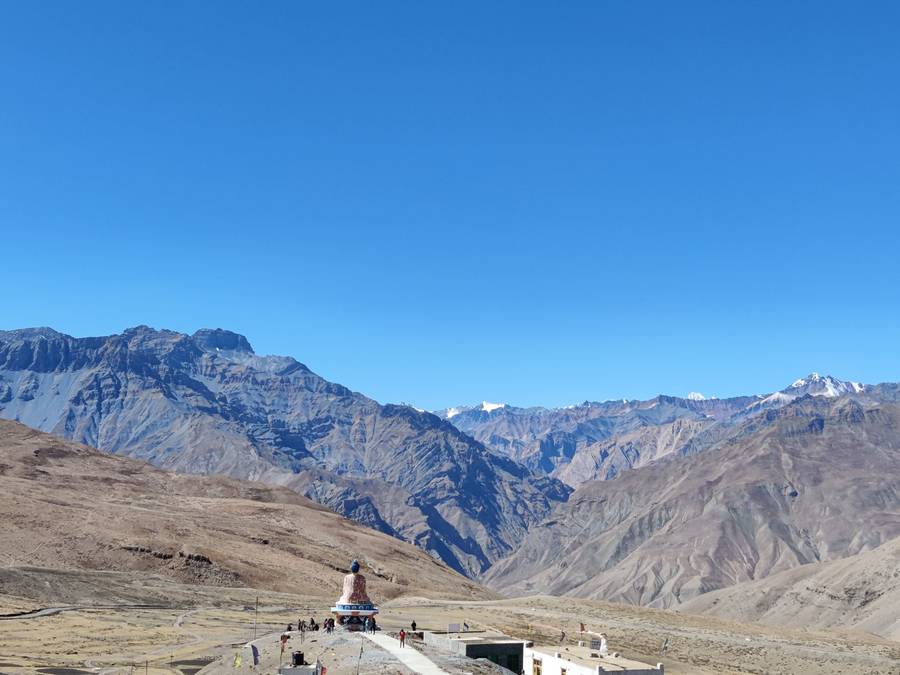
Langza sits at around 4,400 m and is known as the fossil village of Spiti: marine fossils, ammonites among them, lie in its slopes, left from when this land was under the sea. The big statue over the village depicts the Maitreya, the future Buddha. Note that collecting fossils is illegal in India, however many are offered for sale.
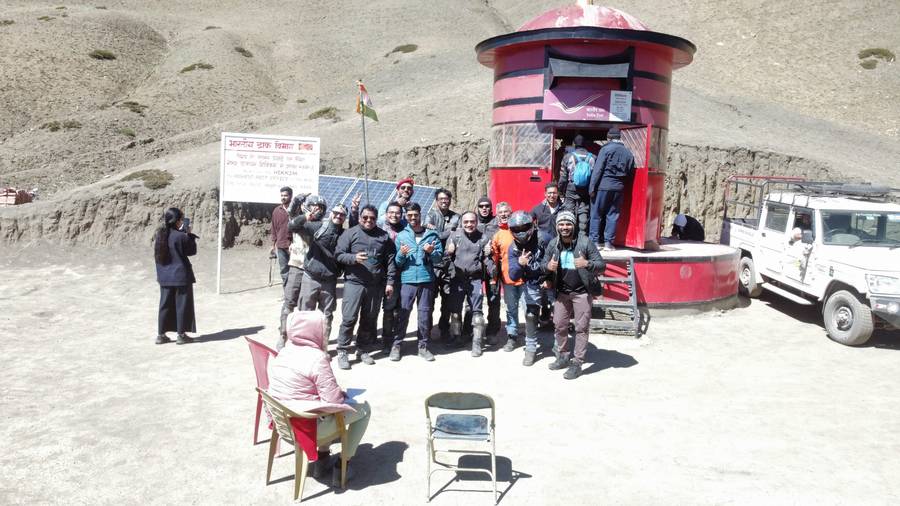
Then up to Komic, where my helmet sticker had its photo taken against a stone wall, and on to Hikkim, home of the post office everyone comes to see. My Mavic went up again for a group photo outside the little red post office.
Day 7 · Snow, a closed pass, and a U-turn
On the morning of day seven we woke in Kaza to fresh snow on the peaks around the town and low cloud hanging in the valley. That snow, it turned out, was the end of our plan. The way home was supposed to be over Kunzum and past Chandratal to Manali, completing the loop. An unexpected snowfall had closed the road. Nobody was going over Kunzum that day.
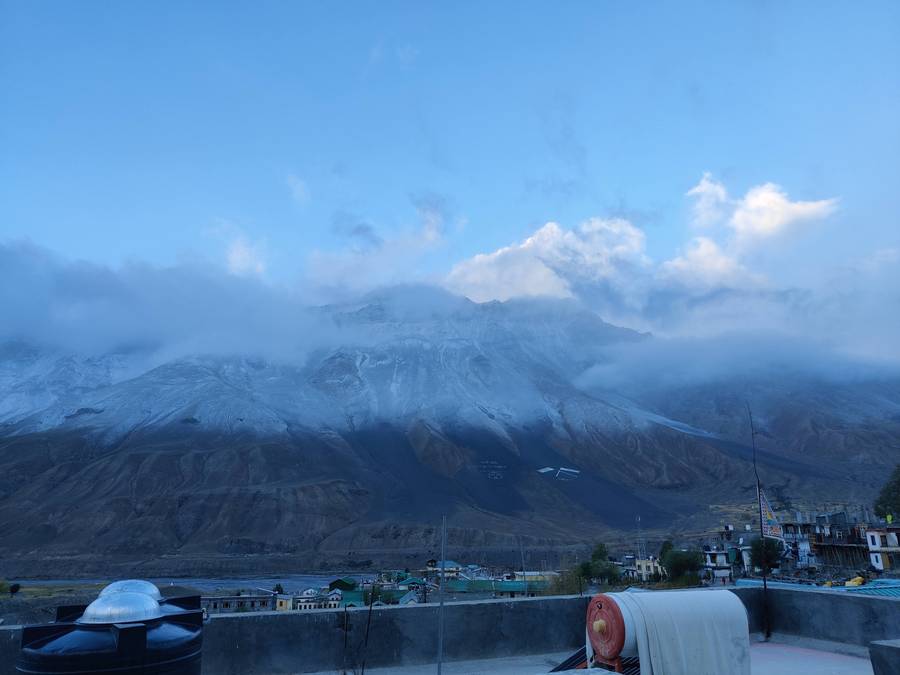
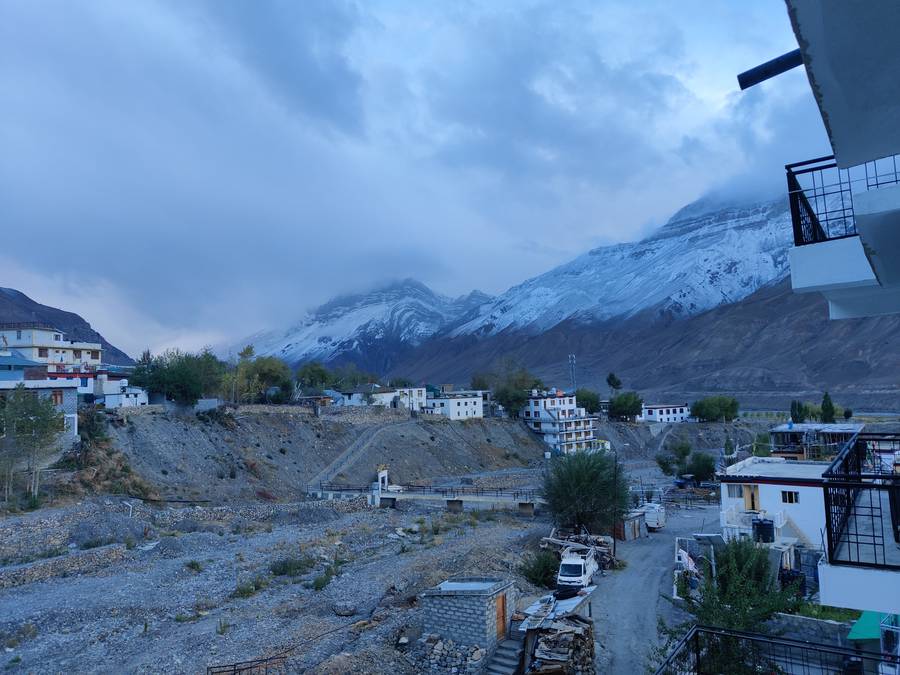
So the plan changed. We would see what we could near Kaza in the morning, then ride all the way back down the way we had come and spend the night at Kalpa. First, Chicham bridge, hanging across a gorge so deep that nobody wanted to look over the edge for long.
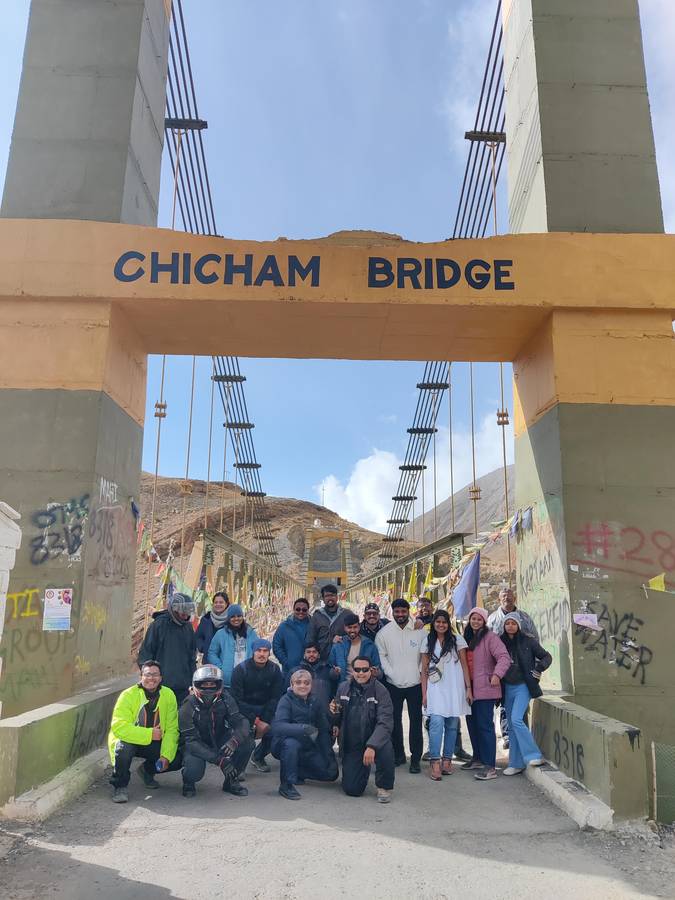
The bridge links Chicham and Kibber across the Samba Lamba gorge. It is usually given as 13,596 ft (about 4,145 m) above sea level, about 114 m long and roughly 1,000 ft above the gorge floor. It opened in 2017 after about fifteen years of construction, replacing a ropeway. It is widely billed as Asia's highest suspension bridge, though some travel writers dispute the title.
Then Key Monastery, piled up its hill like a stack of white boxes, and the last view of the Spiti valley before we turned south.
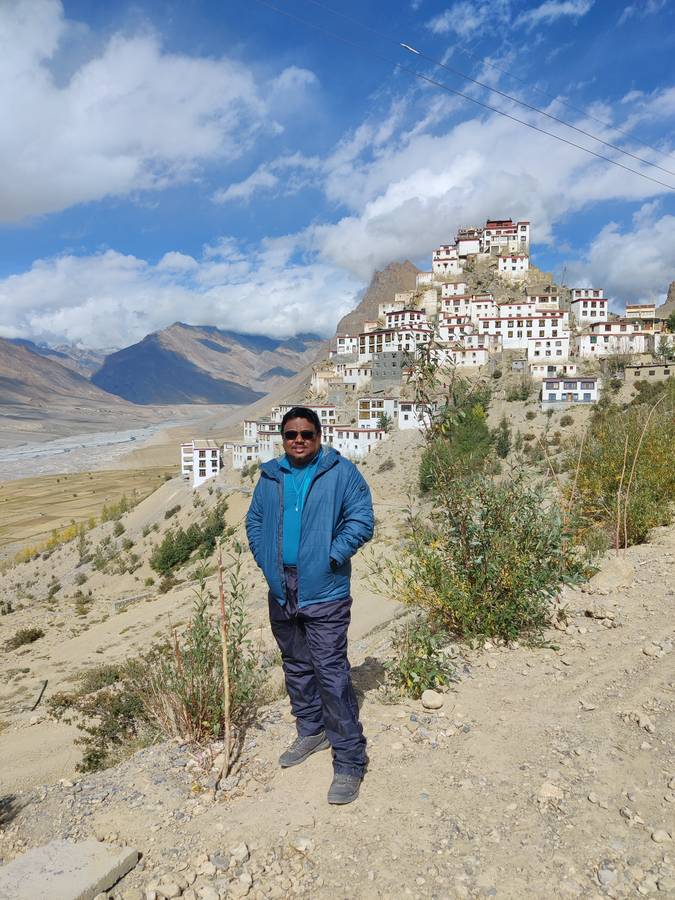
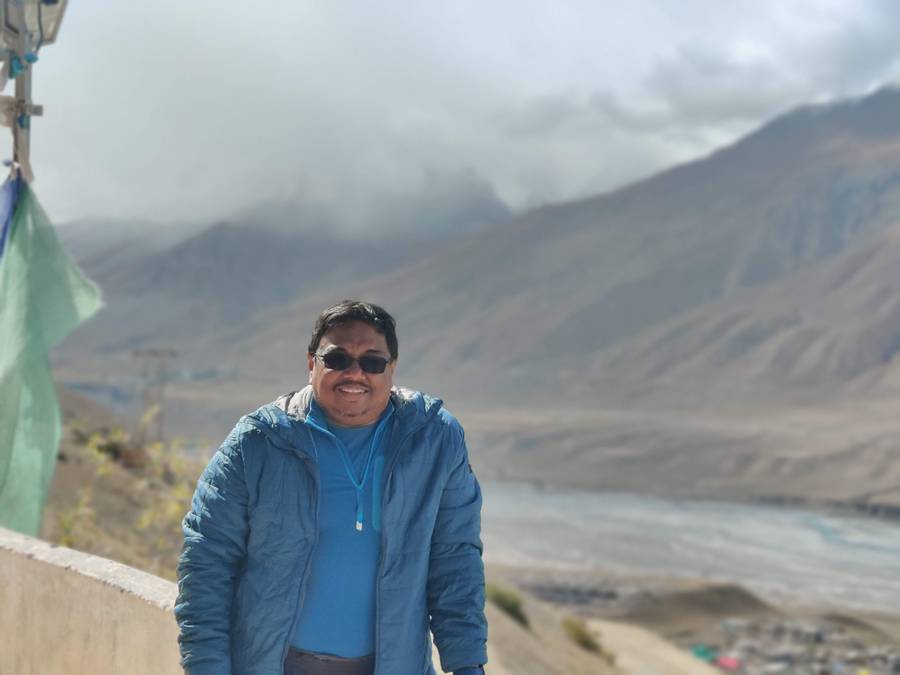
Key Gompa stands at about 4,166 m (13,668 ft) above the Spiti river. It is the largest monastery in the Spiti valley and a training centre for lamas. Tradition says it was founded in the 11th century by Dromtön, a pupil of the teacher Atisha.
Now for the joke the mountains were saving. We rode back down past Dhankar and Tabo, and just after Tabo word came through that the Kunzum road had reopened. By then we were far too far down the valley to turn around. Spiti, it seems, has a sense of humour. The weather that had closed the pass followed us down the valley, with rain and snow as we went, and by evening we were back in Kalpa, at the same hotel as before.
Day 8 · The long day
The bus to Delhi left Manali in the evening, and Manali was the whole of the Sutlej valley, Jalori Pass and the Kullu valley away. There was only one way to make it. We started in the dark, long before dawn, and rode all day: down the Sutlej, a tea stop, breakfast at the same dhaba at Luhri where we had stopped a week before, back over Jalori, and, in the afternoon, the same terrace above the Beas near Aut where it had all started. We rolled into Manali late in the afternoon, the bikes caked in mud and the riders not much cleaner.
I will admit something here. On that last day, somewhere on that long road, I was in tears. I had never really believed that I would get to do this bucket-list ride at this age, with one of my best friends, after fifteen years off a bike. Blisters, three falls, a closed pass and a thirteen-hour last day, and we had done it.
From Manali it was the overnight Volvo back to Delhi, and home by early morning.
The Spiti superlatives audit
Spiti and Kinnaur are full of signboards claiming that something is the highest, oldest, first or last. Being Gen X, I checked them.
| Place | The claim | What the record says | Verdict |
|---|---|---|---|
| Chitkul | India's last village (the new sign says first) | Last inhabited village on the old Hindustan–Tibet road, about 3,450 m | Both, depending on your direction |
| Tabo | Oldest monastery | Founded 996 CE; oldest continuously functioning Buddhist monastery in India | Holds up |
| Hikkim | World's highest post office | About 4,400 m, open since November 1983; a post office at the Everest base camp in Tibet is reported to be higher | India's highest, safely |
| Komic | World's highest village with a motorable road | About 4,587 m; villages elsewhere dispute the title | Contested, but your lungs agree |
| Chicham | Asia's highest suspension bridge | About 13,596 ft, opened 2017; some writers dispute it | Very high, slightly argued over |
The first chapter
Bikes were Anil's and my first love, from the days when cars were out of our reach. Spiti was the first half of a long-cherished dream, and a year later Ladakh completed it. I went to Ladakh with proper gloves and proper shoes, and I stayed upright. Spiti taught me that.
This was my second trip with JustWravel, after their 4x4 winter Spiti expedition, and they ran it beautifully. The itinerary was well thought out, and the stays were clean, spacious and well located. Namit kept the whole show on schedule, and the bike team of Deval, Anshul, Aman and Rakesh was outstandingly professional, caring and buoyant. We did not have a single issue on any day. Five stars, every one of them earned.
And the biggest thanks of all goes to my wife, who believed I could do this before I did, and supported me all the way.
Thirteen bikes, eight riding days, about 1,300 km, three falls at zero km/h, one pass snowed shut, and two coursemates from 1992 who finally rode Spiti together. This is the Way.