In June 2018 the four of us spent a month in South Korea and Japan. This post covers only twelve of those days, 11 to 22 June, when we left our Tokyo base with a JR Pass each, backpacks, and one plan: get our money’s worth out of those passes. Seoul, Tokyo and the rest get their own posts.
Every Indian family has a relationship with trains. Ours started with overnight sleepers, chai in clay cups and the uncle in the next berth who asks how much you earn before the train has left the platform. So when we bought a 14-day Japan Rail Pass each, we were not tourists buying a ticket. We were a family on a mission, and the mission was paisa vasool. If a train went somewhere and the pass covered it, we were going to sit on it.
In twelve days we crossed the Japanese Alps through snow, slept on tatami in Hiroshima, went through an earthquake in Kyoto, watched Mount Fuji refuse to come out in Hakone, and saw fighter jets over the islands of Matsushima. We also saw two of Japan’s official Three Views, five UNESCO World Heritage listings and more deer than we could count. Mostly, though, we sat on bullet trains. Ask the kids what the best part of Japan was and they will not say a temple. They will say the trains, and so will I.
The route
Sixteen numbered stops. A filled circle means we slept there; the green dashed line is the Matsushima day trip. The map is a sketch for orientation, not a scale drawing.
- 11 Jun Tokyo Station: Hokuriku Shinkansen
- 11 Jun Nagano: bus to Ogizawa
- 11 Jun Alpine Route: Kurobe Dam, Murodo snow walls
- 11 Jun Toyama
- 11 Jun Kanazawa, nights 1 and 2
- 13 Jun Himeji Castle
- 13 Jun Okayama: change of trains
- 13 Jun Hiroshima: Peace Memorial, night 3
- 14 Jun Miyajima: Itsukushima Shrine
- 14 Jun Osaka: Shinsekai, USJ, Kaiyukan, castle, Dotonbori; nights 4 to 6
- 17 Jun Nara: deer park and Todai-ji
- 17 Jun Kyoto, nights 7 to 9
- 20 Jun Mishima Skywalk
- 20 Jun Hakone: Lake Ashi, Owakudani; ryokan, night 10
- 21 Jun Enoshima and Kamakura, then back to Tokyo
- 22 Jun Matsushima day trip from Tokyo
Day 1 · 11 June — The Roof of Japan
Before the sun was properly up
The JR Pass rewards early risers, and on our first day the planner in the family (me) decided we were early risers. We were at Tokyo Station before six in the morning for an early Hokuriku Shinkansen, a blue-and-copper E7 with a nose so long it looks as if it is sniffing the platform. The kids posed with it the way kids in India pose with a film star: shoulders squared, slightly overwhelmed. The departure board said Kanazawa. We were only going as far as Nagano. Kanazawa would come in the evening, the long way round, over the mountains.
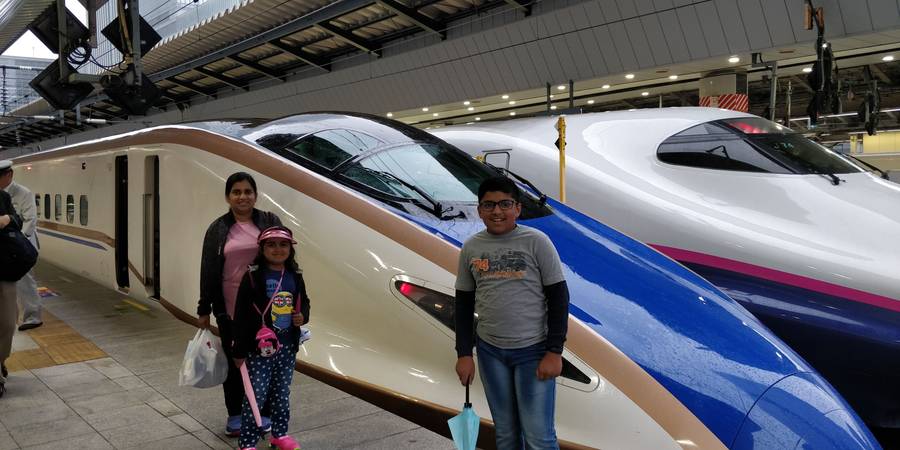
The Japan Rail Pass let foreign visitors ride most JR trains, including the Shinkansen, for one, two or three weeks of consecutive days. In 2018 there was one big exception: the fastest Tokaido, Sanyo and Kyushu Shinkansen services, the Nozomi and the Mizuho, were not covered and had to be paid for in full. That rule was only relaxed in October 2023. So every time a sleek Nozomi glided past us on the platform, we let it go, like a family watching the Rajdhani from the general queue. The pass also does not cover private lines: the Alpine Route, the Hakone pirate ship and the Enoshima trains were all paid separately.
The Alpine Route
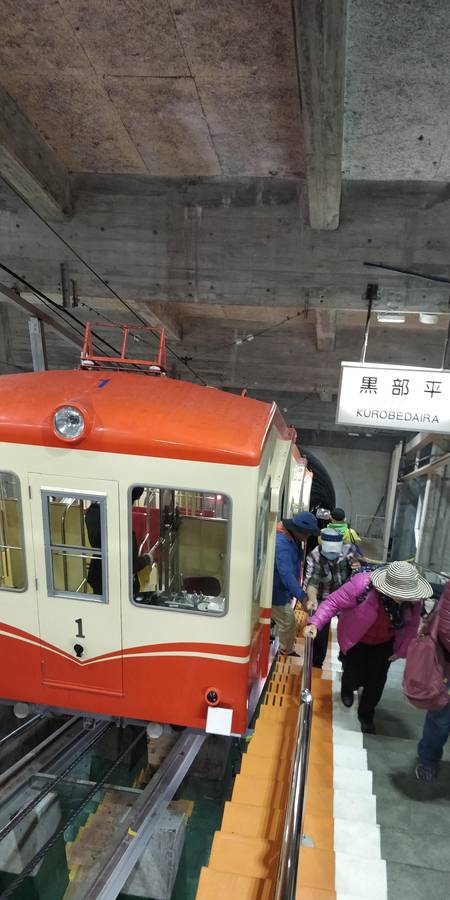
From Nagano a bus took us up into the mountains to Ogizawa, the start of the Tateyama Kurobe Alpine Route, which crosses the Northern Alps using every kind of transport the Japanese could think of. In one day we rode a trolleybus through a tunnel, walked across a dam, took a cable car that runs underground, hung from a ropeway, rode another trolleybus through another tunnel, took a bus down a mountain and a cable car down a slope. Six vehicles and a walk across a dam, between morning and mid-afternoon: in India we would call that a jugaad. In Japan it is a timetable, and every change ran to the minute.
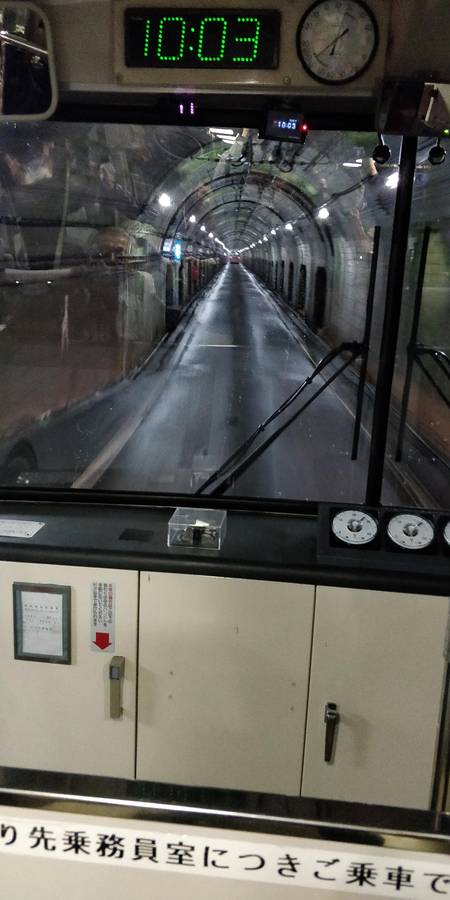
The Kanden Tunnel trolleybus ran 6.1 km through the mountain from Ogizawa to Kurobe Dam and had been doing so since 1964. It was one of only two trolleybus lines left in Japan, and the other was further along the same route. We did not know it then, but we were riding it in its final season: the trolleybuses stopped in November 2018 and were replaced by battery-electric buses in April 2019. The Tateyama Tunnel trolleybus followed a few years later.
Kurobe Dam came first. A wall of concrete holding back a lake the colour of green bottle glass, with snowy peaks behind it in the middle of June. It was cold and grey, and all four of us were in fleeces. You can tell from the photographs that we had packed for a Japanese summer and found a Himalayan one.
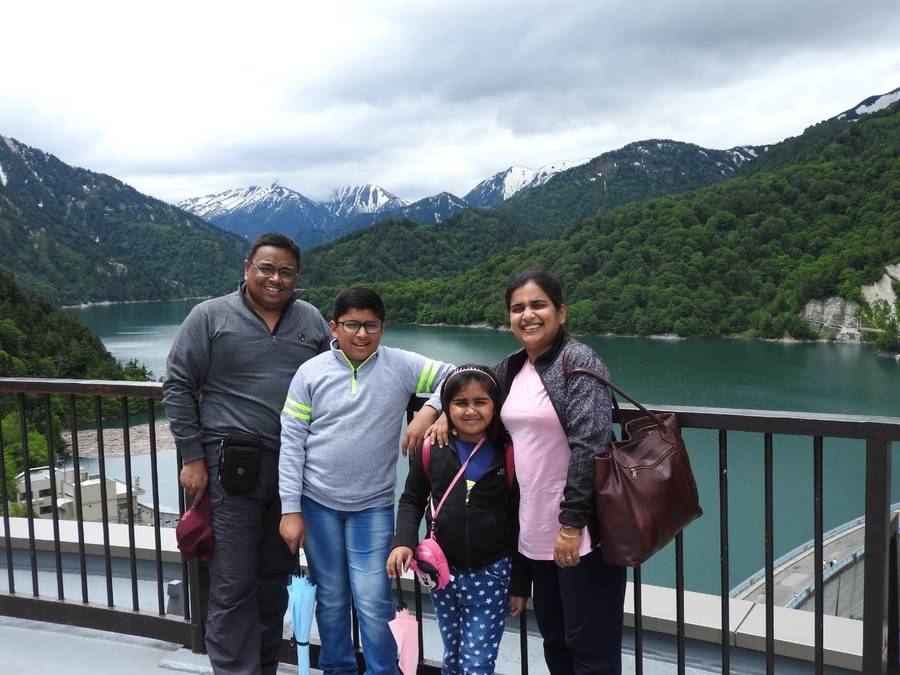
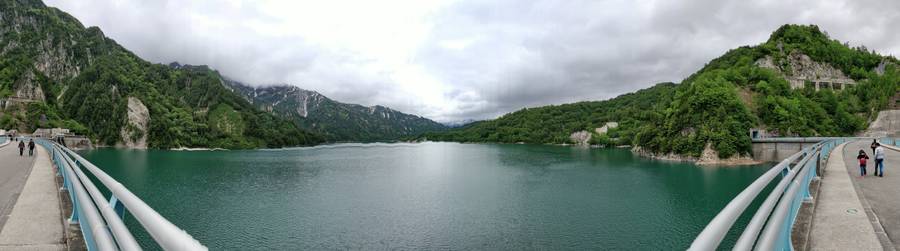
At 186 metres, Kurobe Dam is the tallest dam in Japan. Construction began in July 1956 and finished in June 1963, and it cost 171 lives. It feeds the Kurobe No. 4 power station, and from late June to mid-October water is released from the spillway for visitors. We were a couple of weeks too early for that show. The Alpine Route itself opened on 1 June 1971; end to end it is about 37 km, with up to 1,975 metres between its lowest and highest points.
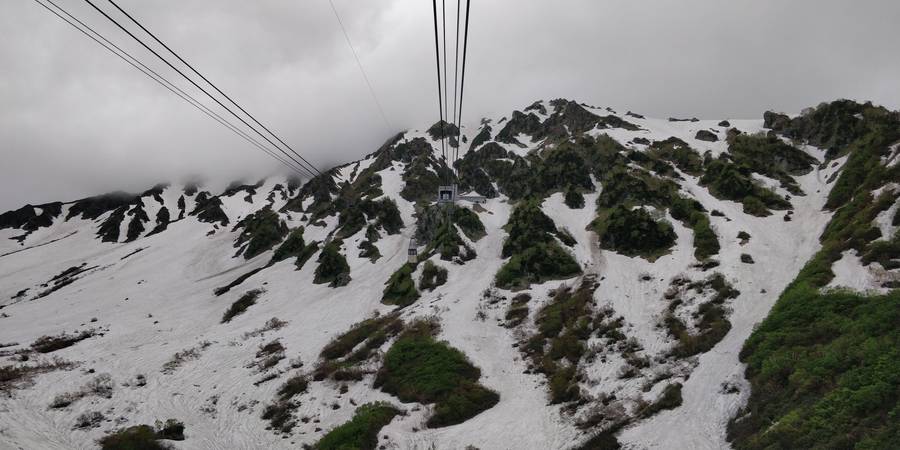
Then up: the underground cable car, and the Tateyama Ropeway, swinging over slopes still half-covered in snow, with the clouds so low they felt like part of the furniture.
Walking between walls of snow
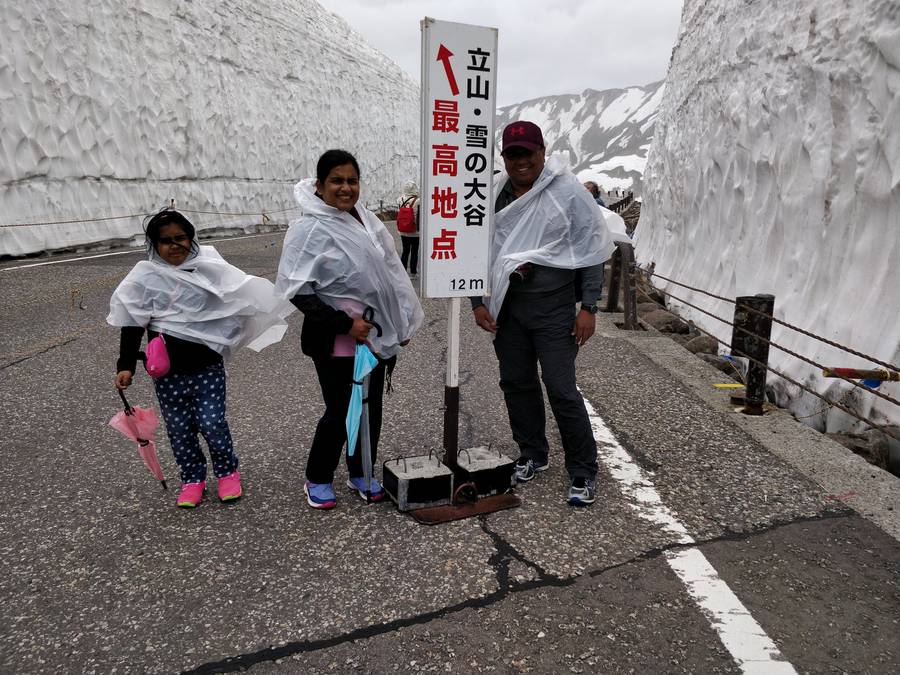
Murodo, at 2,450 metres, is the highest point on the route. Here the road is cut each spring through the snow and the cuttings are left standing as walls: the Yuki-no-Otani, the “great valley of snow”. In spring the walls reach 15 to 20 metres. By the middle of June they had melted down a little, and a signpost marked the highest point that day at 12 metres. Twelve metres of snow on either side, and the four of us in plastic ponchos walking down the middle, looking like leftovers wrapped for the fridge. For a family from the plains of North India, it was the best kind of madness.
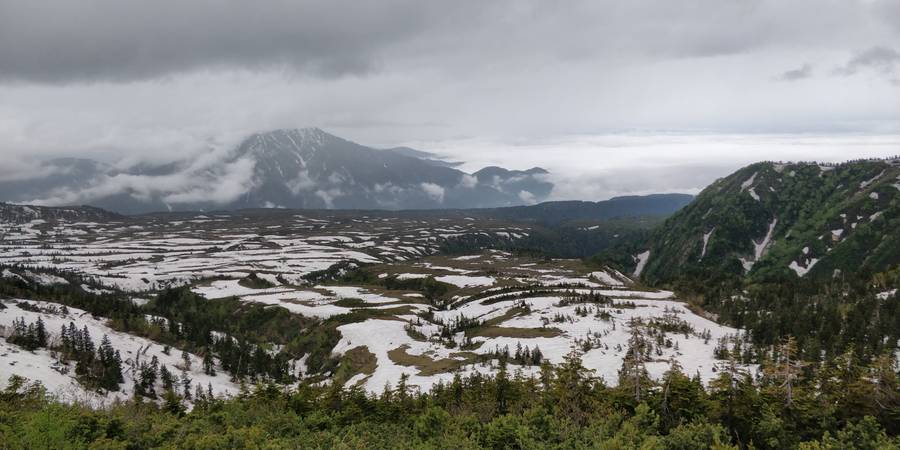
The highland bus took us down past Midagahara, a plateau of marsh and patchy snow that looked, from the window, like a map of an archipelago. At Bijodaira a cable car took us down to Tateyama station, where we finally sat down with something hot.
From Tateyama a small local train took us to Toyama and the JR took us on to Kanazawa, where the station is guarded by the Tsuzumi-mon, a gate of twisted wooden pillars designed after a tsuzumi, a hand drum. Twelve hours, more changes of vehicle than we could count, and two very tired children.
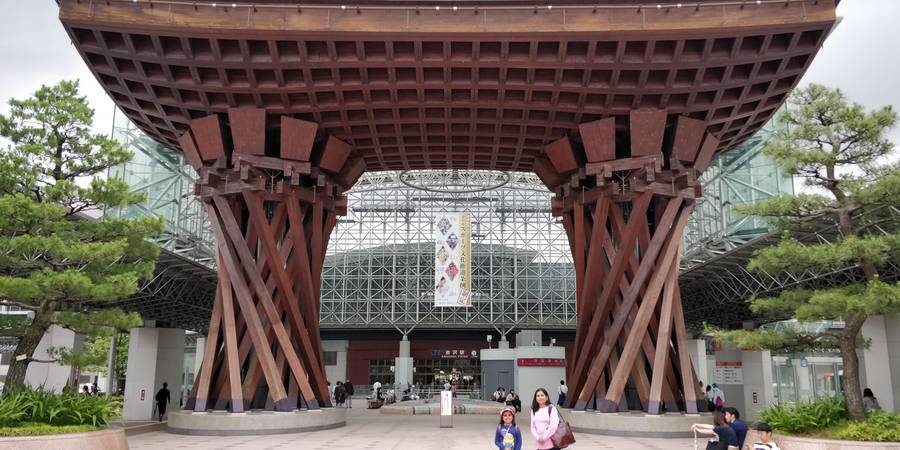
Day 2 · 12 June — Kanazawa in the Rain
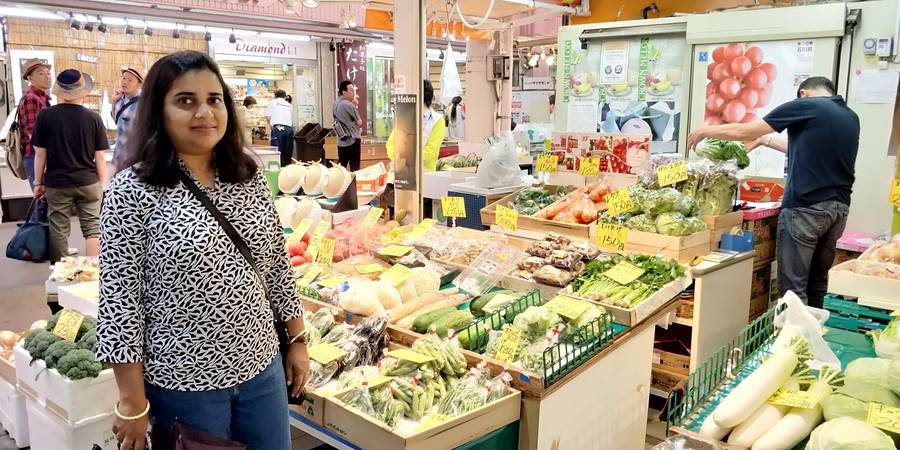
Omicho Market: a nose-first experience
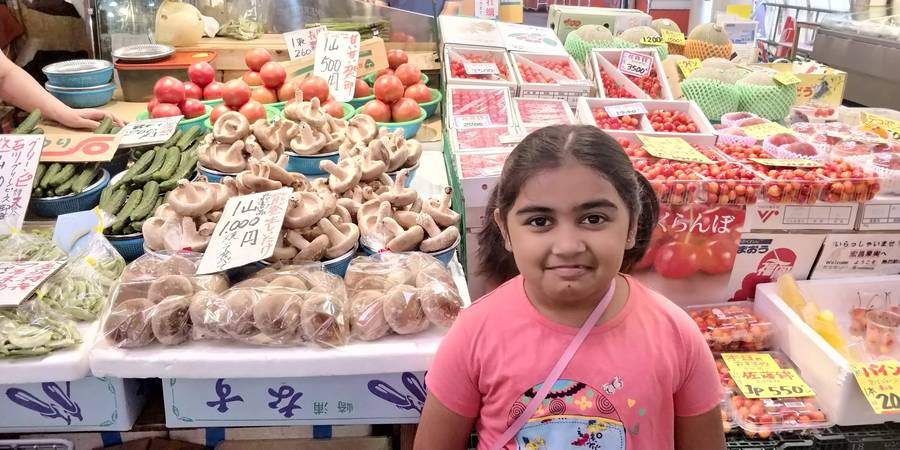
Our first stop in the morning was Omicho Market, which has been Kanazawa’s kitchen for about three hundred years. If you grew up going to a Kolkata fish market or a Delhi sabzi mandi, you will feel at home within thirty seconds, and then your nose will catch up. Everything was very fresh and very raw: crabs, fish, vegetables, fruit laid out like jewellery, and a smell that is sharp and salty and does not apologise. The difference from home is the silence. Nobody shouts the price. Nobody needs to.
Samurai lanes and a garden in the rain
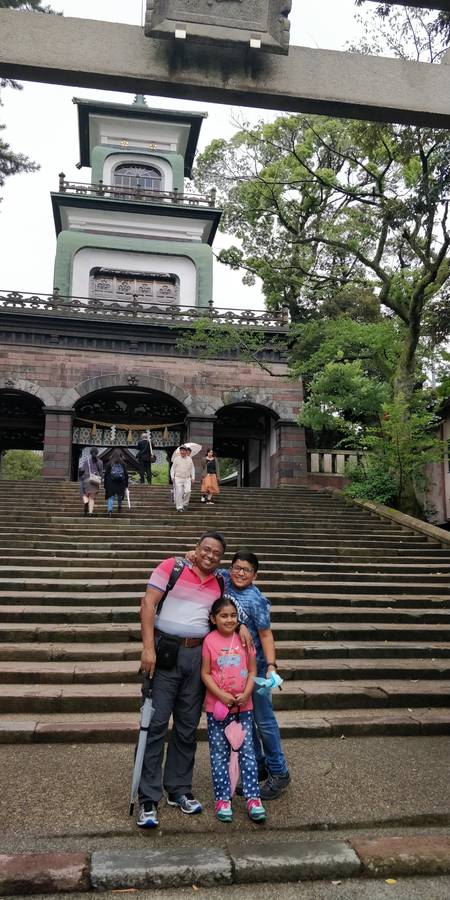
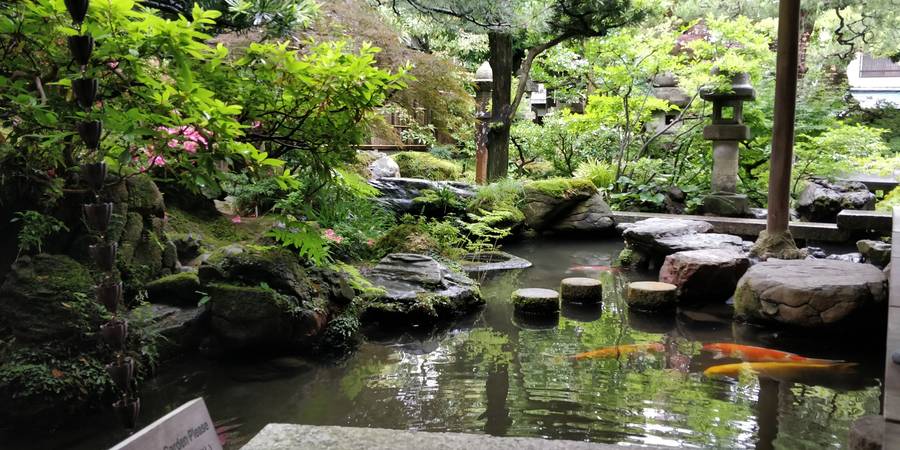
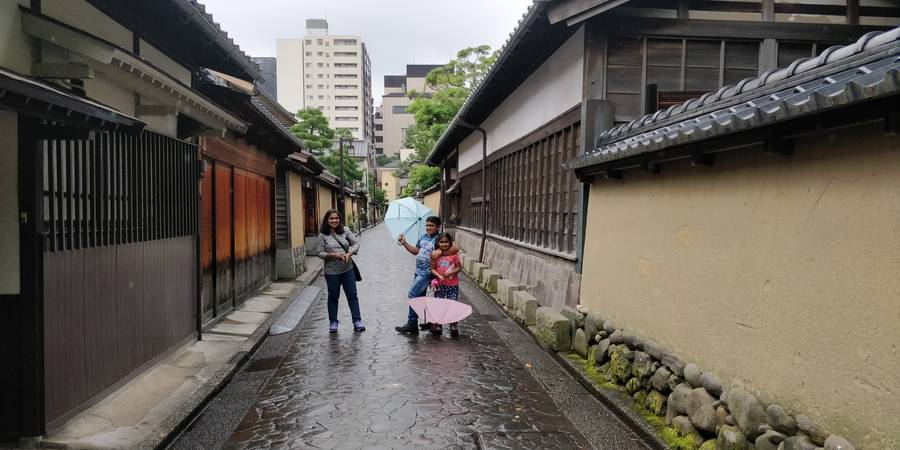
It rained on and off all day, which in a city of gardens is not a problem. Oyama Shrine has a gate with stained glass at the top, a Japanese shrine wearing a European window, and behind it a quiet pond garden. In Nagamachi, the old samurai quarter, the lanes run between mud walls with tiled tops, and a canal runs beside them. We went into the Nomura family house, whose small garden has a koi pond, stepping stones and lanterns, and is the kind of place that makes you whisper without being asked.
Kenroku-en
The afternoon was for Kenroku-en, one of Japan’s three great gardens. Its name means “the garden of six attributes”: spaciousness and seclusion, artifice and antiquity, waterways and views. The joke is that these qualities contradict each other, and the garden manages all six anyway. The Karasaki pine sprawls over the pond, its branches propped on poles; in winter the gardeners rig ropes from a central post to hold the snow off. It was the first time all trip that our son put his phone away without being asked.
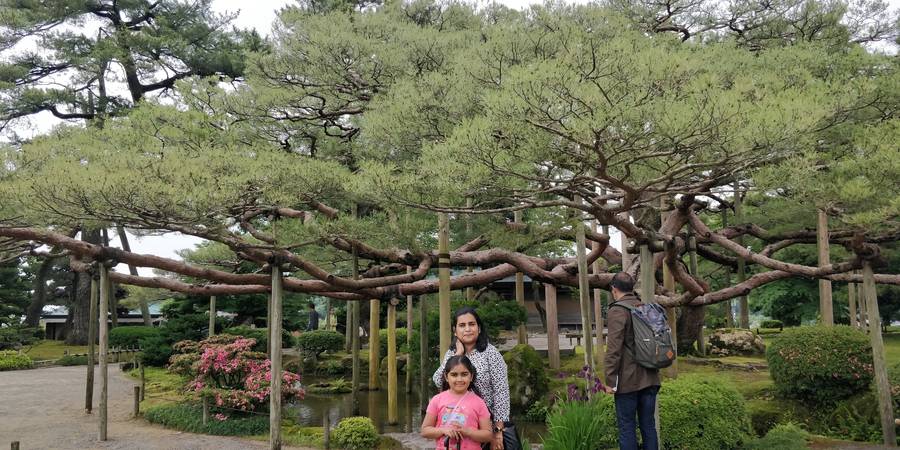
The Maeda lords of Kaga built the garden over two centuries, from the 1620s to the 1840s, and it covers nearly 25 acres. It was given its name in 1822 and opened to the public in the 1870s. With Koraku-en in Okayama and Kairaku-en in Mito it makes up Japan’s Three Great Gardens. The Karasaki pine was grown from a seed brought from Karasaki on Lake Biwa, and the garden’s fountain, driven only by the natural pressure of water from higher ground, is thought to be one of the oldest in Japan.
We ended at Kanazawa Castle, then a burger lunch far too late in the day, and back to the hotel, where one of the children took over the bath, with bubbles.
Day 3 · 13 June — The White Heron and Hiroshima
The Thunderbird and a Coke you could see through
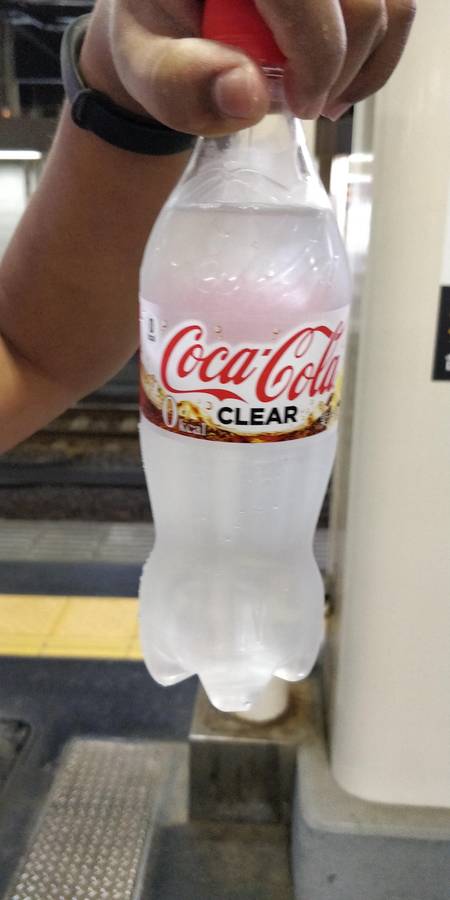
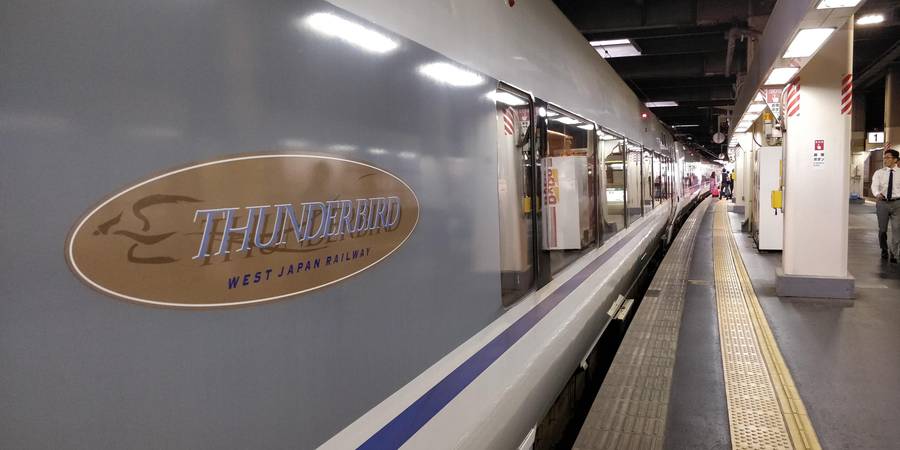
Early in the morning the Thunderbird limited express took us south along Lake Biwa to Osaka. On the platform we bought a Coca-Cola Clear, which had just been launched in Japan that week: a lemon-flavoured, zero-calorie cola as transparent as water. It tastes like cola. It looks like a glass of water lying about it. Our verdict was that it is a very Japanese idea and a very confusing drink.
Himeji Castle
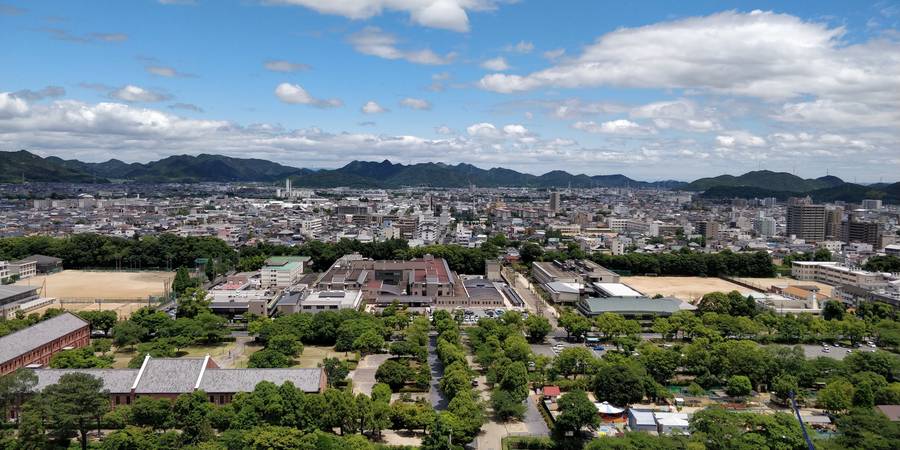
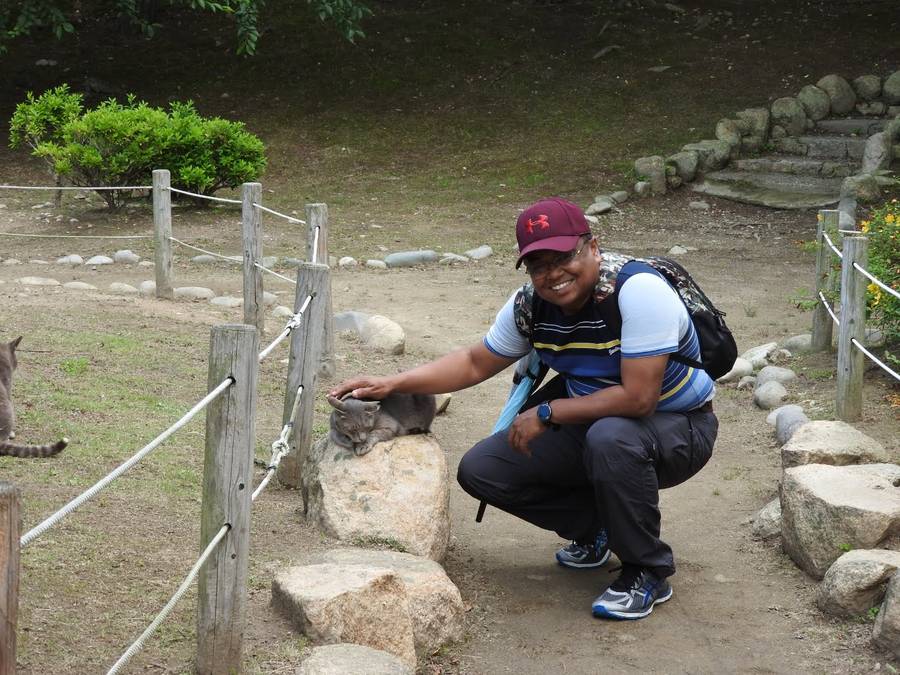
From Shin-Osaka a Shinkansen got us to Himeji by midday, and for the first time the weather changed sides: a hard blue sky with white clouds, which is exactly what the White Heron needs. Himeji Castle is white plaster on a massive stone base, and it does look like a bird about to take off. We climbed the keep with our shoes in plastic bags, up steep wooden stairs worn smooth by centuries, and looked out from the top over the whole town. On the way out a cat by the moat accepted a scratch from me with the air of a landowner receiving rent.
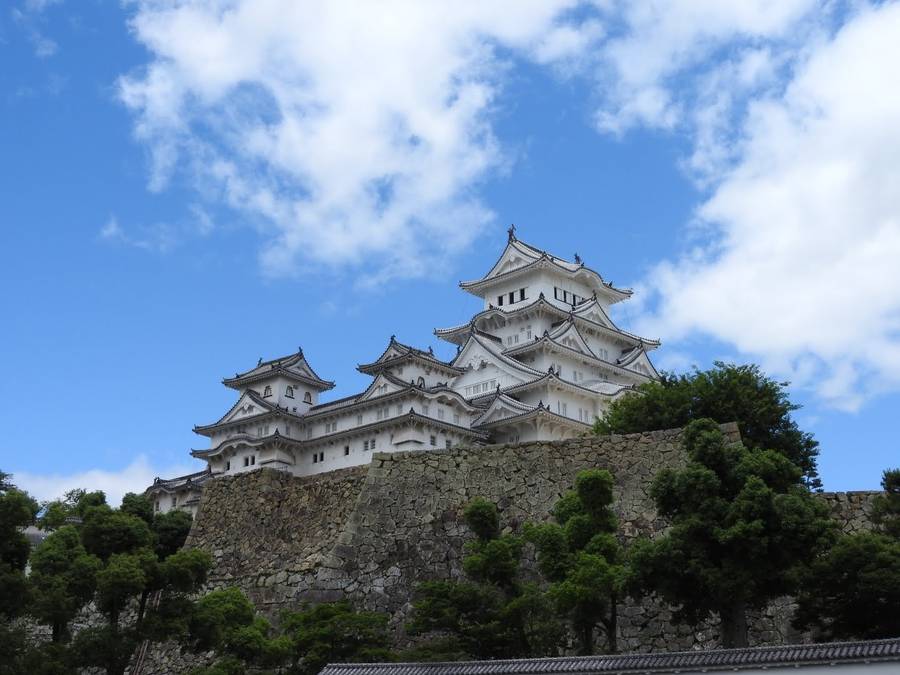
Himeji was one of Japan’s first UNESCO World Heritage Sites, inscribed in December 1993. The complex has 83 buildings and the main keep is 46.4 metres tall. It is called Shirasagi-jo, the White Heron (or White Egret) Castle. In 1945 the town around it was heavily bombed and burned, and a firebomb that landed on the top floor of the keep did not go off. It also came through the 1995 Kobe earthquake standing. A major restoration ran from 2010 and the keep reopened in March 2015, only three years before we visited, which explains why it looked freshly whitewashed.
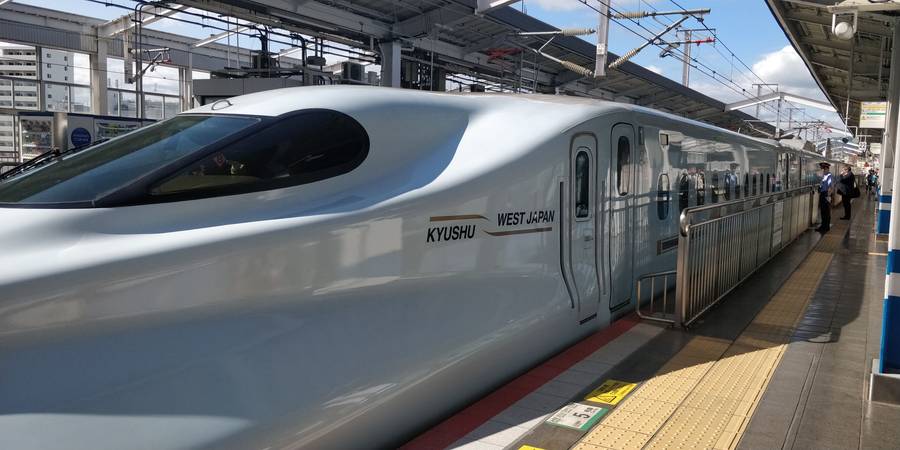
At Okayama we changed trains, and the platform gave us a Kyushu-liveried N700 Shinkansen to admire. By now the kids could tell an E7 from an N700 by the shape of the nose. I have no idea where they learned it. Probably from me.
Hiroshima
We checked in at K’s House, a friendly guesthouse near the station, in a tatami family room with a low table, and walked out to the Peace Memorial Park in the early evening.
There is no humour in this section. Hiroshima was the most surreal and humbling experience of the whole trip. You stand in a green, pleasant park, beside a river, in a modern city full of trams and people going home from work, and across the water is a broken dome of brick and steel that has been kept exactly as it was left on the morning of 6 August 1945. The Children’s Peace Monument is hung with chains of paper cranes, thousands of them, in every colour, sent by schoolchildren from all over the world. It was impossible not to feel small there.
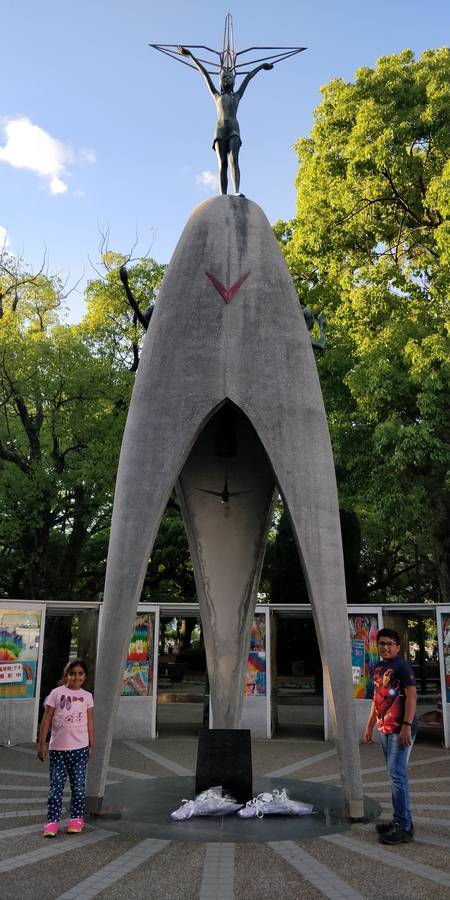
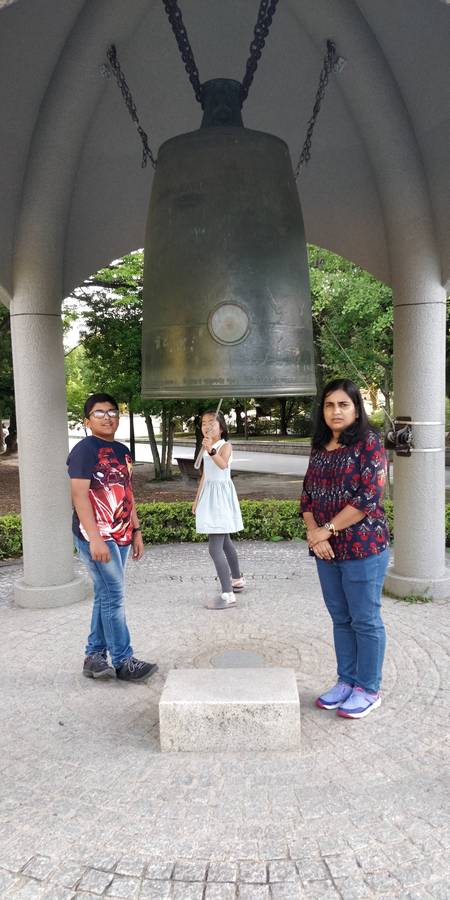
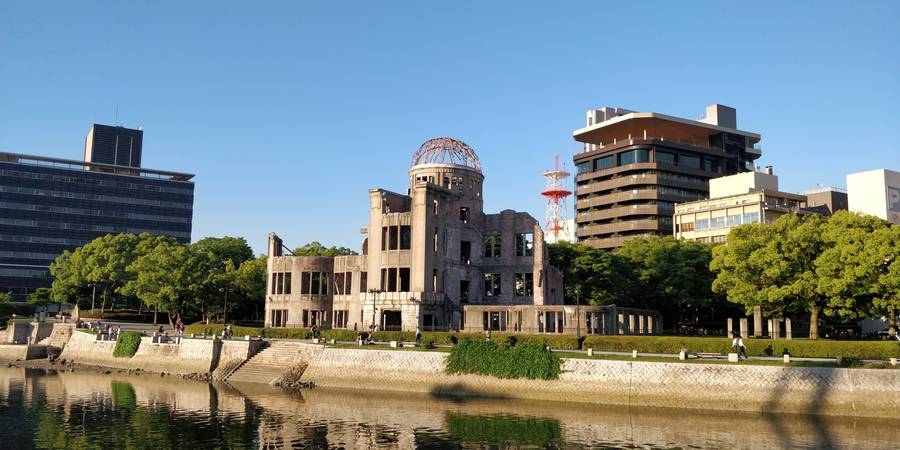
The Dome was built as the Hiroshima Prefectural Commercial Exhibition hall, designed by the Czech architect Jan Letzel and opened in 1915. At 8:15 a.m. on 6 August 1945 the bomb exploded about 600 metres above the ground and roughly 150 metres to the side of it. The building’s walls stood. It was inscribed as a World Heritage Site in December 1996. The Children’s Peace Monument, unveiled on Children’s Day, 5 May 1958, remembers Sadako Sasaki, who was two when the bomb fell and died of leukaemia in 1955 at the age of twelve. She folded paper cranes in the belief that a thousand of them would grant a wish, and cranes have been arriving for her ever since.
Afterwards we walked back through Hondori’s covered shopping street and its neon. That evening, in the guesthouse lounge, the four of us played cards.
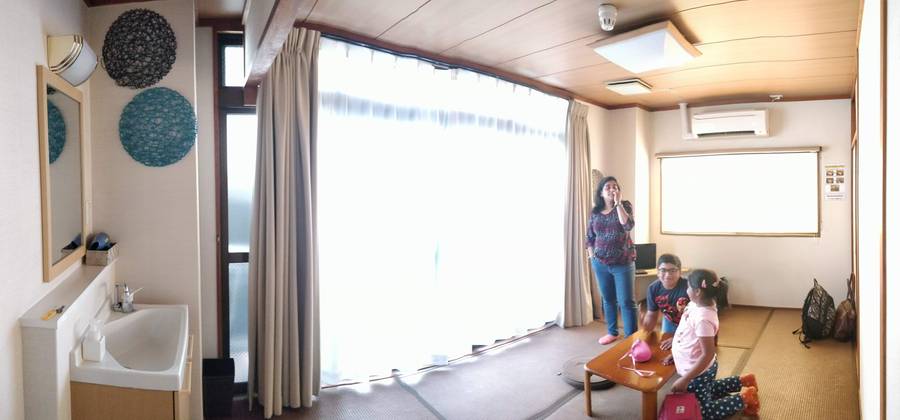
K’s House Hiroshima, a guesthouse close to Hiroshima Station. We had a Japanese-style family room with tatami mats, a low table and futons. Downstairs there was a shared lounge with a bookshelf, a TV and big tables, where we spent the evening over a pack of cards.
Day 4 · 14 June — Miyajima, and Osaka by Evening
The torii in the sea
A JR train took us to Miyajimaguchi and a JR ferry, also covered by the pass (paisa vasool), took us across to Itsukushima, the island everyone calls Miyajima. The deer met us at the pier. They are wild, unbothered and confident in the way of animals that know they are protected; one of them settled down for a cuddle with our daughter as if she had booked an appointment.
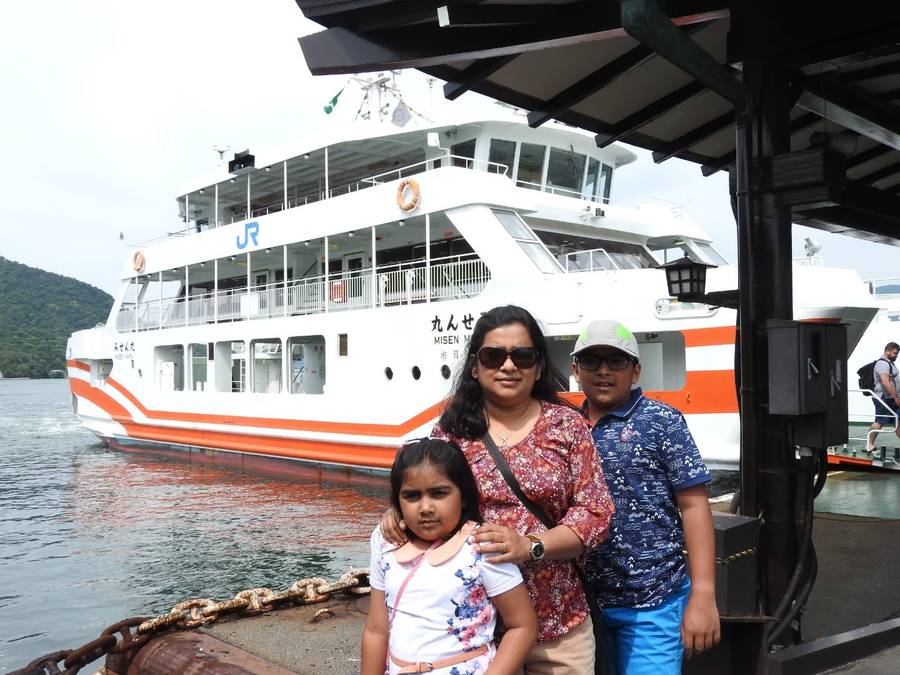
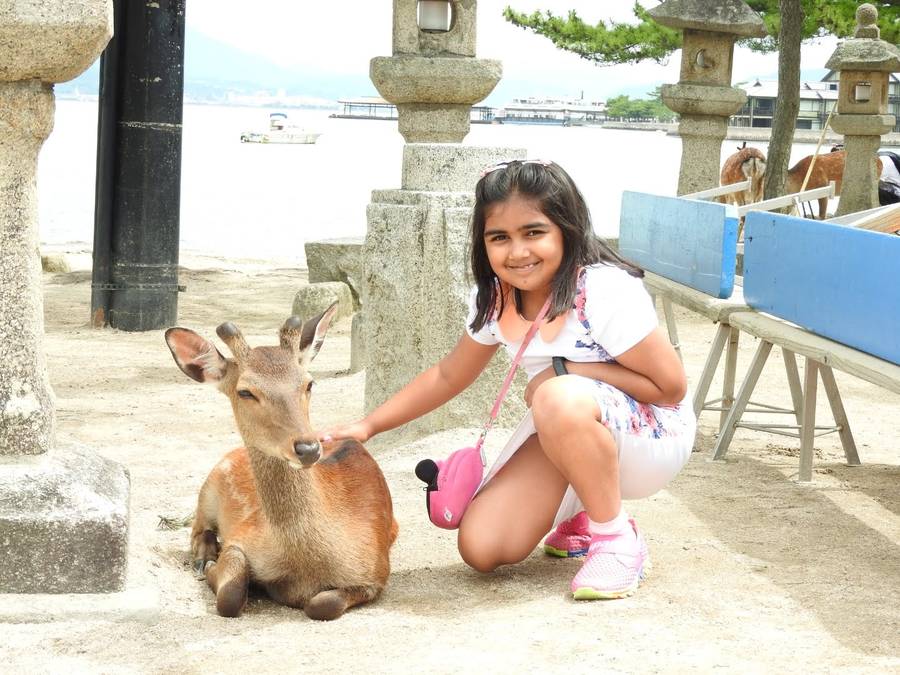
We were lucky with the tide. The great torii was standing in water, which is the view on the postcards; at low tide you can walk out to it on the sand. Itsukushima Shrine itself is built over the water too, on stilts, with long vermilion corridors that seem to float when the tide is in.
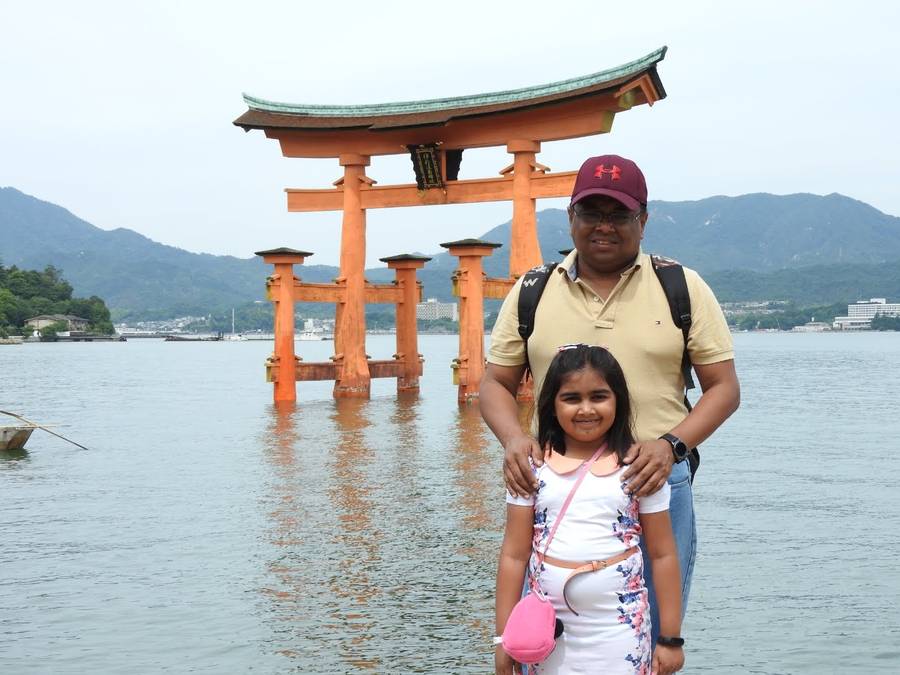
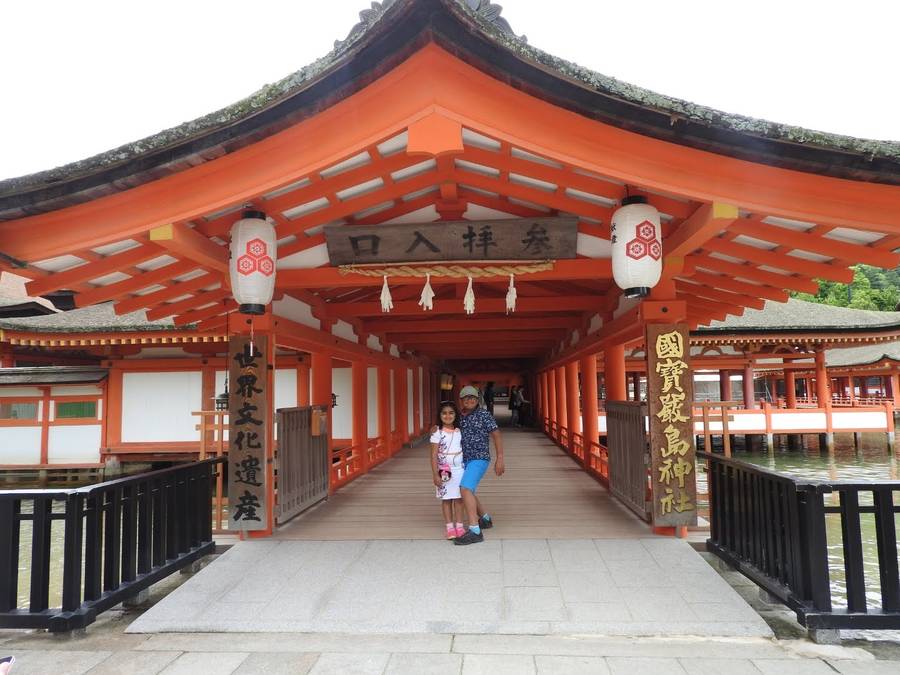
A torii has stood on this spot since 1168; the one we saw dates from 1875. Its two main pillars are camphor trees more than 500 years old, and it is not driven into the seabed at all. It stands under its own weight, about 60 tonnes, including some 7 tonnes of stones packed into the top beam. The shrine was inscribed as a World Heritage Site in 1996. Miyajima is one of the Three Views of Japan, a list drawn up by the scholar Hayashi Gaho in 1643, and the island is treated as so sacred that since 1878 no births or deaths have been allowed near the shrine. Eight days later we would tick off a second of the Three Views.
Shinsekai
Back on the mainland, the Shinkansen carried us east to Osaka, where we had booked an Airbnb in the Shinsekai and Tennoji area for three nights. In the evening we went out to see Shinsekai, Osaka’s loud, old-fashioned “New World”: a steel tower in the middle, and around it restaurants whose signs are enormous models of pufferfish, crabs and lanterns. After the hush of Hiroshima it was like walking out of a library into a wedding baraat.
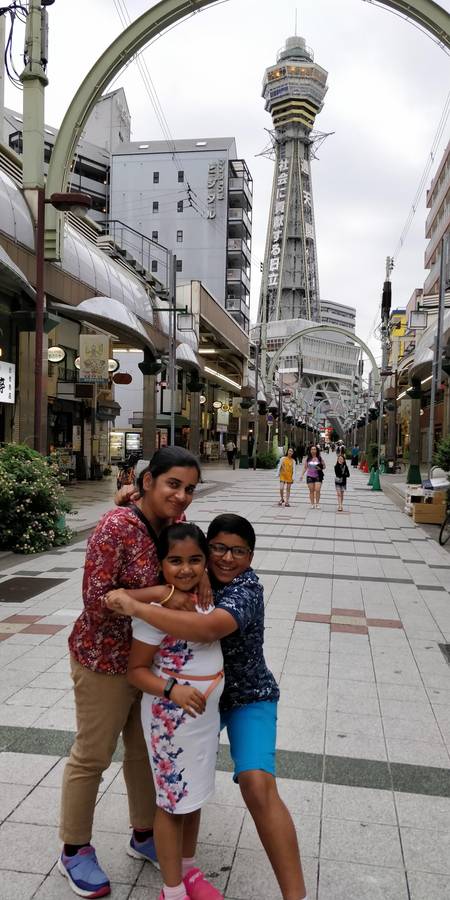
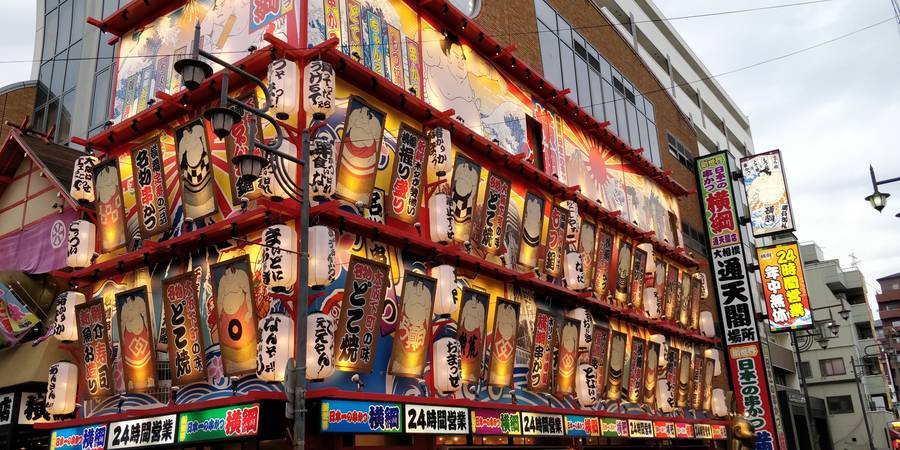
The first Tsutenkaku went up in 1912, modelled partly on the Eiffel Tower and the Arc de Triomphe, and was taken down after a fire in 1943, its steel recycled for the war. The present tower, 108 metres tall, opened in 1956. Inside lives Billiken, a cheerful American charm doll; visitors rub the soles of his feet for luck.
Day 5 · 15 June — Universal Studios Japan
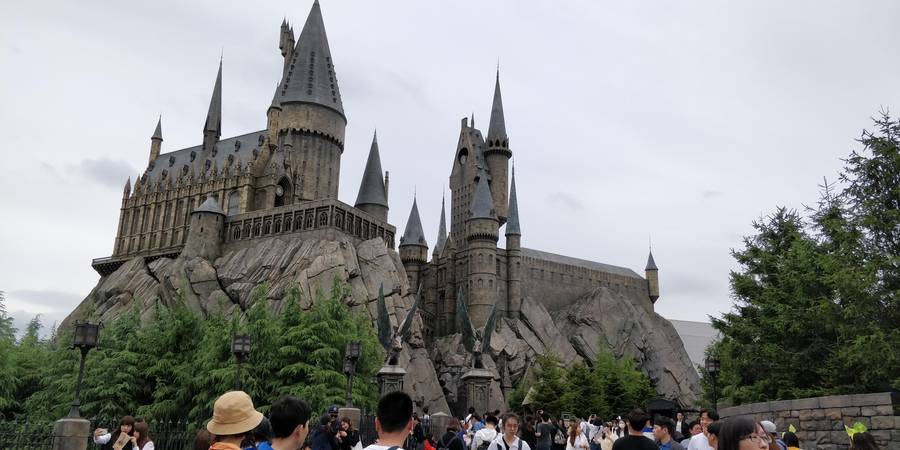
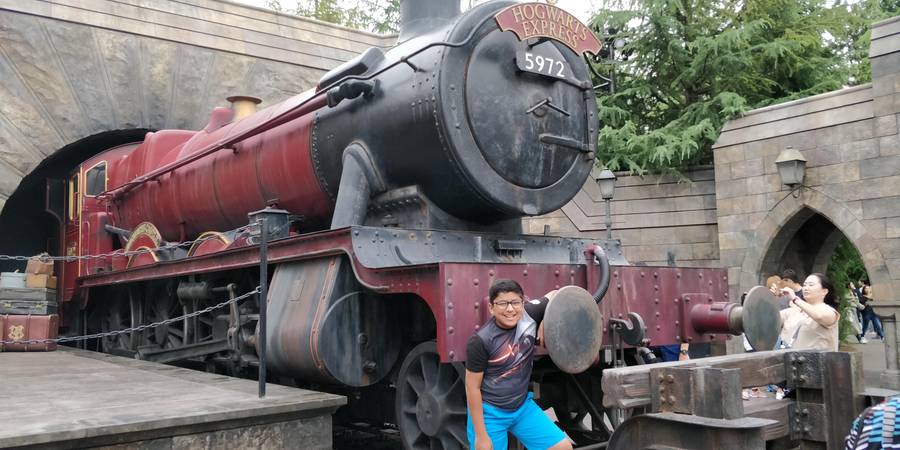
One day was for the children. Under a grey sky, with our daughter in a raincoat, we went from Minion Park to the Hello Kitty corner, past the shark from Jaws, and on into the Wizarding World of Harry Potter, where Hogwarts sits on a fake mountain and the Hogwarts Express waits at a fake platform, steaming. The photographs, wisely, leave out the queues.
Day 6 · 16 June — Whale Sharks, a Castle and Dotonbori
Kaiyukan
Osaka’s aquarium, the Kaiyukan, is built around one enormous tank, and in that tank swims a whale shark. You go round and down the building in a spiral, so the whale shark keeps reappearing beside you, now at eye level, now from below, like a large and patient relative at a family function who keeps finding you to say hello.
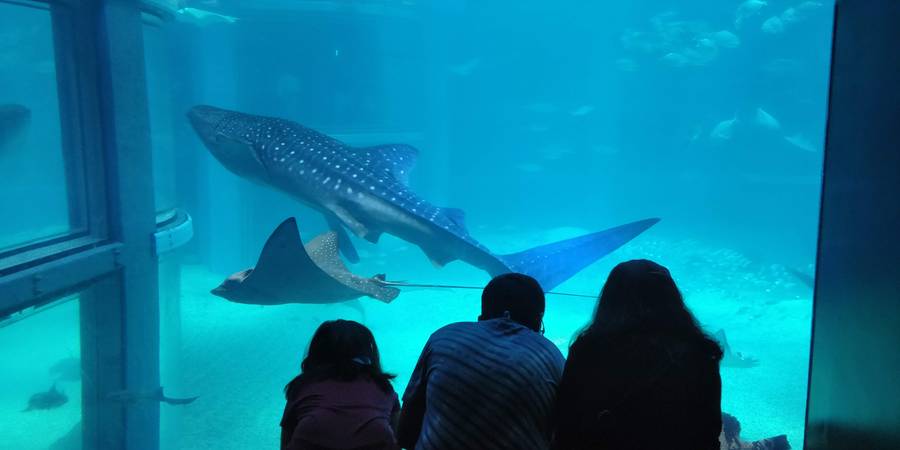
When it opened in 1990, the Kaiyukan was the largest public aquarium in the world. Its Pacific Ocean tank holds about 5,400 cubic metres of water and is 9 metres deep, and it was only the second aquarium in the world, after Okinawa, to keep whale sharks.
Osaka Castle
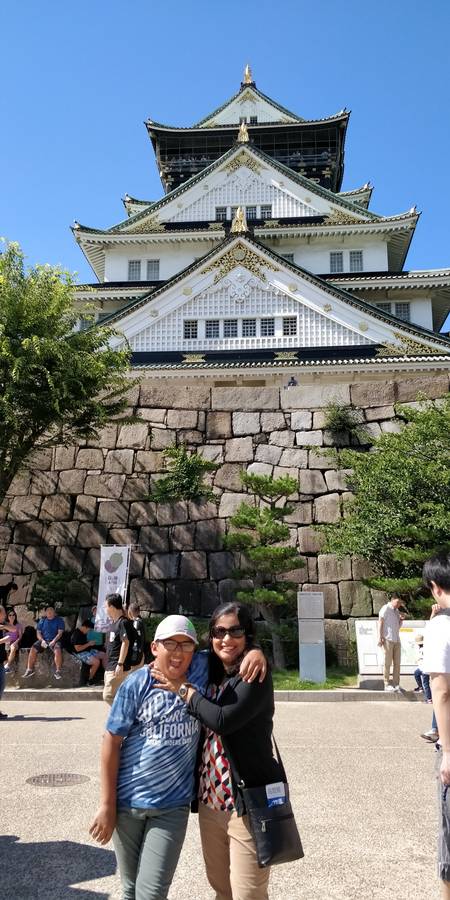
The sun came out for Osaka Castle, which is a 1997 concrete reconstruction of the castle that Toyotomi Hideyoshi began in 1583, with a museum and lifts inside. Purists sniff at the lifts. After the stairs at Himeji, our knees had no such objection.
Dotonbori at night
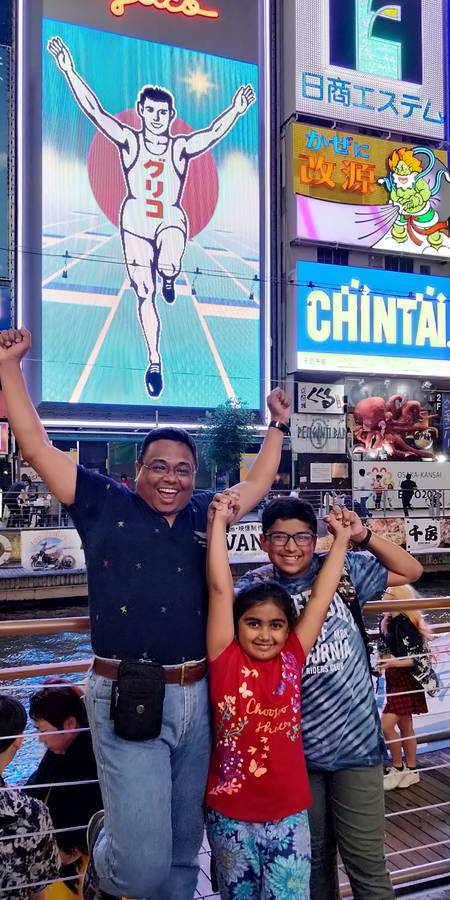
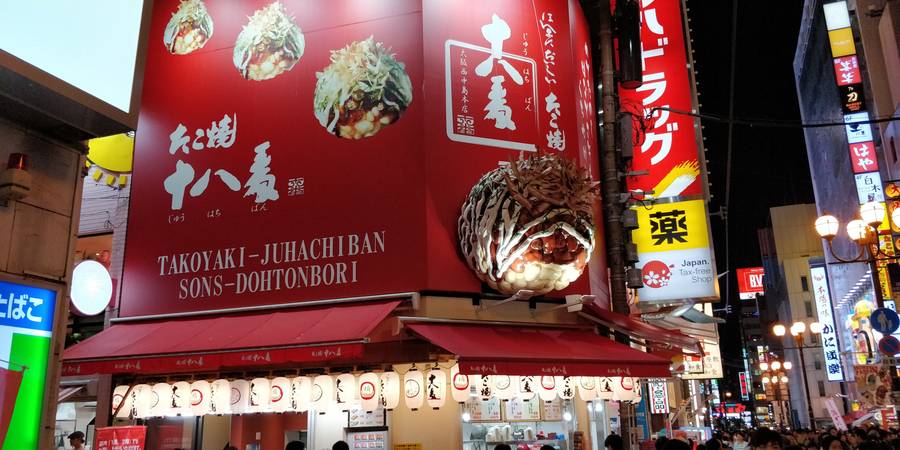
The evening was for Dotonbori, the canal-side street where Osaka goes to eat. The Glico running man glows over the bridge, a giant mechanical crab waves its legs over a restaurant door, an octopus advertises takoyaki, and the crowd moves slowly in every direction at once, which felt very much like home. We did the Glico pose. Everybody does the Glico pose.
Day 7 · 17 June — Deer With Manners, and a Very Large Buddha
Nara
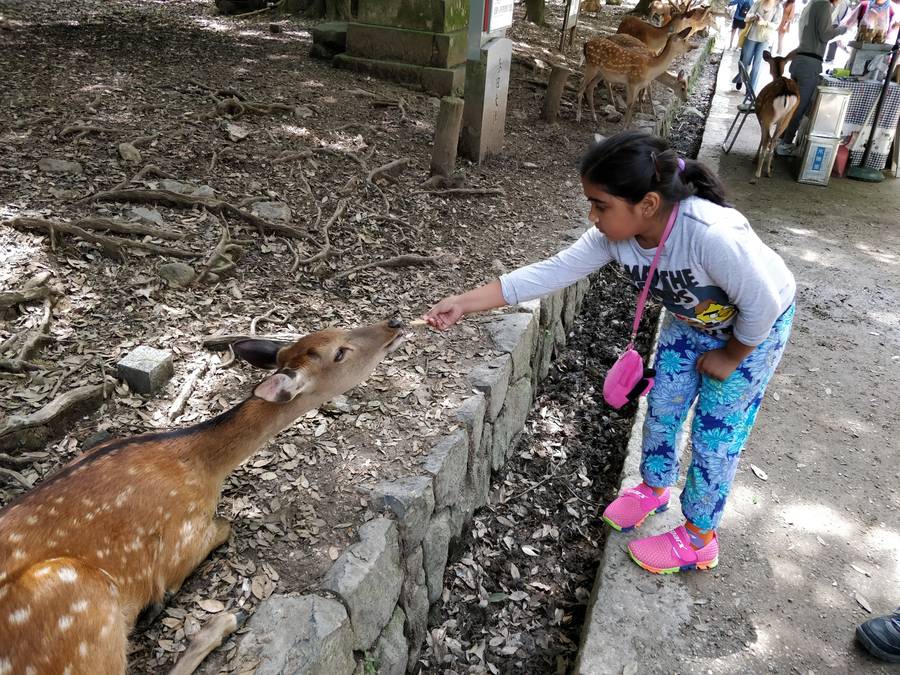
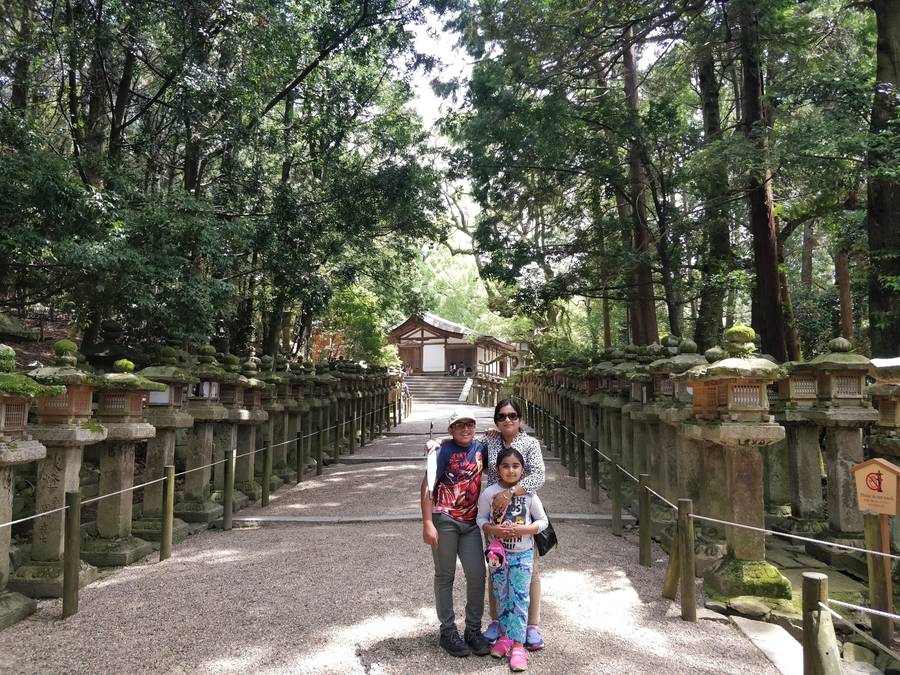
We left Osaka with our backpacks on and took the train to Nara, where the deer are as famous as the temples. There are more than a thousand of them in Nara Park, and they know exactly who is holding the deer crackers. Our daughter fed them one cracker at a time, with the seriousness of a bank officer handing out cash.
Todai-ji
Todai-ji’s Great Buddha Hall is one of those buildings that makes you check the scale twice. Inside sits the Daibutsu, a bronze Buddha nearly 15 metres high. Behind it is a wooden pillar with a hole at the bottom said to be the size of the Buddha’s nostril; squeeze through it and, the story goes, you are blessed with enlightenment in your next life. Our daughter made it through, and the photograph is the proof. The next life is sorted for at least one of us.
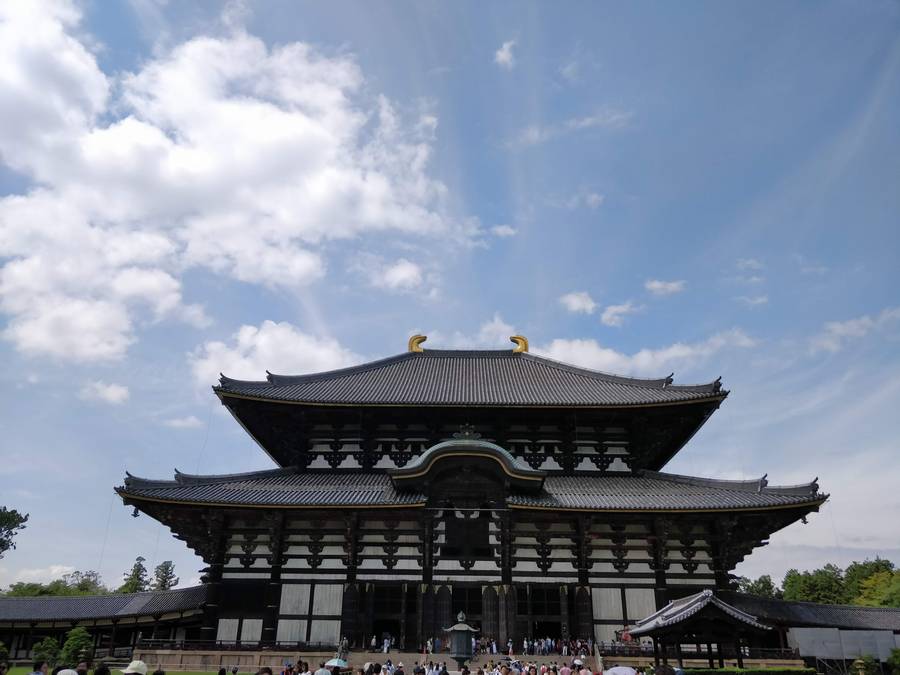
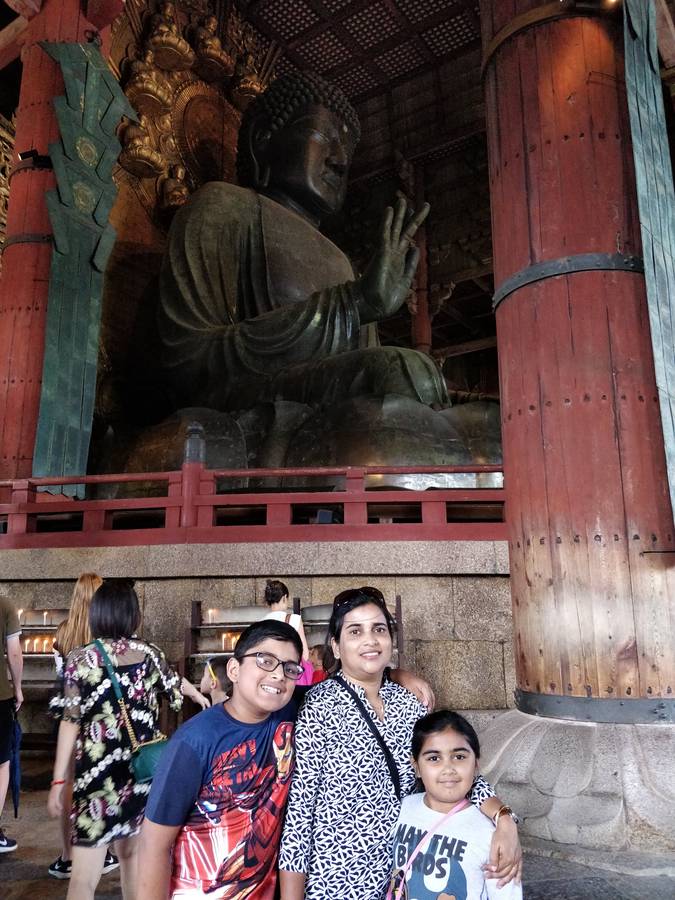
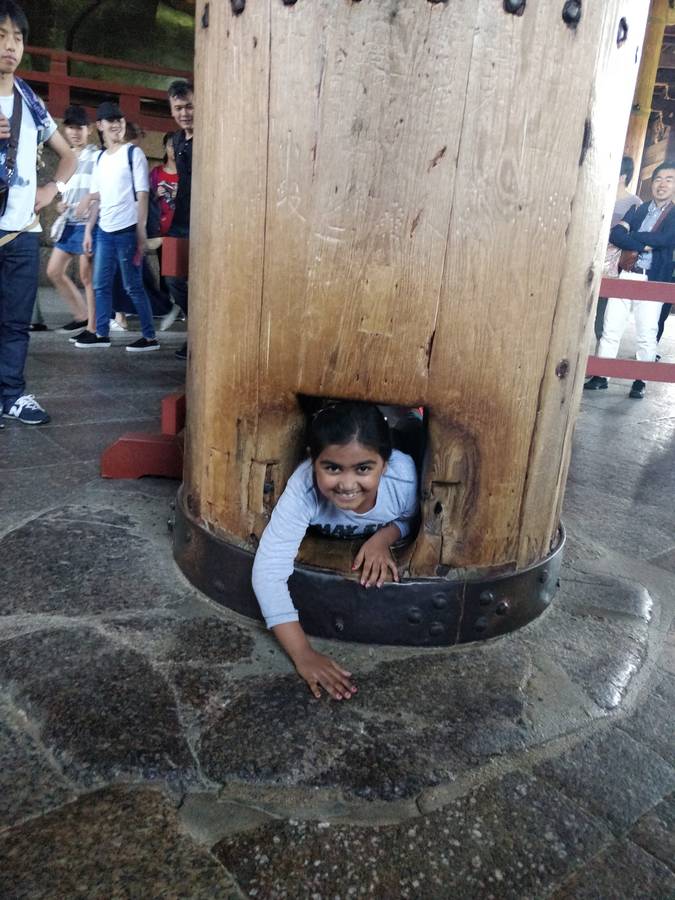
The Great Buddha weighs about 500 tonnes and is now 14.98 metres tall. The hall around it is 57 metres long, 50 metres wide and 49 metres high, and was the largest wooden building in the world until 1998. Even so, the present hall, finished in 1709, is about 30 per cent smaller than the one before it, because the money ran out. At the Nandaimon gate stand two guardian figures 8.5 metres tall, carved around the end of the 12th century by Unkei, Kaikei and their workshop. Todai-ji is part of the Historic Monuments of Ancient Nara World Heritage Site.
By late afternoon we were in Kyoto, at our home for the next three nights: RESI STAY Owan Hanami, an apartment-style hotel in the centre of the city with soft lighting, low wooden furniture and twin beds. Dinner was pizza, eaten in the room, with football on TV. We are not proud. We are not ashamed either.
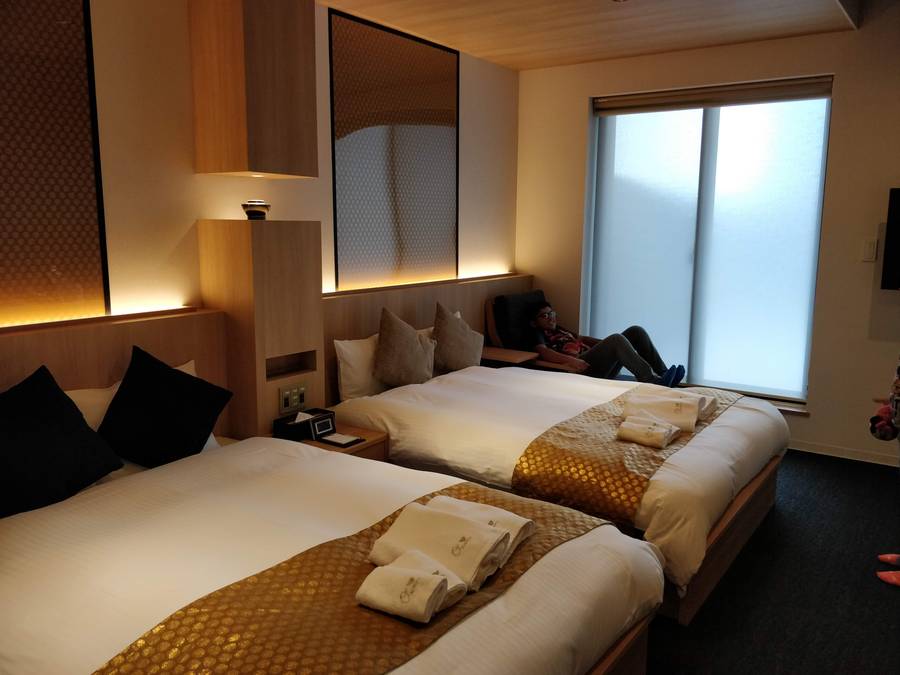
RESI STAY Owan Hanami, an apartment-style stay in central Kyoto, convenient for the buses to Nijo Castle and Kyoto Station. Ours had twin beds, a sitting area with a low table and sofas, and a TV. Clean, modern, and quiet, until the next morning.
Day 8 · 18 June — The Morning the Ground Moved
The alarm we did not set
At two minutes to eight the next morning the building shook so hard that we fell off the bed. That is not an exaggeration for comic effect; that is what happened. It was the most forceful thing any of us had ever felt. We waited until things were back to normal, and only then did we start the day.
The earthquake struck at 7:58 a.m. on 18 June 2018 with its centre in northern Osaka Prefecture: magnitude 6.1 on the Japan Meteorological Agency scale. In central Kyoto’s Nakagyo ward, where we were staying, and in Fushimi, where we went that day, the shaking registered 5+ on Japan’s shindo scale, which tops out at 7. Four people died, including a nine-year-old girl in Takatsuki killed by a collapsing wall on her way to school, and more than 400 were hurt. Trains across the region, the Shinkansen included, stopped during the morning rush and ran again about six hours later.
Fushimi Inari
The pass was no use that day, but Kyoto’s buses were running and by midday we were at Fushimi Inari, walking through the tunnels of vermilion torii that you have seen on a hundred screensavers. Each gate is donated by a business, with its name and date painted in black down the pillar, so the whole hillside is, in a way, a company directory. Very Japanese, very Kolkata Durga Puja sponsorship banner.
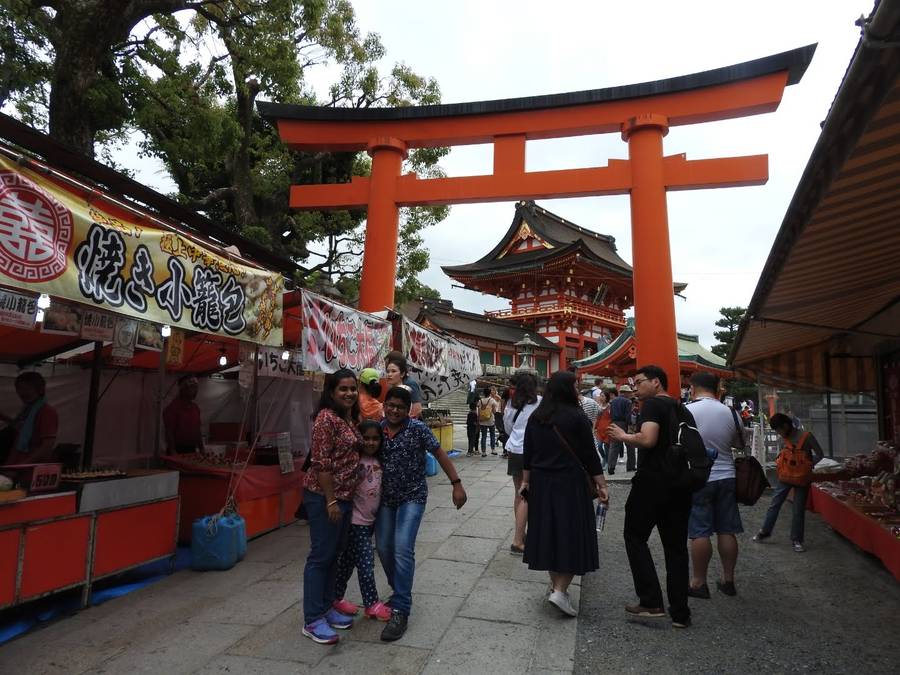
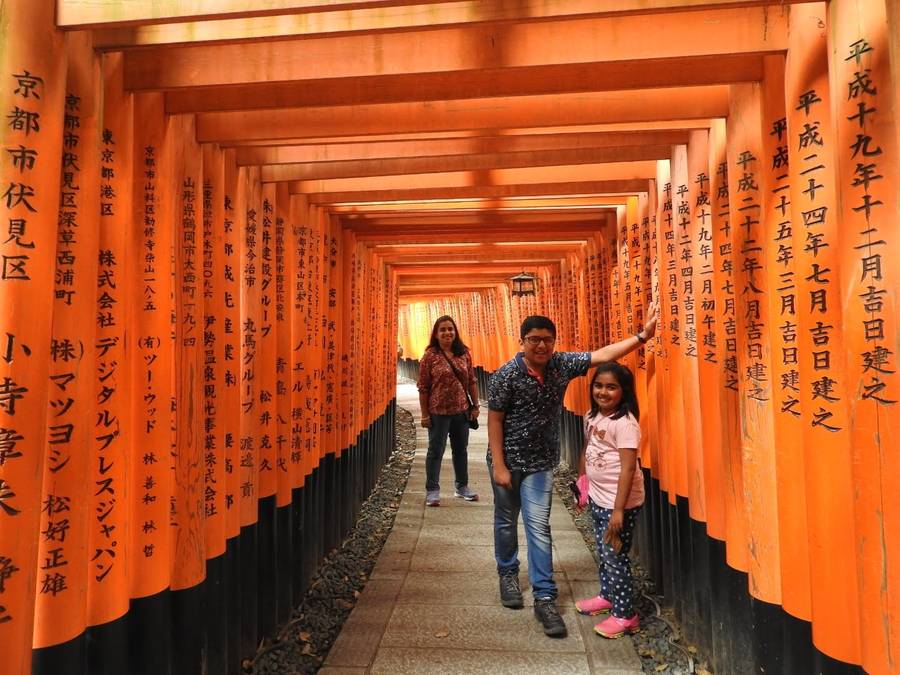
Founded in 711, Fushimi Inari is the head shrine of Inari, the god of rice and, these days, of business. There are about 10,000 torii on Mount Inari, around 800 of them in the Senbon Torii rows near the bottom. The trail to the top, 233 metres up, is about 4 km and takes around two hours. The foxes you see everywhere are Inari’s messengers, often carrying the key to the rice granary in their mouths.
Kiyomizu-dera
Kiyomizu-dera, high on the eastern hills, was half-hidden that summer. Its famous wooden stage was under scaffolding for a new roof. The view from beside it was still wide open: green hills, and the whole of Kyoto spread out below in the haze. We stopped at the Otowa waterfall, which falls in three streams, and at Jishu Shrine, the shrine for luck in love, where our daughter posed beside the statue with a lot of conviction.
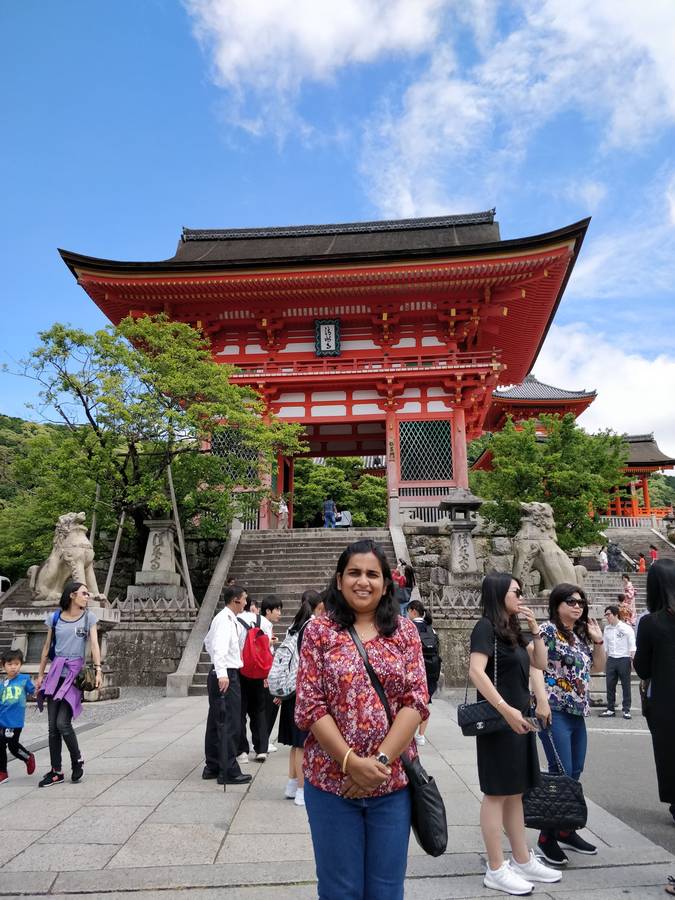
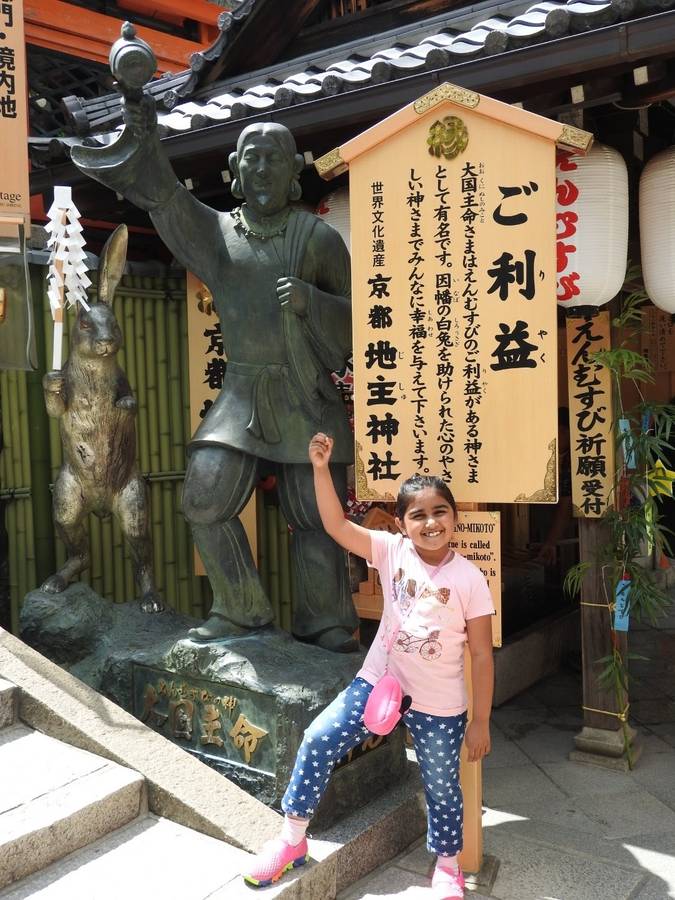
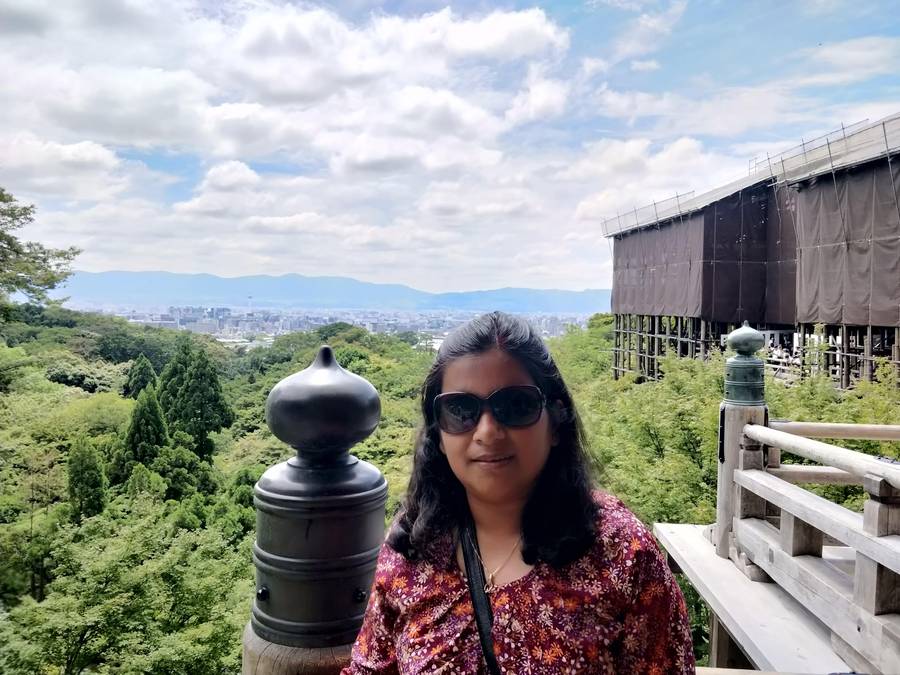
The temple dates from 778. Its main hall stands on a wooden stage about 13 metres above the slope, built without nails, and “to jump off the stage at Kiyomizu” is the Japanese way of saying “to take the plunge”. In the Edo period 234 people actually did, and about 85 per cent survived; the practice was banned in 1872. We saw the hall during its first full re-roofing in about 50 years, in hinoki cypress bark, which began in February 2017; the scaffolding came down in February 2020.
We walked down past Kodai-ji and its small bamboo grove, along the stone-paved Nene-no-Michi lane, and ended the day in the covered arcades of Teramachi and Nishiki Market, another market full of fresh, sharp smells, as pungent as Omicho.
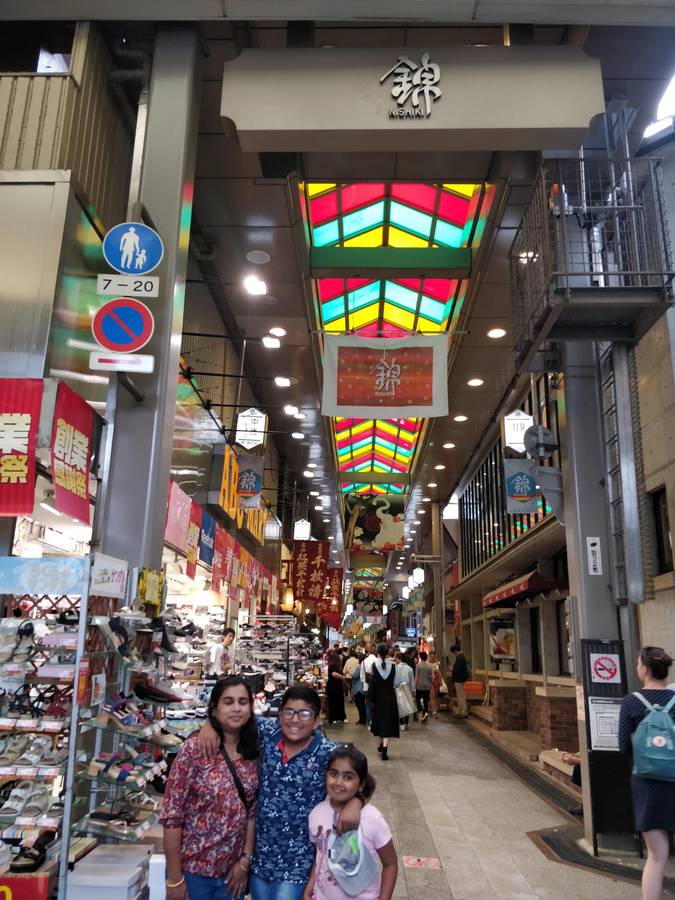
Day 9 · 19 June — Bamboo, Gold and a Castle That Squeaks
Arashiyama
A grey morning in Arashiyama on the western edge of Kyoto. We started in the garden of Tenryu-ji, which is ranked first among Kyoto’s five great Zen temples and has a pond garden laid out in the 14th century by the monk Muso Soseki. Then the bamboo grove, which is exactly as tall and green and hushed as the photographs promise, at least until the next tour group arrives. We finished at the Togetsukyo bridge over the river.
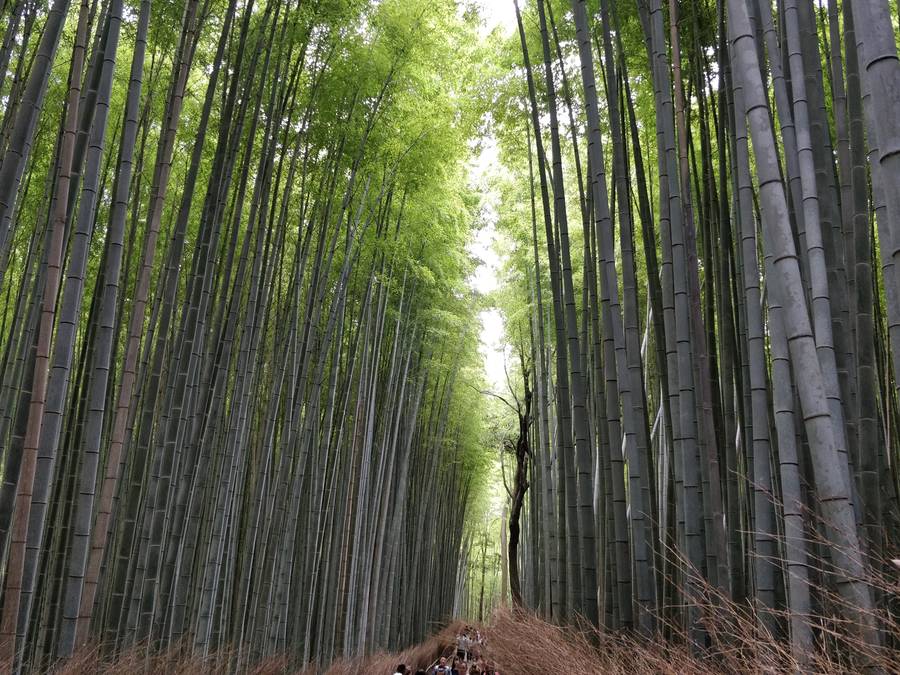
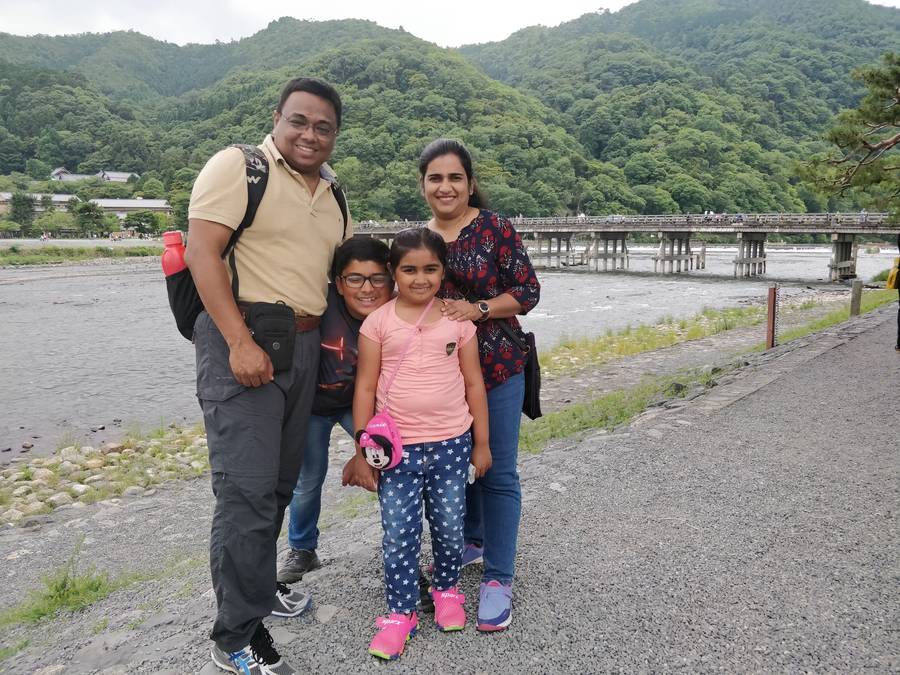
Kinkaku-ji
A taxi took us to Kinkaku-ji, the Golden Pavilion, gleaming across its pond even on a grey day. Here we had our celebrity moment: an older couple came up and asked, very politely, if they could take a photograph with us. We said yes, of course. We still don’t know why. Perhaps it was the kids, perhaps the Indian family abroad is a sight in itself. We have decided to treat it as fame.
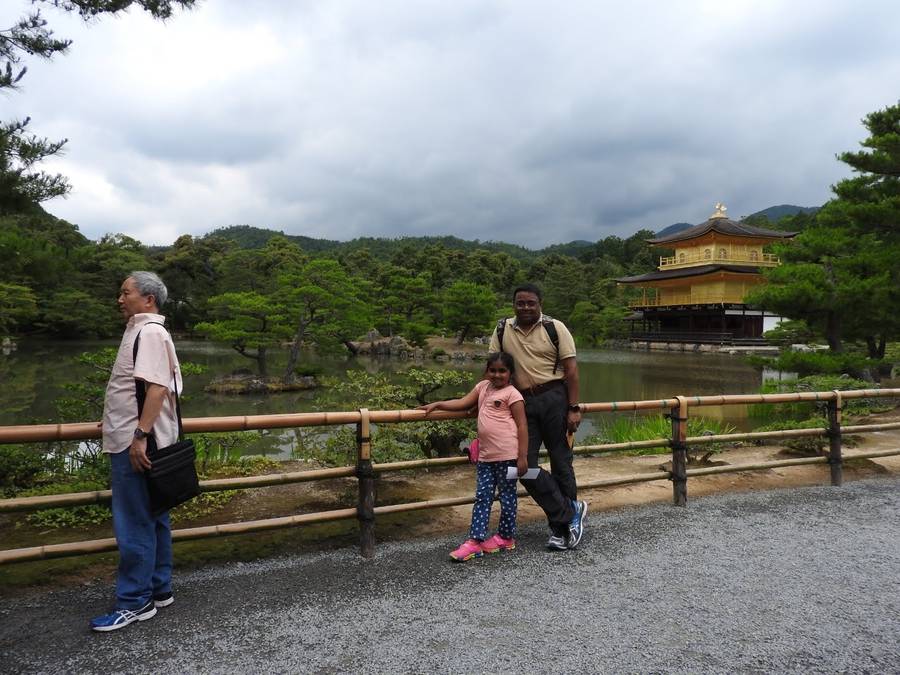
The Golden Pavilion was built around 1399 for the shogun Ashikaga Yoshimitsu. In 1950 a young novice monk burned it down, and the building you see today dates from 1955; its gold leaf was replaced in 1986–87 with leaf five times thicker than the original. Nijo Castle was begun in 1601 on the orders of Tokugawa Ieyasu, and it was in its Ninomaru Palace in 1867 that the last shogun announced the return of power to the Emperor. The palace corridors have “nightingale floors” that chirp as you walk on them. Both are part of the Historic Monuments of Ancient Kyoto World Heritage Site, with Tenryu-ji and Kiyomizu-dera.
Nijo Castle
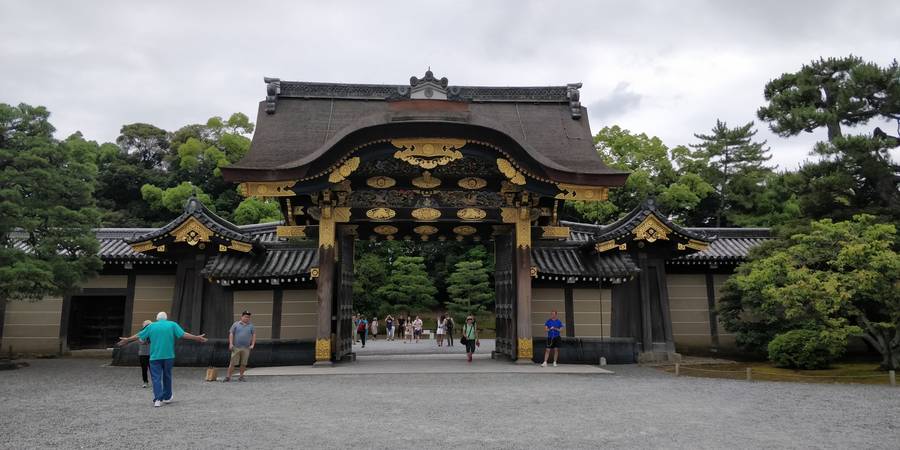
Nijo Castle was close to our stay, so we finished there in the afternoon: the gilded Karamon gate, the palace with its chirping floors, and a garden of rocks and pines around a pond. Four hundred years ago the shogun had a burglar alarm made of floorboards; we were impressed.
Day 10 · 20 June — Mount Fuji Is Shy
The longest footbridge, and the missing mountain
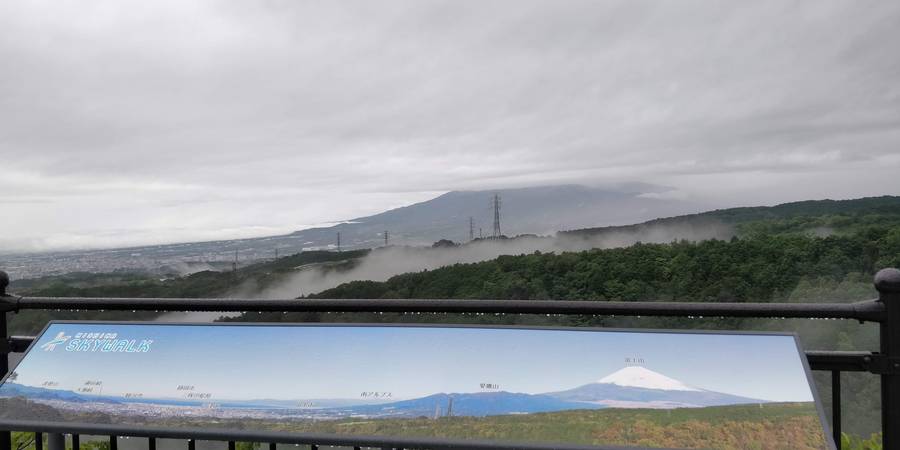
We were out of the Kyoto stay before seven, on the bus to the station and a Shinkansen to Mishima. It rained all day. The plan was the Mishima Skywalk, a long suspension footbridge with a famous view of Mount Fuji. The bridge was there, swaying gently in the rain. Fuji was not. The information board at the viewing deck showed us exactly what we were missing: a perfect snowy cone over a clear sky, painted on a sign, in front of a wall of cloud. Mount Fuji, we learned, is like a Bollywood star in the monsoon. It might come, it might not, and nobody can tell you in advance.
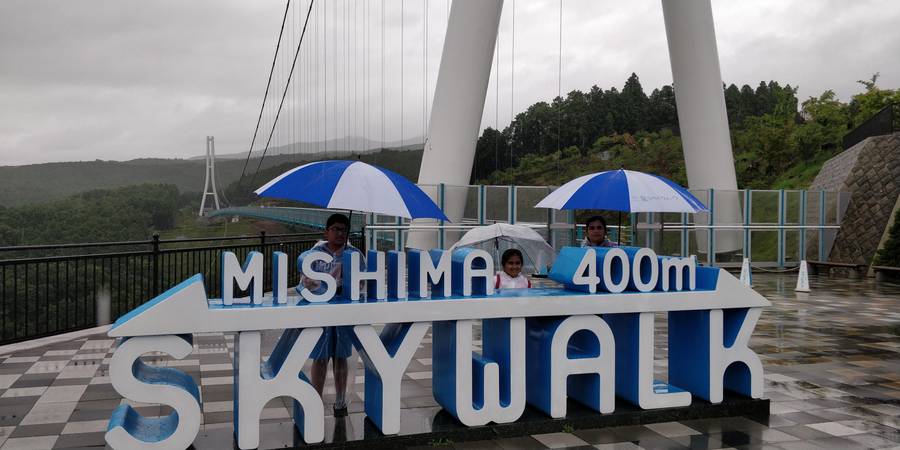
Opened in December 2015, the Mishima Skywalk is 400 metres long and the longest suspension footbridge in Japan. On a clear day it looks across to Mount Fuji, Japan’s highest mountain, and down to Suruga Bay, Japan’s deepest. We can confirm the bridge.
Pirates on Lake Ashi
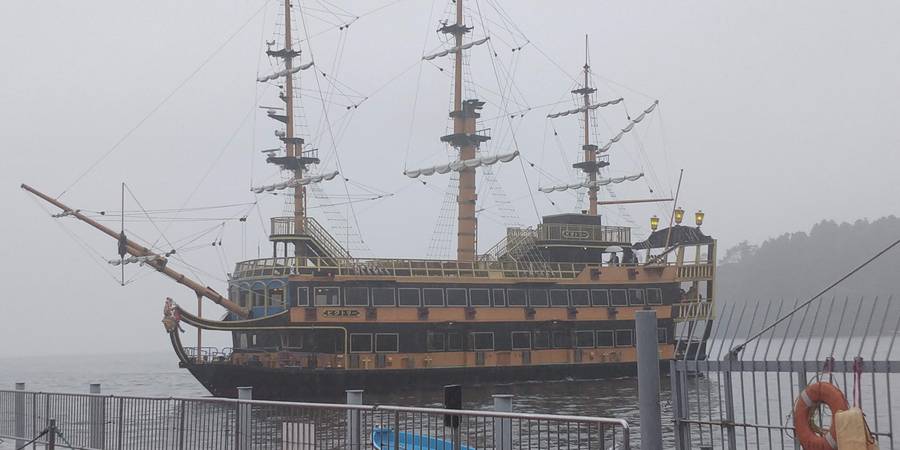
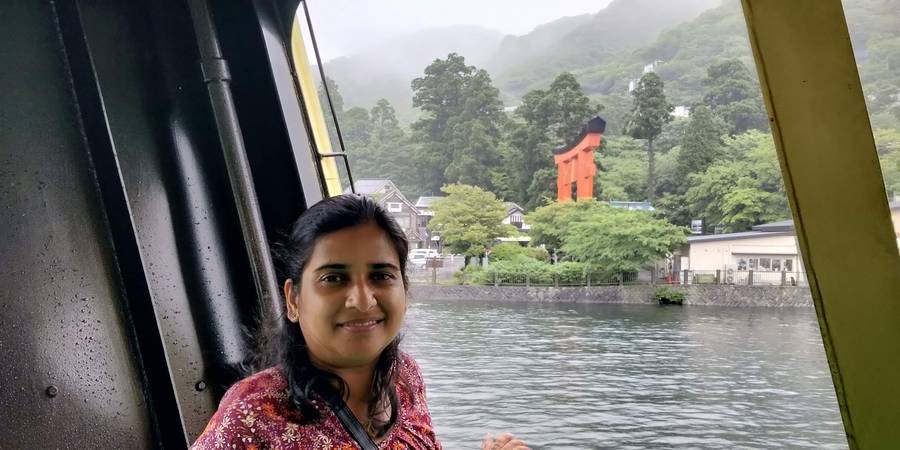
A bus took us up into Hakone and down to Lake Ashi, where the sightseeing boats are built as pirate ships, with masts, rigging and gilded figureheads. In the fog, with rain on the decks, they looked properly mysterious. On board, the kids found a treasure chest, and from the window we saw the red torii of Hakone Shrine standing at the edge of the water.
Owakudani and a night in a ryokan
From Togendai the ropeway climbed into the cloud to Owakudani, where the volcano is still steaming and the air smells of sulphur. The local speciality is eggs boiled in the hot springs until their shells turn black; eating one is said to add seven years to your life. We stood next to the giant black egg for the photo, in the fog, looking pleased with our extra years.
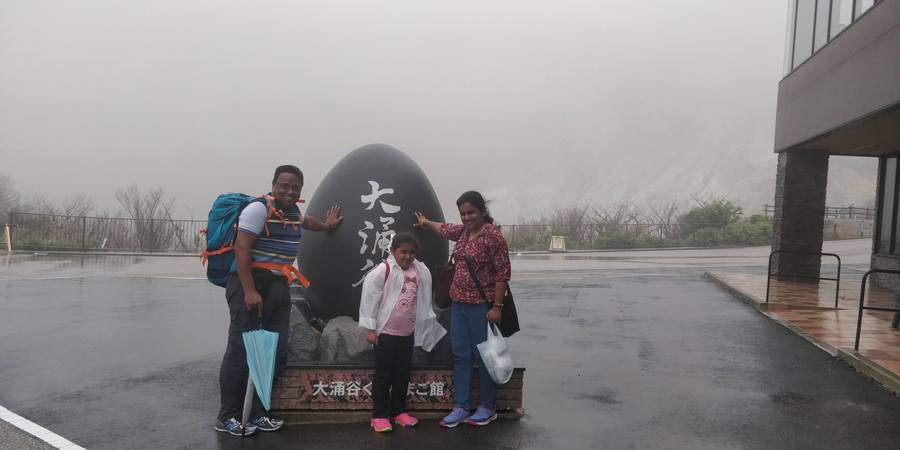
Owakudani, the “great boiling valley”, was formed about 3,000 years ago by an eruption of the Hakone volcano. The sulphur in the hot springs is what turns the eggshells black. The area was closed in 2015 because of volcanic activity and partly reopened in April 2016, with the trail to the vents still shut.
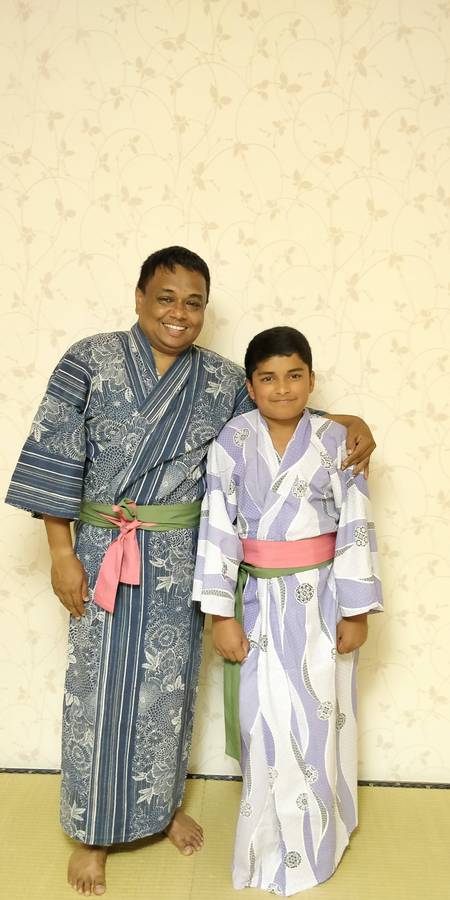
The ropeway and a cable car took us down towards Gora and our ryokan for the night: tatami rooms, a low table, green tea and cotton yukata. The kids wrestled on the tatami, which is what tatami is clearly for. At night the futons came out and covered the whole floor.
Day 11 · 21 June — Hydrangeas, an Island and Another Buddha
The hydrangea train
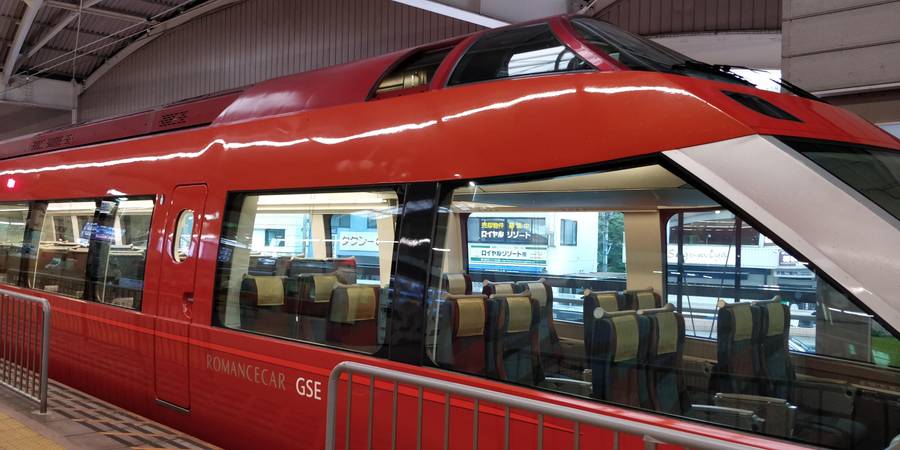
Early in the morning the little red Hakone Tozan train took us down the mountain, zigzagging on switchbacks, past hedges of blue, pink and purple hydrangeas brushing the windows. We had arrived in exactly the right week. At Hakone-Yumoto the platform gave us one more train to admire: a brand-new Odakyu Romancecar GSE in red, with a glass observation lounge at the front.
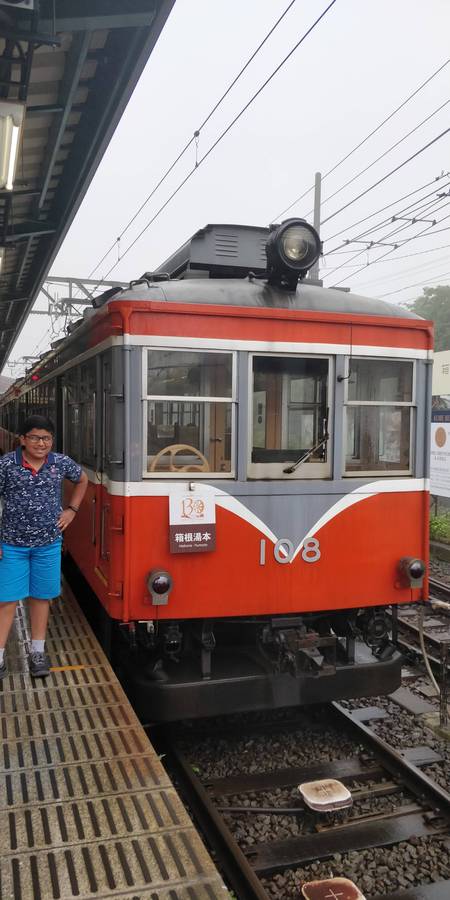
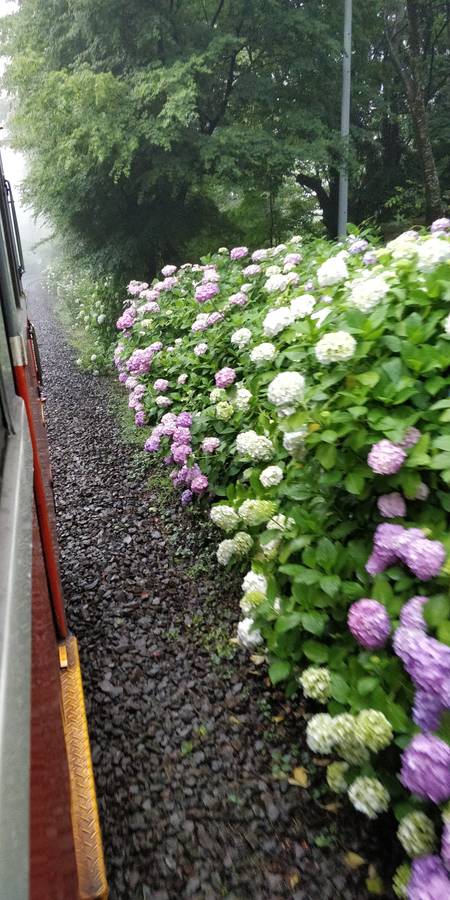
The mountain section of the Hakone Tozan line, from Hakone-Yumoto to Gora, opened in 1919 and climbs gradients of up to 8 per cent, steep enough that the train reverses up the hill at switchbacks. Around 10,000 hydrangeas grow along the line, blooming from mid-June into July and moving up the mountain as the season goes on. The red Romancecar we saw was the Odakyu 70000 series GSE, “Graceful Super Express”. The first train entered service on 17 March 2018 and the second only on 11 July, so the one we saw on 21 June was the only one there was.
Enoshima
Via Odawara and Fujisawa we reached the coast and walked across the long bridge to Enoshima, a small green island in a grey sea. At the shrine there was a big ring woven from grass to walk through: the chinowa, put up in June for the summer purification, to clear away the first half of the year’s bad luck. We walked through it, given the week we were having. From the Sea Candle, the observation lighthouse at the top of the island, we looked back along the coast towards Kamakura.
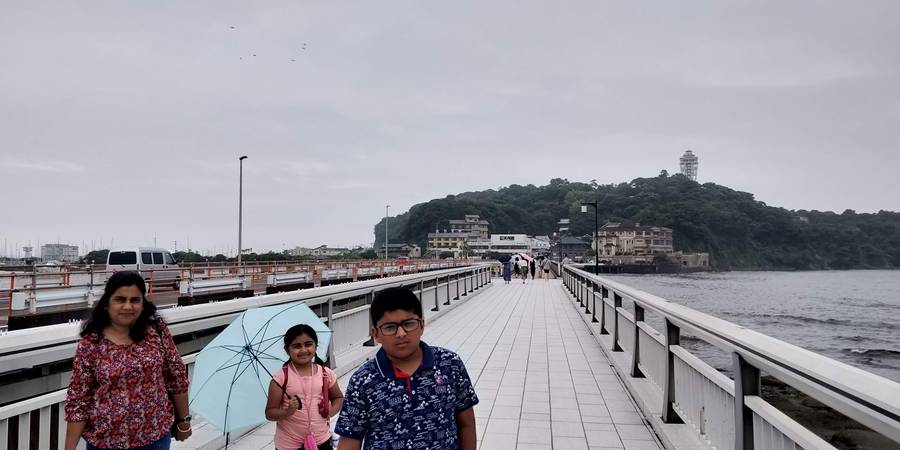
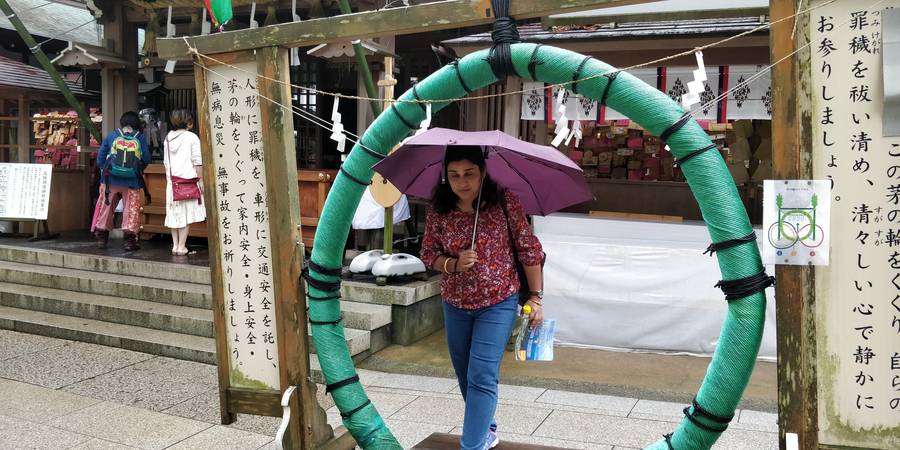
The island is about 4 km round and is joined to the mainland by a bridge of 389 metres. The whole island is dedicated to Benzaiten, the goddess of music and the arts. Enoshima was the sailing venue for the 1964 Tokyo Olympics, and again for the 2020 Games.
Kamakura
The little Enoden train ran along the coast to Hase, for Hase-dera. The temple is known for its hydrangeas, but what stays with you are the rows and rows of small stone Jizo statues. Each one has been placed by parents in memory of a child they lost, and some wear knitted red caps. We went into the Benten-kutsu cave, low and candlelit, with figures carved into the rock. Then up the road to the Great Buddha of Kamakura, sitting in the open air, as he has done since a tsunami took his hall away in 1498.
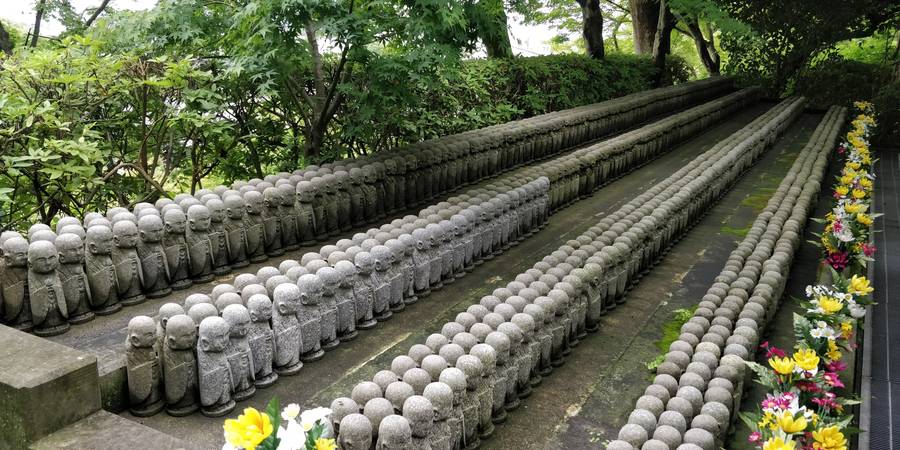
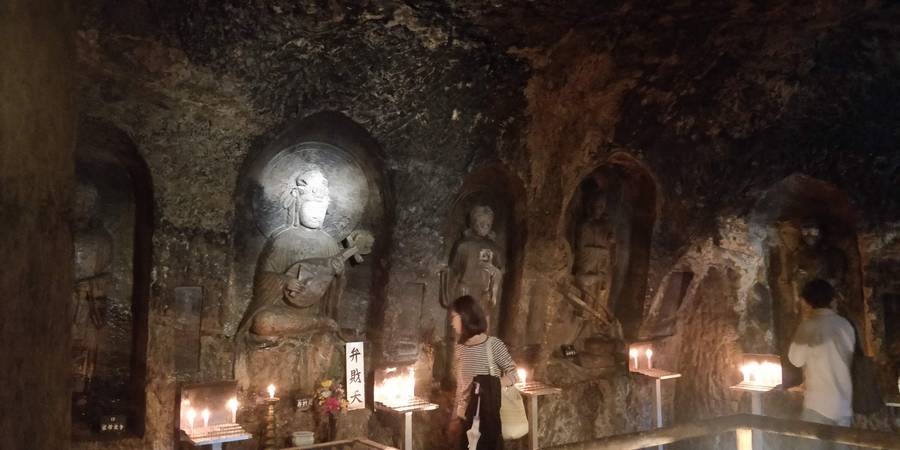
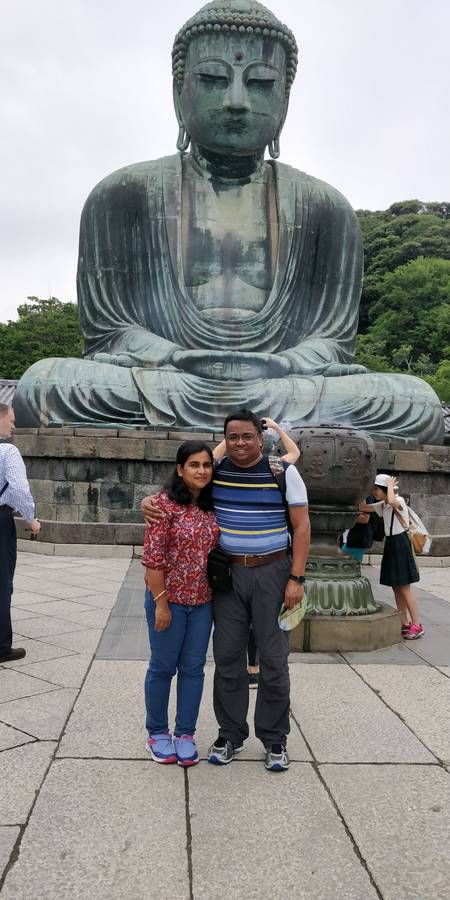
The Kamakura Daibutsu at Kotoku-in was cast around 1252. It is 13.35 metres tall including its base, hollow, and you can go inside. Its hall was washed away by the tsunami of 1498, and it has sat outside ever since. Hase-dera’s main hall holds an eleven-headed Kannon, about 9 metres tall, carved in camphor and gilded. Some 50,000 Jizo statues have been placed at the temple since the Second World War.
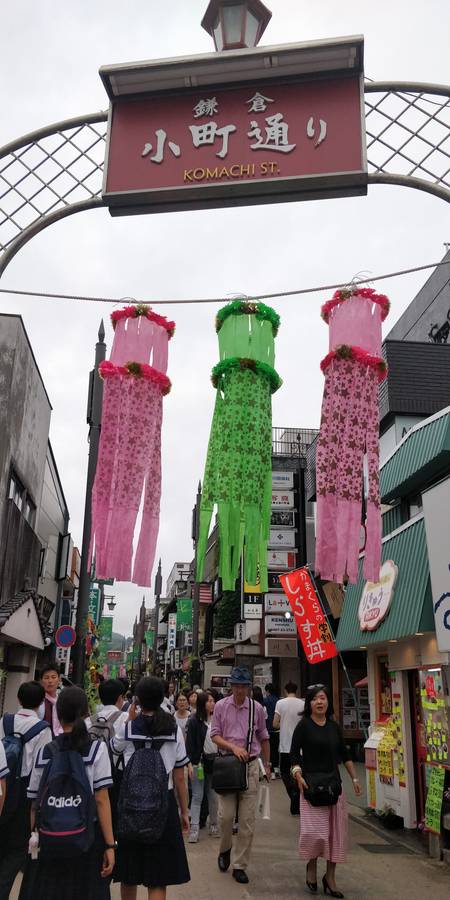
We finished on Komachi-dori, with Tanabata streamers already hanging over the shopping street, and at Tsurugaoka Hachimangu, before a train back to Tokyo.
Day 12 · 22 June — Matsushima, and Jets We Did Not Order
The fastest of them all
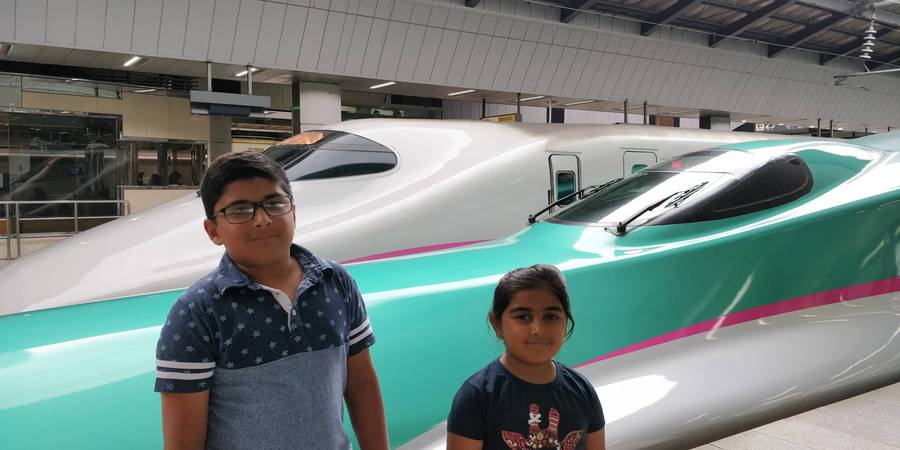
For the last day of the trip we saved the most impressive-looking train: the green-and-white E5 of the Tohoku Shinkansen, the train that runs the Hayabusa services, with a nose longer than most cars. Hayabusa trains run at up to 320 km/h, the fastest of any train we saw on the trip. Delhi to Agra at that speed would take under forty minutes. Do not tell Indian Railways; they will want to know how.
Matsushima Bay, with an air show
From Sendai a local train took us to Matsushima, a bay full of small islands covered in pines, the second of the Three Views of Japan on this trip. We took a sightseeing cruise among the islands, and just as the cruise was setting off, six jets came out of the sky in tight formation, trailing white smoke, and looped over the bay. It was the Blue Impulse, the aerobatic team of the Japan Air Self-Defense Force, whose home base is Matsushima Air Base, just along the coast. We had not planned it, we had not known about it, and it was the best free show of the trip. Paisa vasool, and then some.
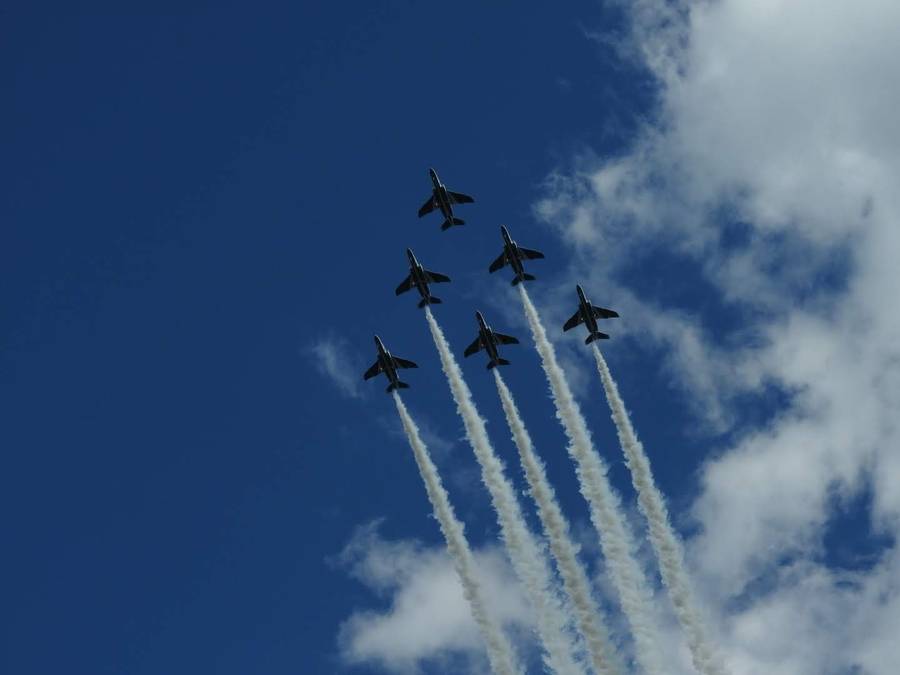
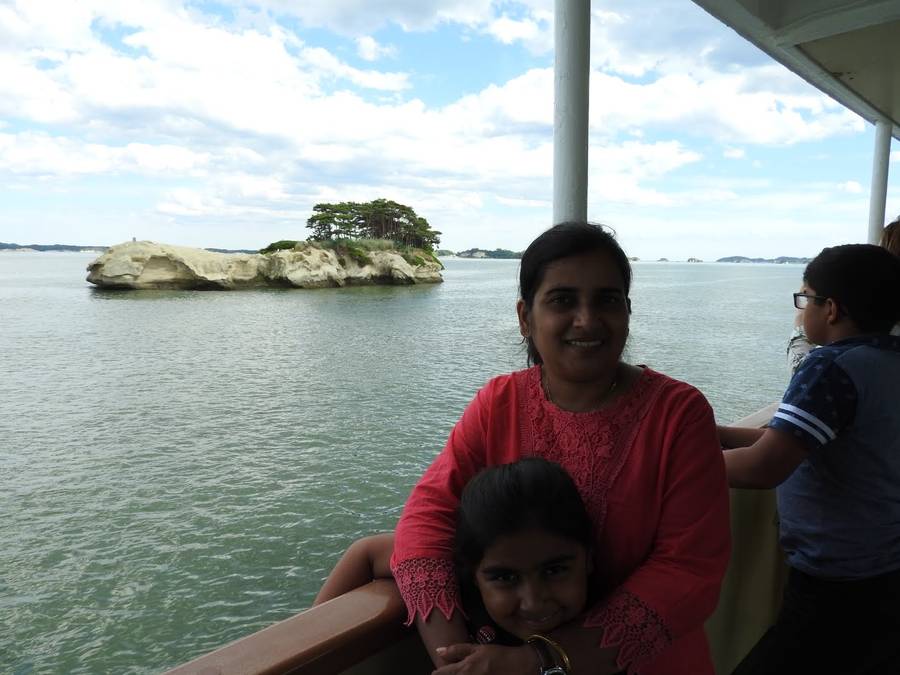
Matsushima Bay has about 260 small islands covered in pines, and with Miyajima and Amanohashidate it is one of the Three Views of Japan. During the 2011 tsunami the islands broke the force of the wave, and the town suffered relatively little damage. Blue Impulse was formed in 1960, painted the Olympic rings in the sky over Tokyo in 1964, and has flown the Kawasaki T-4 since 1995. The tsunami badly damaged its home at Matsushima Air Base; the team happened to be away in Kyushu that day, and only came home in March 2013.
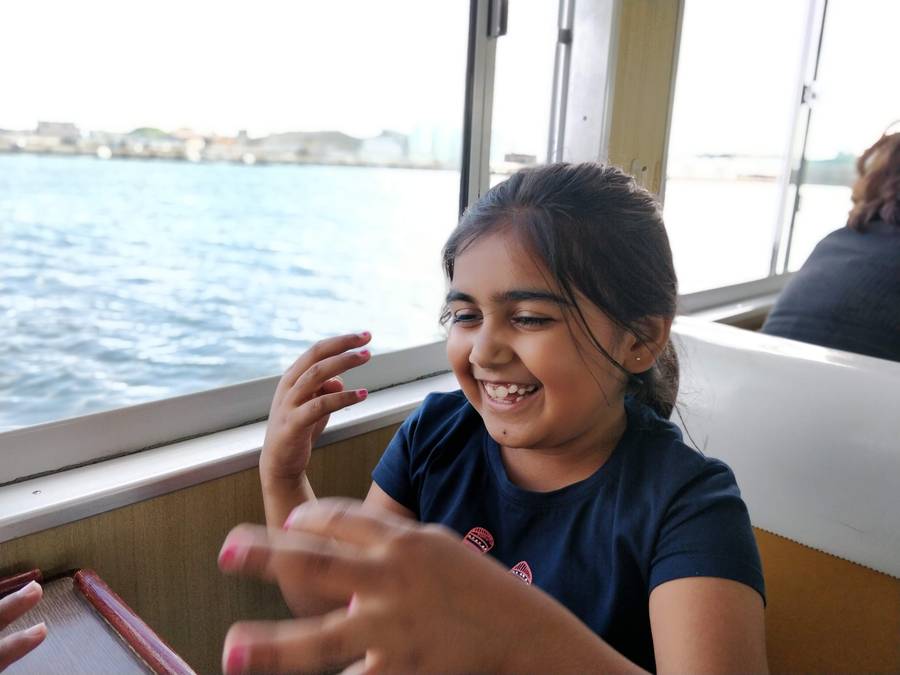
The cruise brought us round to Shiogama, and the kids spent the last part of it at a table by the window, playing a hand game and laughing. Then a train to Sendai, one last Shinkansen, and Tokyo by evening.
Bullet trains: the verdict
We went to Japan for the temples, castles and gardens, and we saw them, but if you ask the four of us what we remember, the trains come first: the noses, the silence, the way they arrive at exactly the second printed on the ticket, the staff who bow to the carriage when they leave it, the seats that turn round so the family can sit facing each other. From the E7 to Nagano to the E5 to Sendai, the kids collected trains the way some children collect stamps. For a family raised on Indian Railways, the bullet train was the real tourist attraction.
| Day | Route | Night |
|---|---|---|
| 11 Jun | Tokyo – Nagano – Alpine Route – Toyama – Kanazawa | Kanazawa |
| 12 Jun | Kanazawa: Omicho, Nagamachi, Kenroku-en, castle | Kanazawa |
| 13 Jun | Kanazawa – Osaka – Himeji – Okayama – Hiroshima | Hiroshima |
| 14 Jun | Miyajima – Osaka (Shinsekai) | Osaka |
| 15 Jun | Universal Studios Japan | Osaka |
| 16 Jun | Kaiyukan, Osaka Castle, Dotonbori | Osaka |
| 17 Jun | Nara – Kyoto | Kyoto |
| 18 Jun | Earthquake; Fushimi Inari, Kiyomizu-dera, Nishiki | Kyoto |
| 19 Jun | Arashiyama, Kinkaku-ji, Nijo Castle | Kyoto |
| 20 Jun | Kyoto – Mishima – Lake Ashi – Owakudani | Hakone |
| 21 Jun | Hakone – Enoshima – Kamakura – Tokyo | Tokyo |
| 22 Jun | Tokyo – Sendai – Matsushima – Tokyo | Tokyo |