We come from a country with a famously generous supply of gods, so we assumed a trip to Greece would be a quick courtesy call on the neighbours. It turned out the Greek gods were not only still in residence, they had better PR. The places, the photographs and the facts here are real, and every number was checked against a source. The jokes are ours, and the immortals have so far declined to comment.
The briefing
Ten of us made the trip: the Bose family (Niladri, Priyanka, Saswat and Kyna), the Majumdars (Saibal, Ritisha and Shreyan) and the Valloors (John, Archana and Joshua). This was the first leg of a longer European trip, with Italy and Istanbul to follow, so Greece got six days and a lot of walking.
The plan was simple. Three nights in Athens, two on the island of Santorini, and one more night in Athens before an early flight west. We would walk everything we could. In Athens that is easy, and we were helped by two things: a walking route I had found on YouTube, and a free audio guide we used on the first full day to follow a set route past the major sights. Between them they covered the major sights, and I recommend both to anyone with a pair of legs and a phone.
Being from the land of Hindu gods, I also arrived with a theory, which was that a country of twelve Olympians would be a gentler challenge than a country with a god for every occasion. The theory held up. The Olympians are well organised, well documented and mostly in marble, and they live on a very walkable hill.
Santorini was split two ways, on purpose. One group, the Boses and the Majumdars, took the ferry out and the plane back. The Valloors did it the other way round. That way the family got to try both, and the budget was kind to us: the ferry people carried the luggage, and the plane people took one small bag each. Small bags are what the cheap airline fares are for, so the flights came to about €40 a seat. The deck-lounge ferry seats cost roughly €20 to €25 a head. I count this as a deal worthy of Hermes, who is the god of travellers, merchants and, as far as I am concerned, discount fares.
| Group | To Santorini, 6 June | Back to Athens, 8 June |
|---|---|---|
| Bose and Majumdar | Blue Star Ferries, Piraeus 07:25 to 14:50 | Volotea flight, 12:00 |
| Valloor | Volotea flight, 12:00 | Blue Star Ferries, 15:30 to 23:15 |
- 3 to 6 June Athens: Day in Athens apartments, Ermou area
- 6 June Piraeus: the ferry to Santorini
- 6 June Athinios port, then up to the caldera rim
- 6 to 8 June Fira and Firostefani: Katerina Kafieri Apartments
- 7 June Oia, by public bus
- 7 June Perissa black-sand beach, by public bus
| Where | Where we slept | Nights |
|---|---|---|
| Athens | Day in Athens, apartments right in the centre | 3 (3 to 6 June) |
| Santorini | Katerina Kafieri Apartments, Firostefani | 2 (6 to 8 June) |
| Athens | Day in Athens again | 1 (8 to 9 June) |
Day 1: Saturday 3 June. Delhi to Athens, by way of Hermes
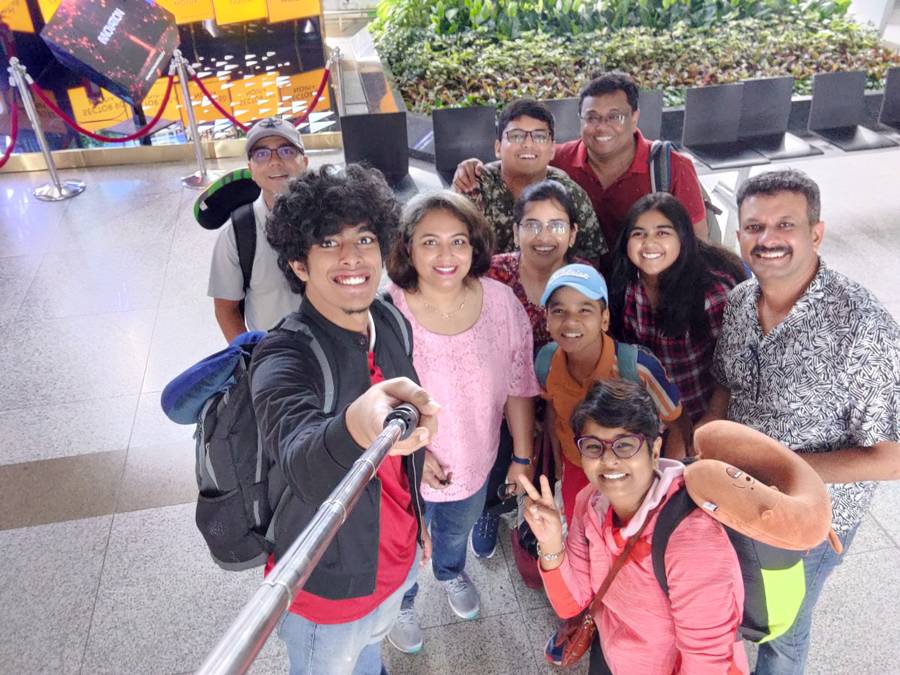
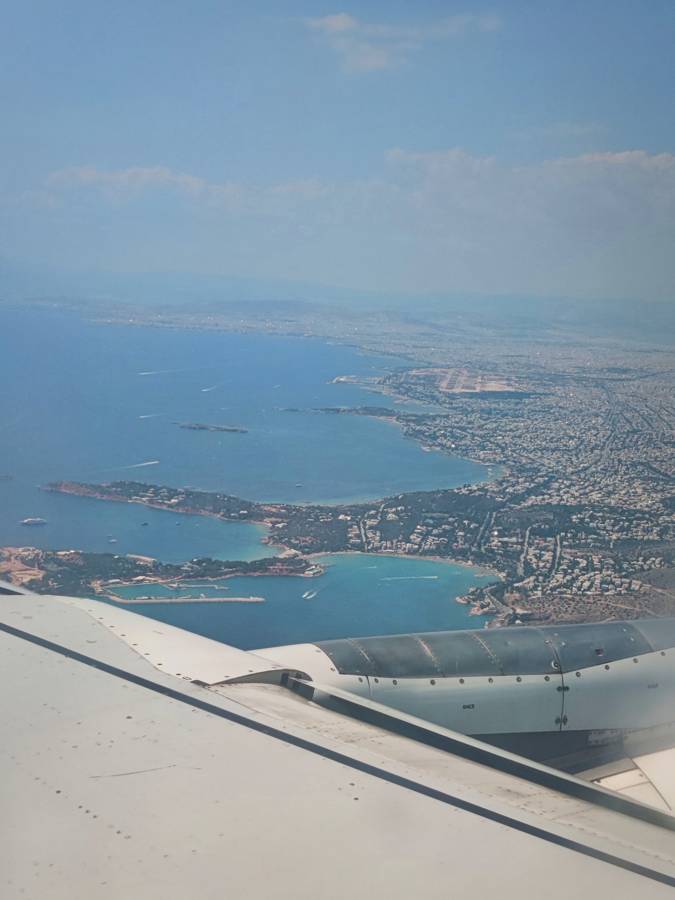
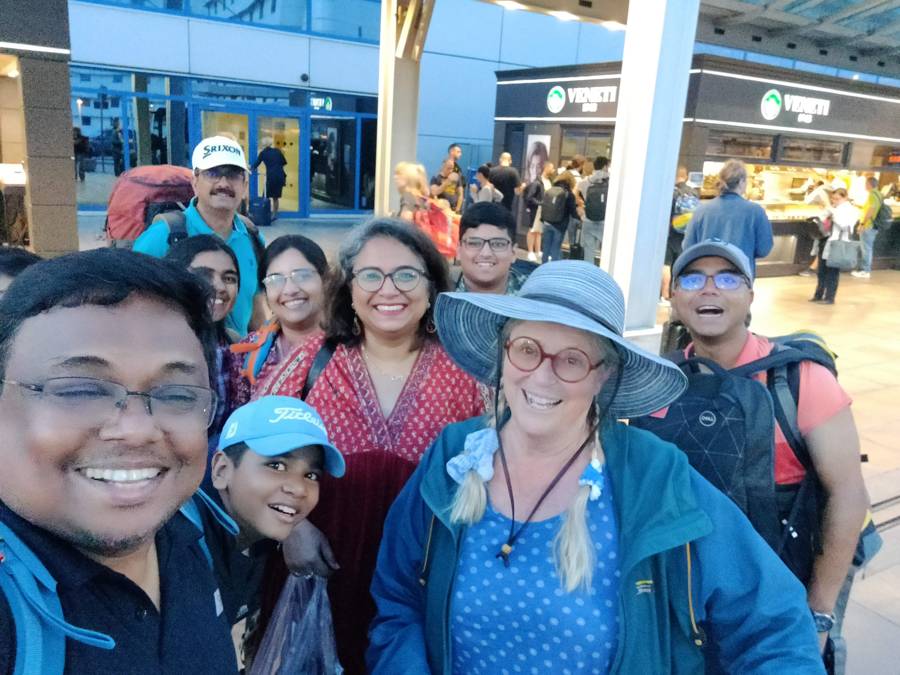
Our day began before the sun did, with a selfie at Delhi airport that has the look of people who have been told a lot of things about Europe. Then Turkish Airlines took us to Istanbul, and on the next flight to Athens, where the window gave us the first sight of the Athenian coast and a wing that looked very pleased with itself.
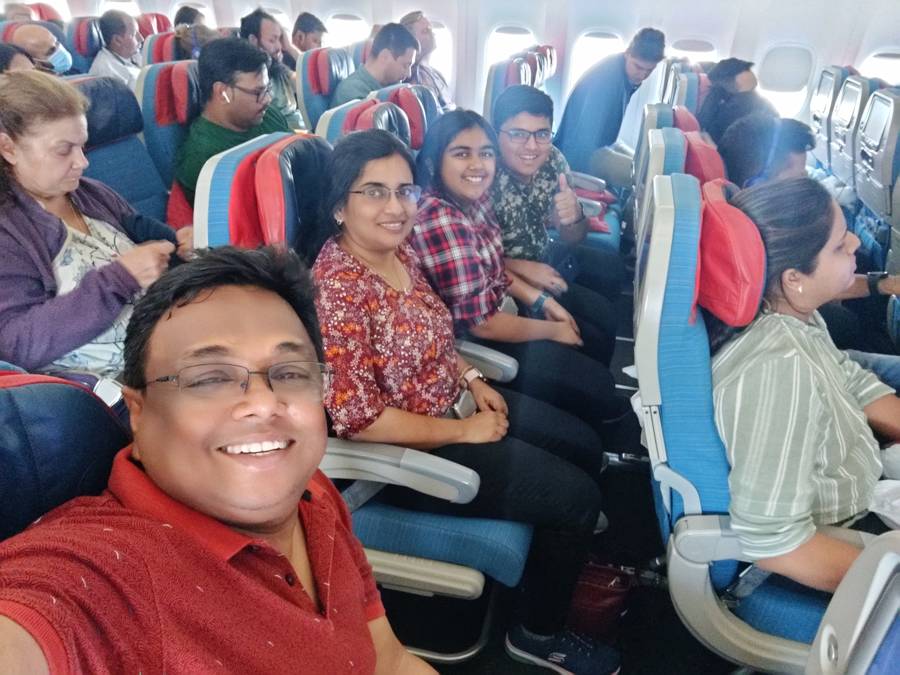
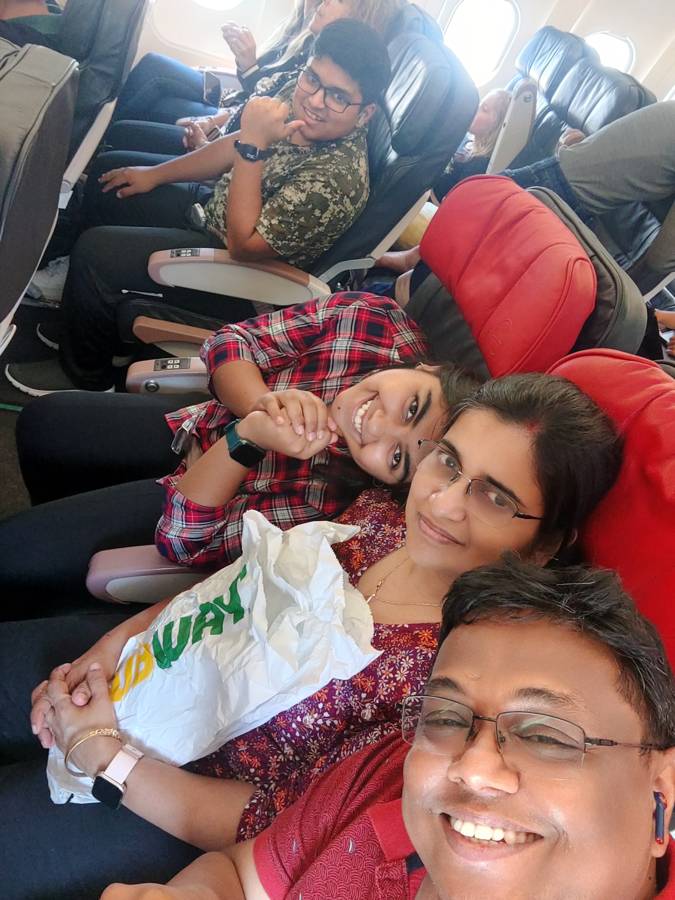
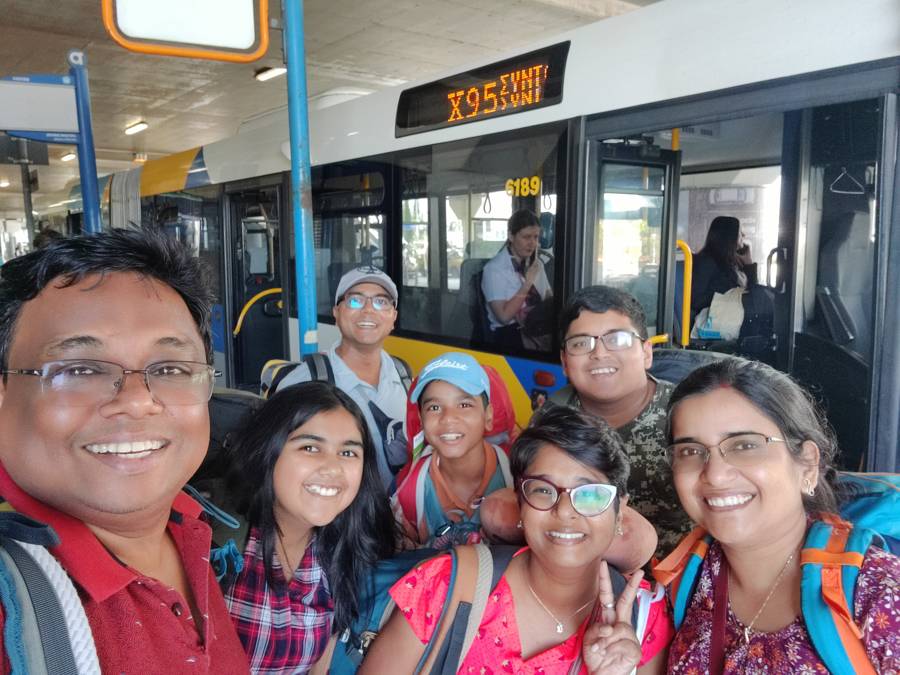
From the airport we took the X95 express bus into town. It runs straight from the airport to the centre, and it gave the whole group a chance to sit with our backpacks on and take a first look at Athens.
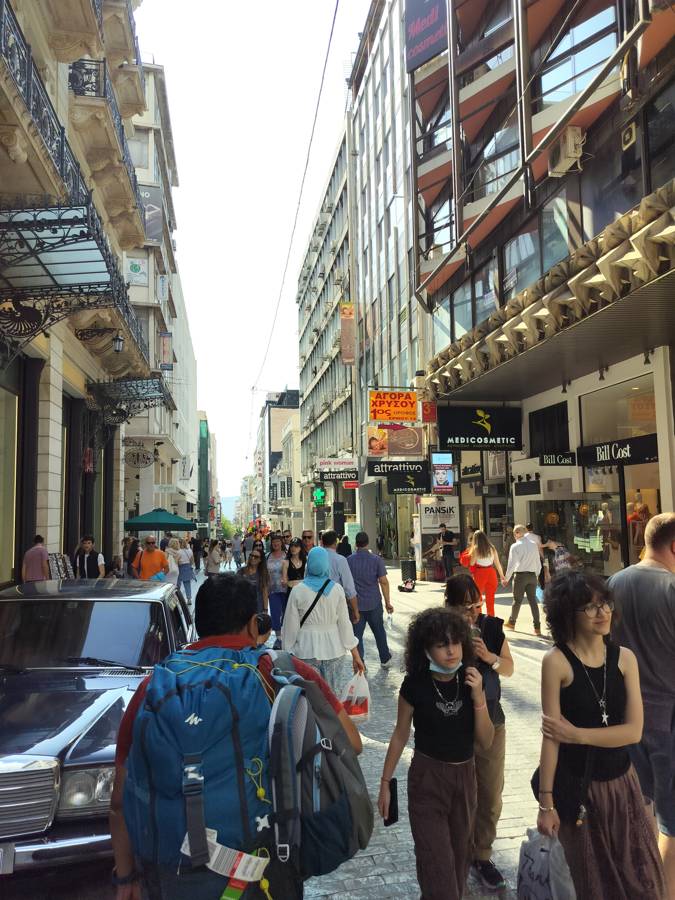
Our apartments were in Ermou, right in the middle of the old city, and it is hard to overstate how good that was. Ermou is a long pedestrian shopping street that runs from the foot of the Acropolis to Syntagma Square, and for the next days almost everything we wanted to see was a walk away. That is not a figure of speech: we covered nearly all of Athens on foot.
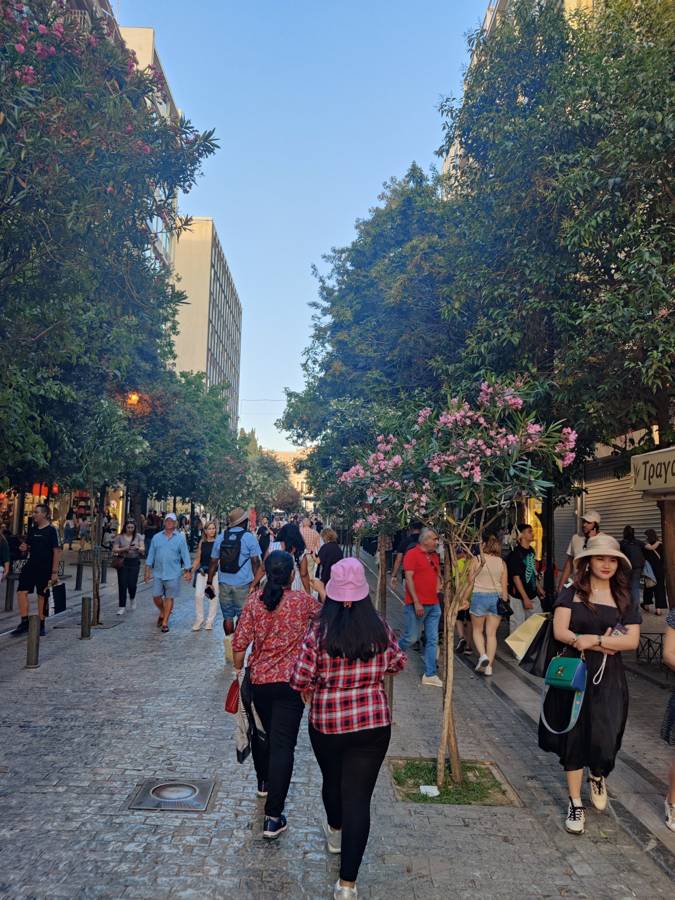
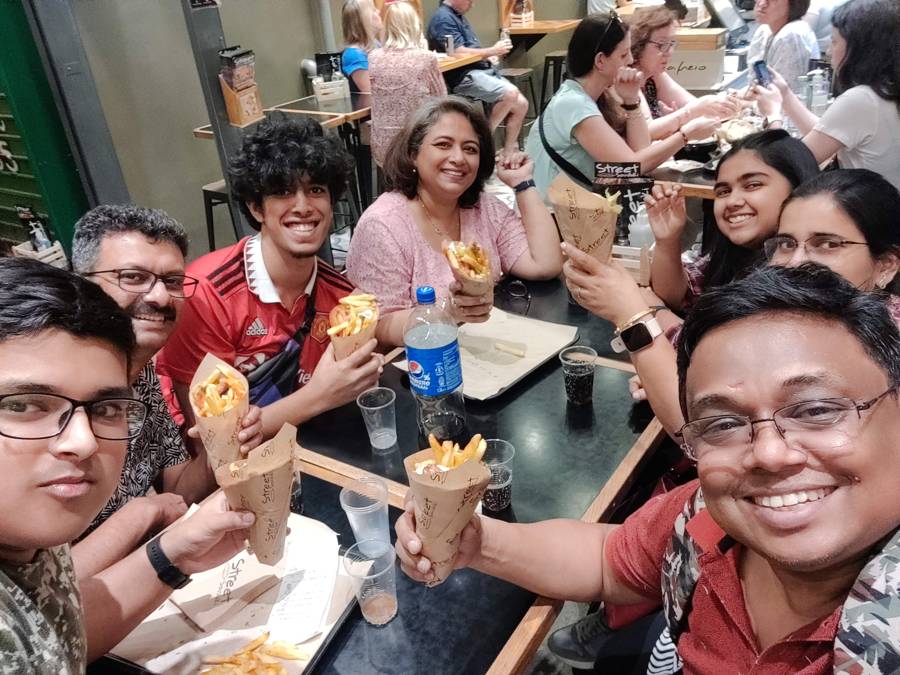
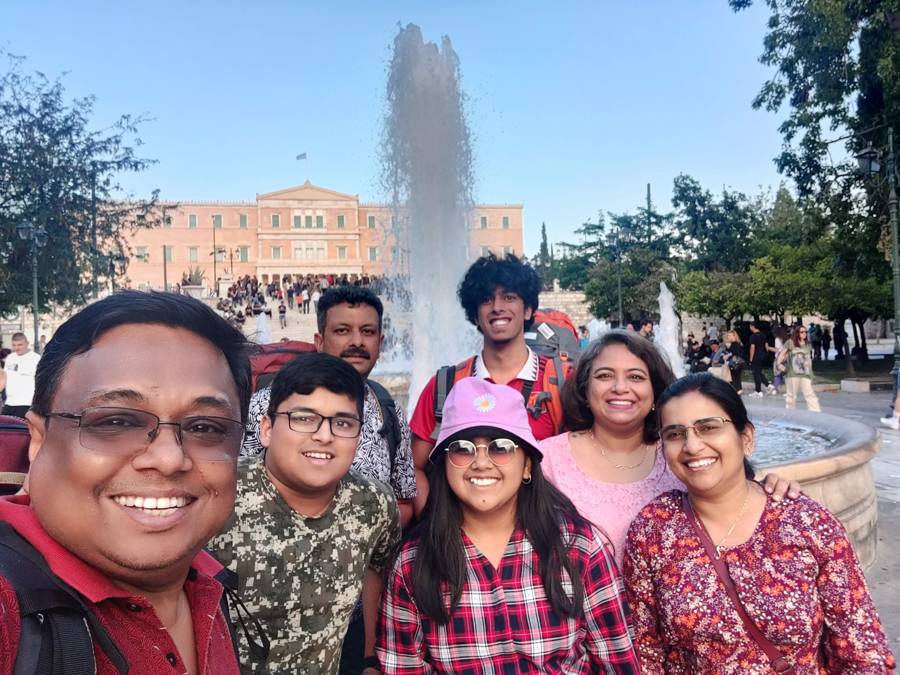
The evening was a gentle first walk: down a street of pink-flowering trees to Syntagma Square, where the fountain, the sky and the Hellenic Parliament put on a very good show. Dinner was gyros at Street Souvlaki on Kolokotroni Street, served in paper cones with fries on top, which is how you celebrate surviving two flights. It was so good that we came back to the same place for our last night in Athens.
Day 2: Sunday 4 June. The audio-guide walk and the home of Zeus
Day two was the big Athens day, and we put a free audio guide to work from the start, following a set route that took us past the major places in an order that made sense. If you have never walked a city with a voice in your ear telling you what the stones used to be, I recommend it. The YouTube walking route did the same job on the other days.
Plaka, the cathedral and the oldest house
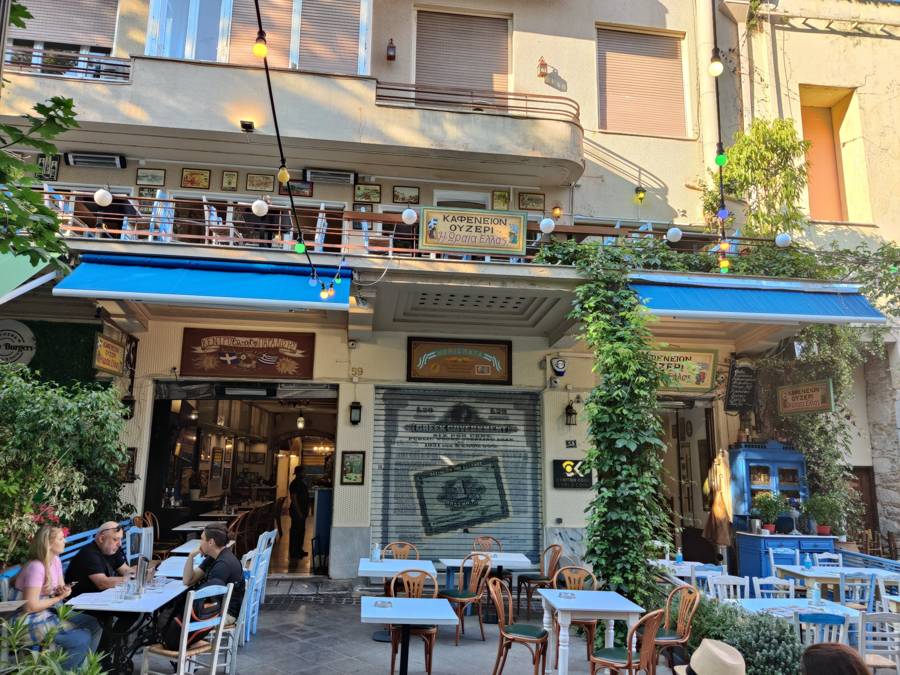
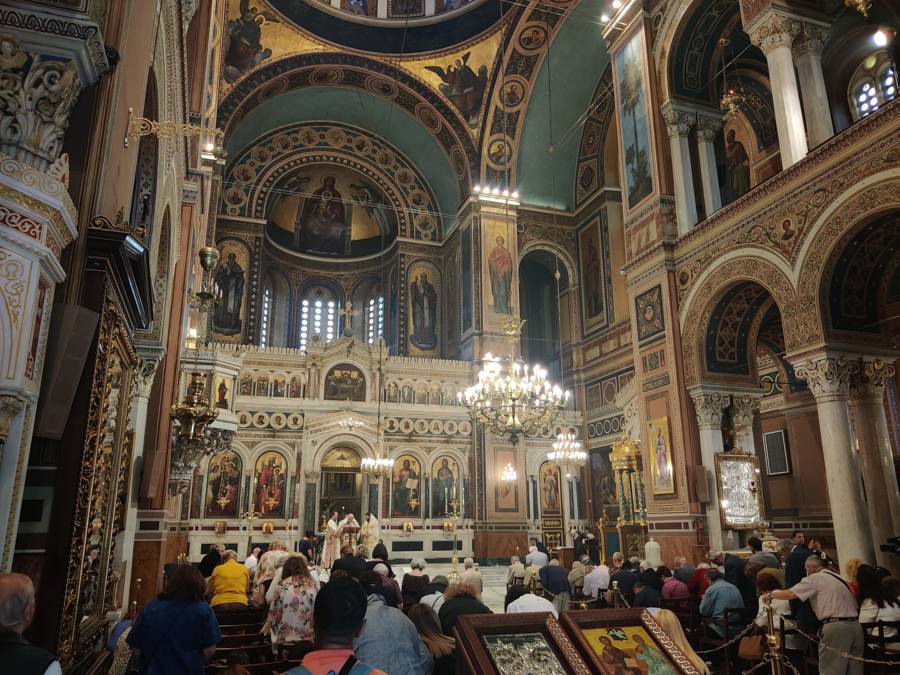
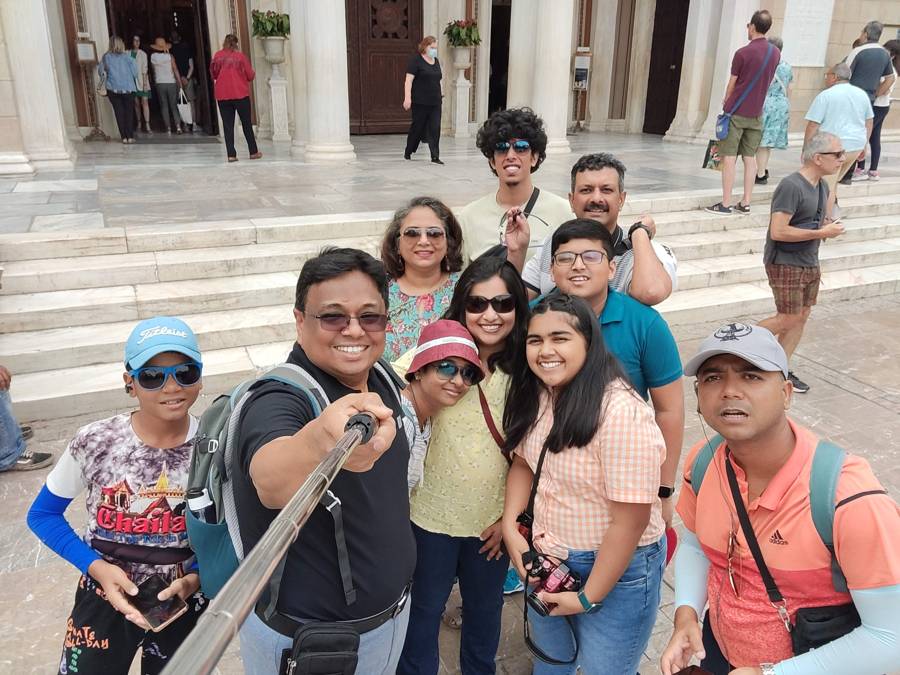
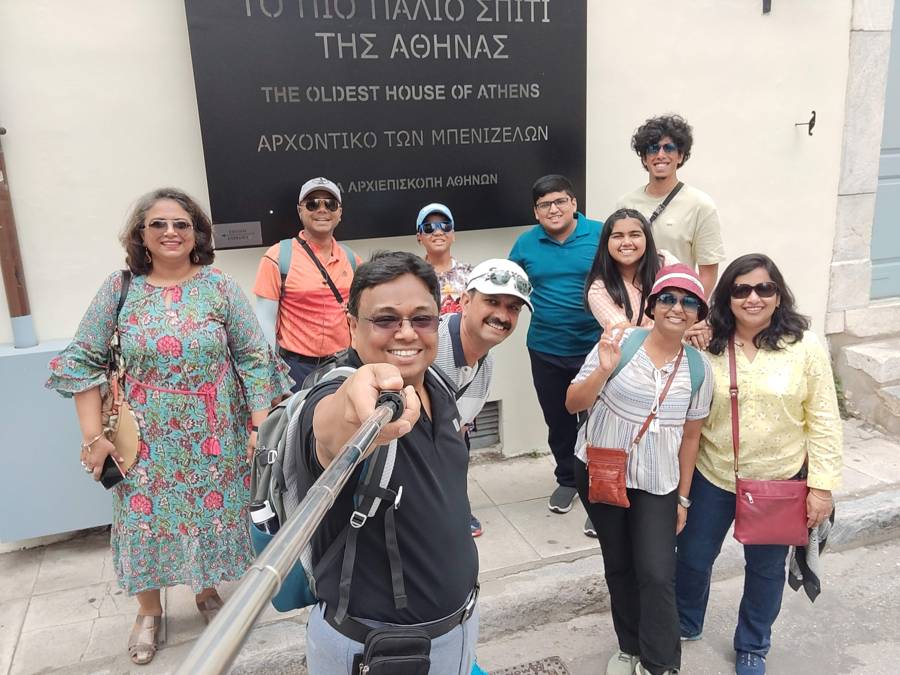
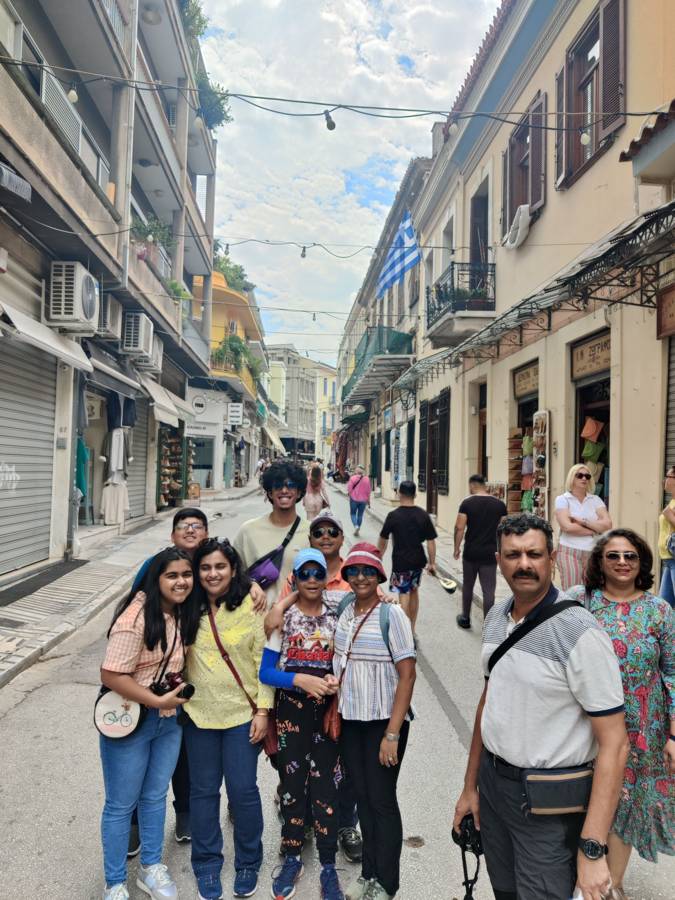
We started early, in the old quarter of Plaka, on a street of cafés waking up for breakfast. It was a Sunday, and the Metropolitan Cathedral was full of people, in a church that glows gold from the inside. The cathedral was built in the mid-19th century, so by Athens standards it is practically new. Not far away is a house with a sign that claims to be the oldest house of Athens, which is a bold boast in a city that counts its history in thousands of years.
The Roman Agora, and the ticket that does seven sites
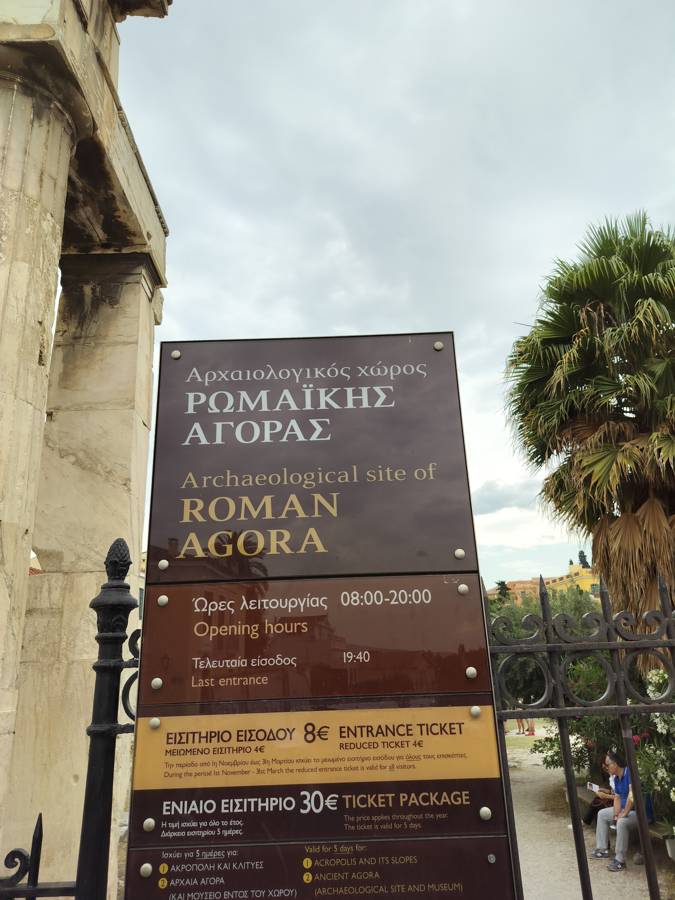
Our next stop was the Roman Agora, where a sign by the gate gave us the useful news. A single ticket was €8, but a combined ticket was €30 and covered seven sites: the Acropolis and its slopes, the Ancient Agora, the Roman Agora, Hadrian’s Library, the Olympieion, the Kerameikos and Aristotle’s Lyceum. We had bought the combined tickets in advance. Each site can be visited once, so a combined ticket is a promise that you will do a lot of walking.
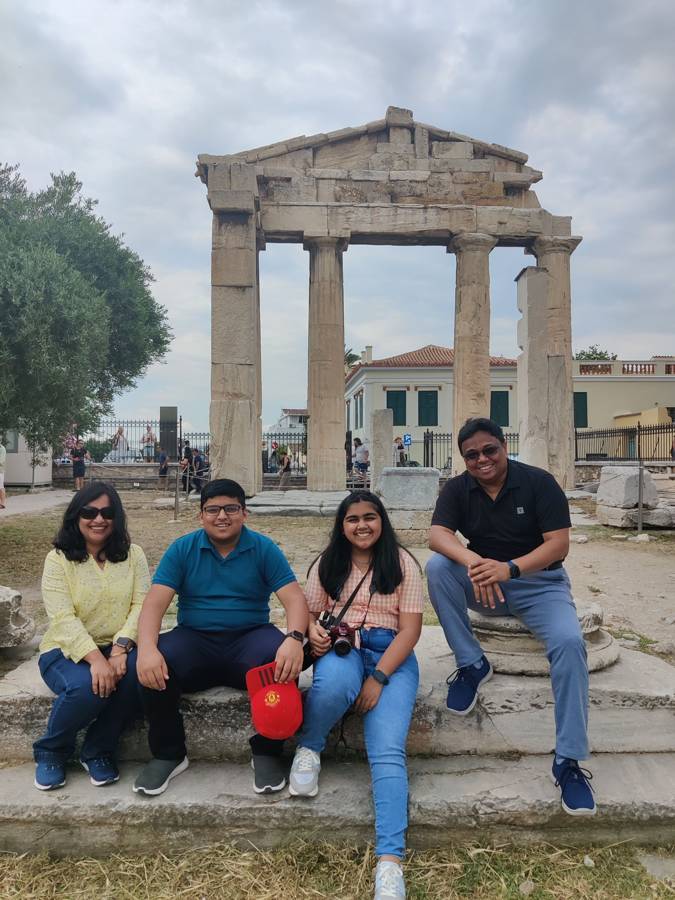
- Built in the 1st century BC as a new commercial centre, when the old Agora had become too cramped for trade.
- The west entrance is the Gate of Athena Archegetis, built in 11 BC. It is the one in the picture below.
- The octagonal Tower of the Winds stands nearby. It was built around 48 BC by the astronomer Andronikos, carries a frieze of the eight winds and once held a water clock.
- The market measured about 112 by 96 metres, with Ionic colonnades on all four sides.
Figures from the Athens Roman Agora page at A View on Cities.
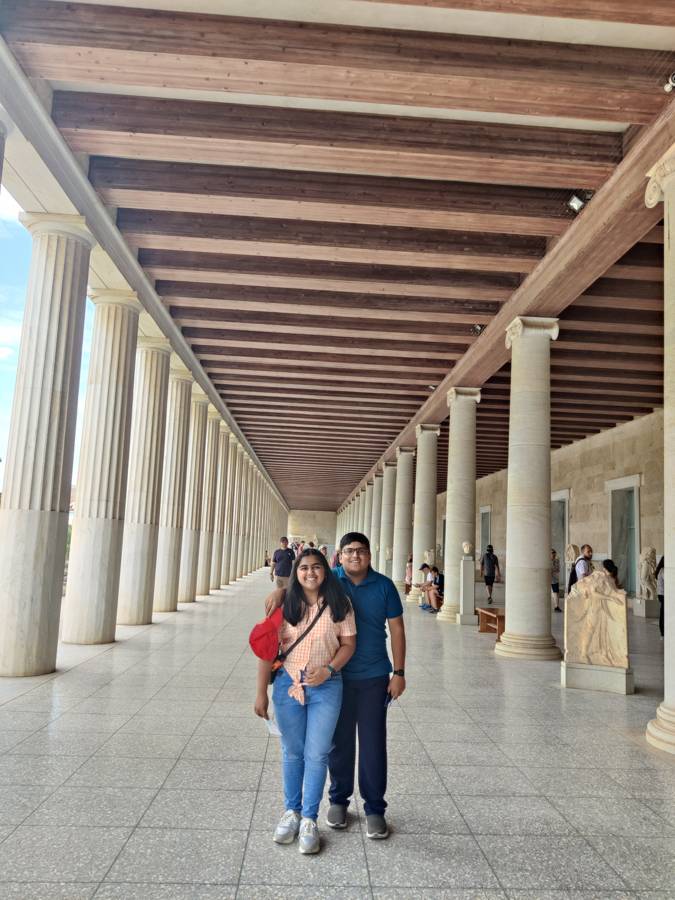
From there we went on to the Ancient Agora, the working heart of old Athens, where the Stoa of Attalos stands rebuilt as a museum. The marble columns, the cool shade and the beams of cedar-coloured ceiling make it one of the loveliest places to stop in the city.
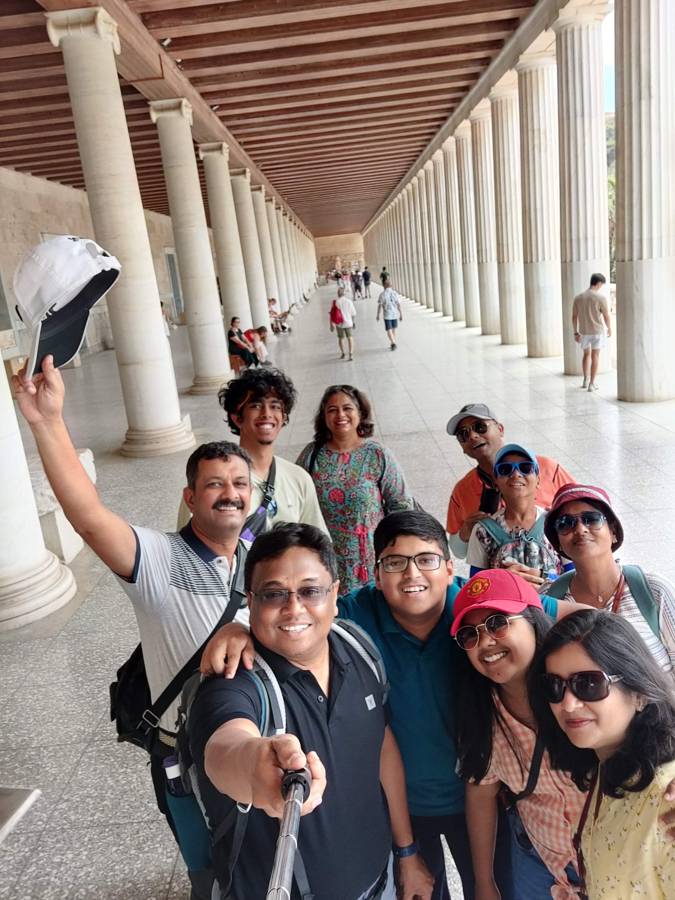
- Built by King Attalos II of Pergamon, who ruled 159 to 138 BC, and in use from around 150 BC.
- About 115 by 20 metres, two storeys, with 42 rooms at the back that served as shops.
- Its woodwork was burned by raiders in AD 267, and for centuries only ruins were left.
- The present building was reconstructed with American donations, including US$1 million from John D. Rockefeller Jr., and was dedicated on 3 September 1956.
- It now houses the Museum of the Ancient Agora, mostly about Athenian democracy, which is a nice thing to have invented.
Figures from Wikipedia’s Stoa of Attalos article, which cites its sources.
Monastiraki, lunch, and a doughnut stop
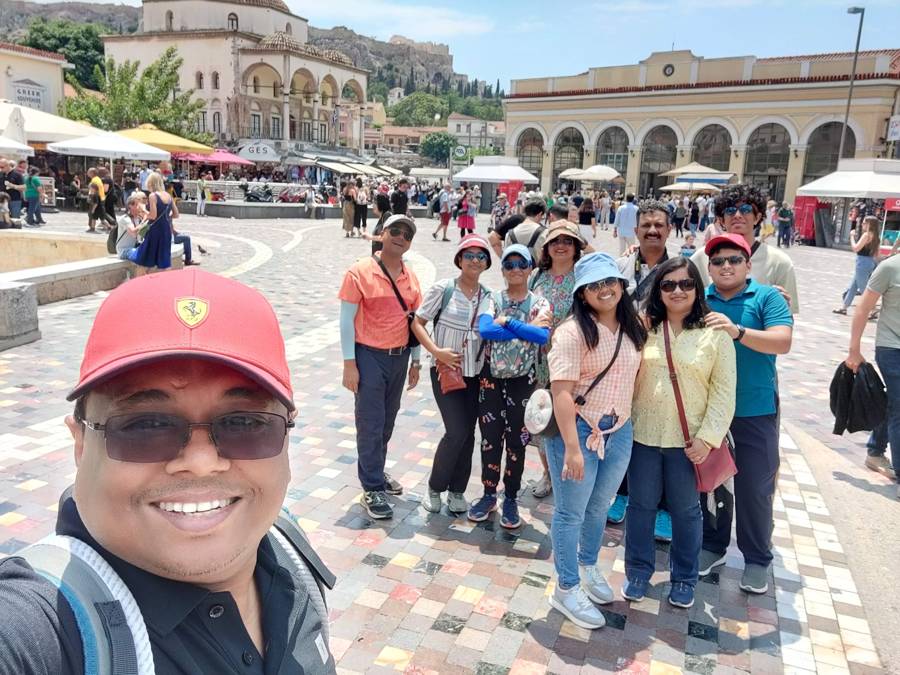
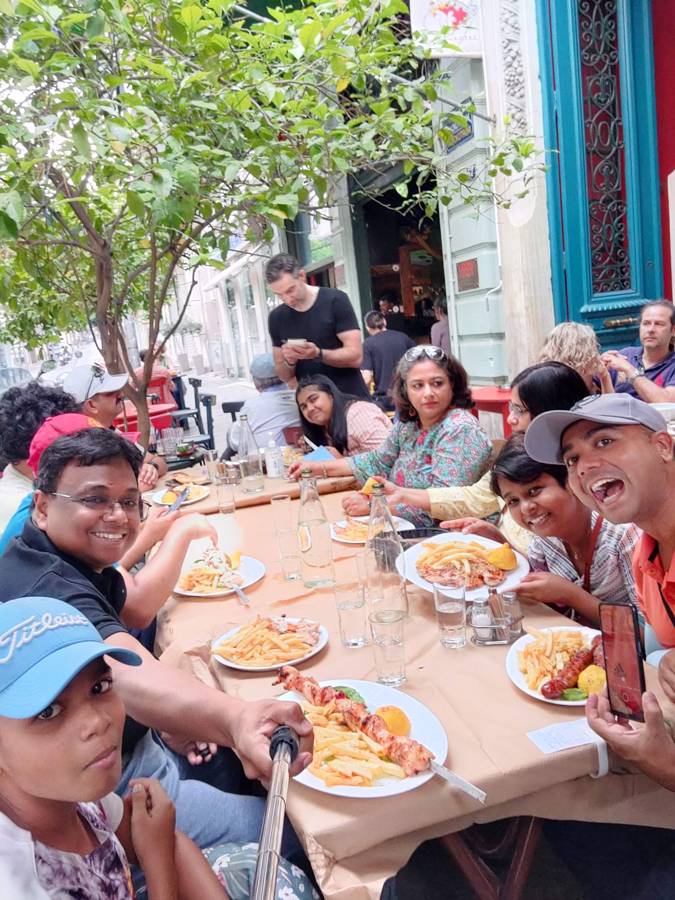
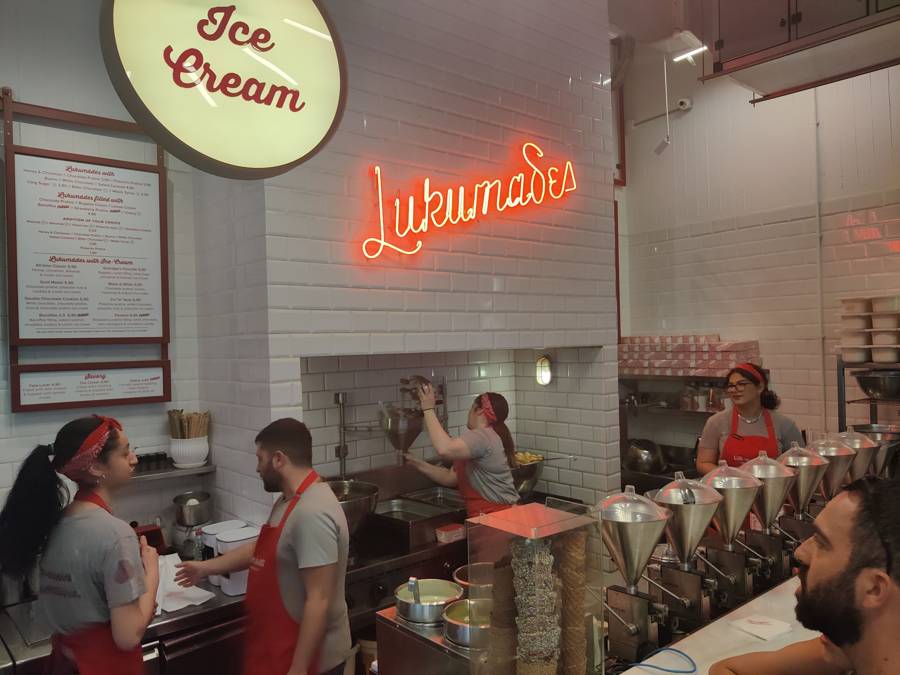
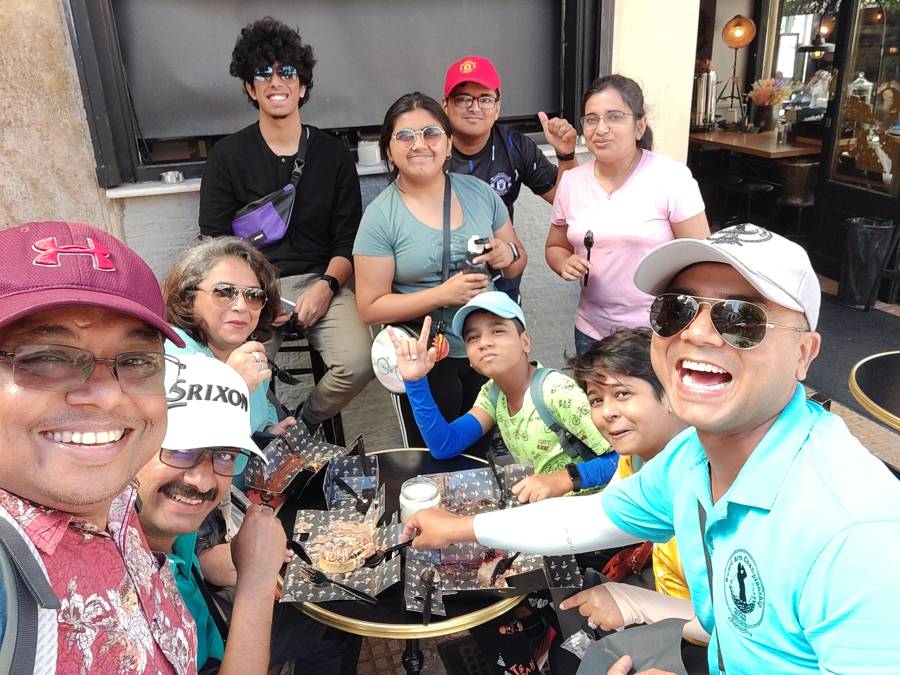
At midday we reached Monastiraki Square, where the Acropolis peeks over the rooftops and the market stalls open onto the streets. We had lunch here, and then, later in the afternoon, we stopped at Lukumades, a shop devoted to loukoumades, the little fried dough balls that Greeks drizzle with honey, which is exactly the kind of food any god would accept as an offering.
Hadrian, Zeus and the world’s first modern stadium
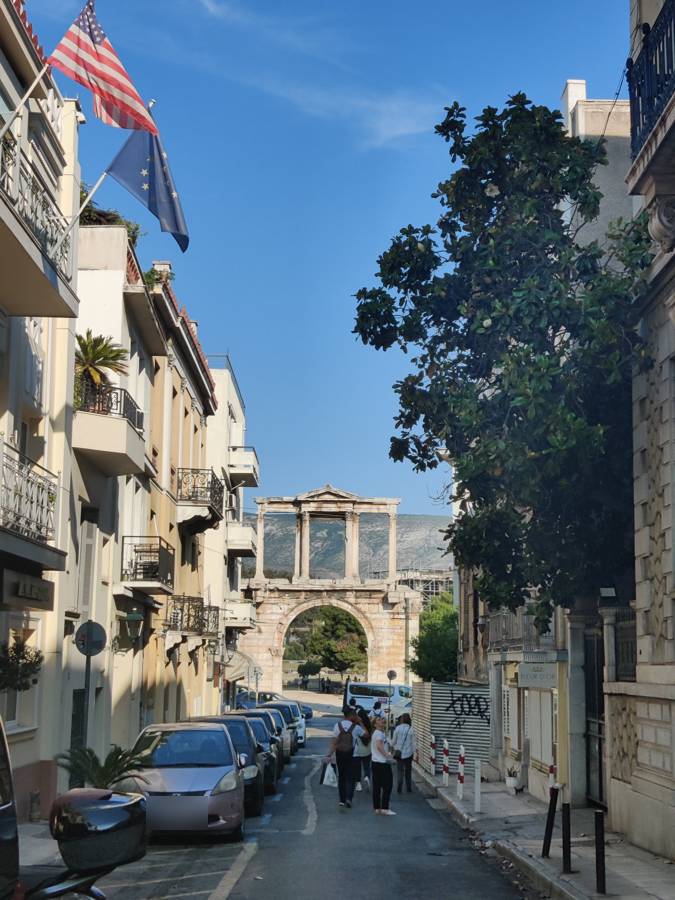
In the evening the route took us south of the Acropolis. We came down a quiet street with Hadrian’s Arch at the end of it, standing against the hills like a gate to another century. Beyond it is the Temple of Olympian Zeus, a colossal temple that took about 638 years to build, which is the longest project delay I have ever heard of, and the Roman emperor Hadrian finally finished it in AD 131 or 132.
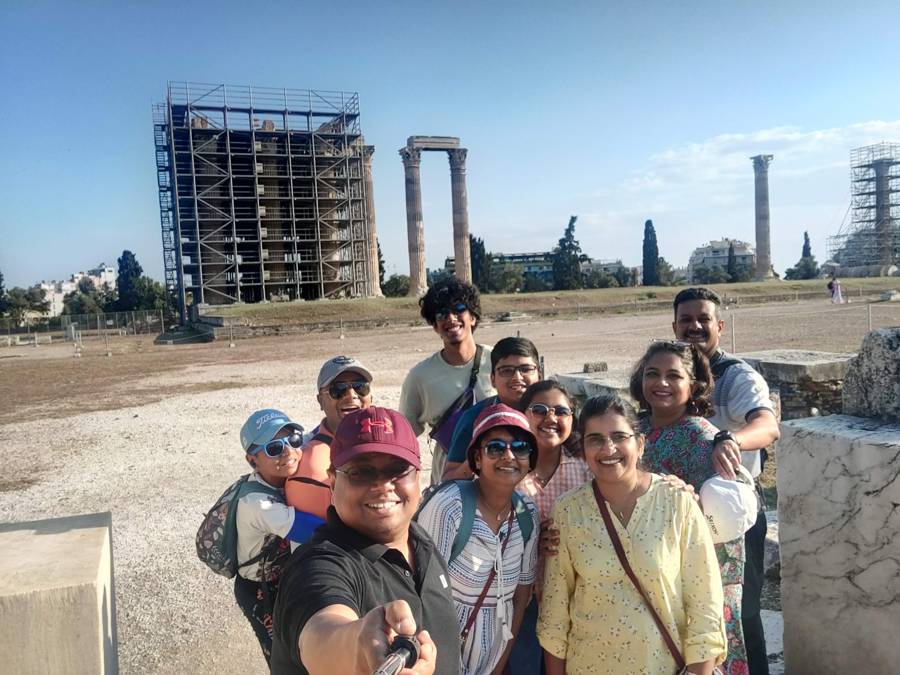
- Begun around 520 BC under the sons of the tyrant Peisistratos, and left unfinished for centuries.
- Completed and dedicated by the Roman emperor Hadrian in AD 131 or 132, about 638 years after the project began.
- 104 columns originally, each about 17 metres tall. Fifteen are standing today, and a sixteenth lies on the ground where it fell in a storm in 1852.
- The god in question is Zeus, king of the Olympians and the thrower of thunderbolts. His Indian cousin, Indra, would recognise the job description. In fact, the old Sanskrit sky-father Dyaus Pitar and the Greek Zeus Pater share a root, which makes this a family visit of a sort.
Figures from Wikipedia’s article on the temple.
A short walk further is the Panathenaic Stadium, which is not just old, it is also made entirely of marble.
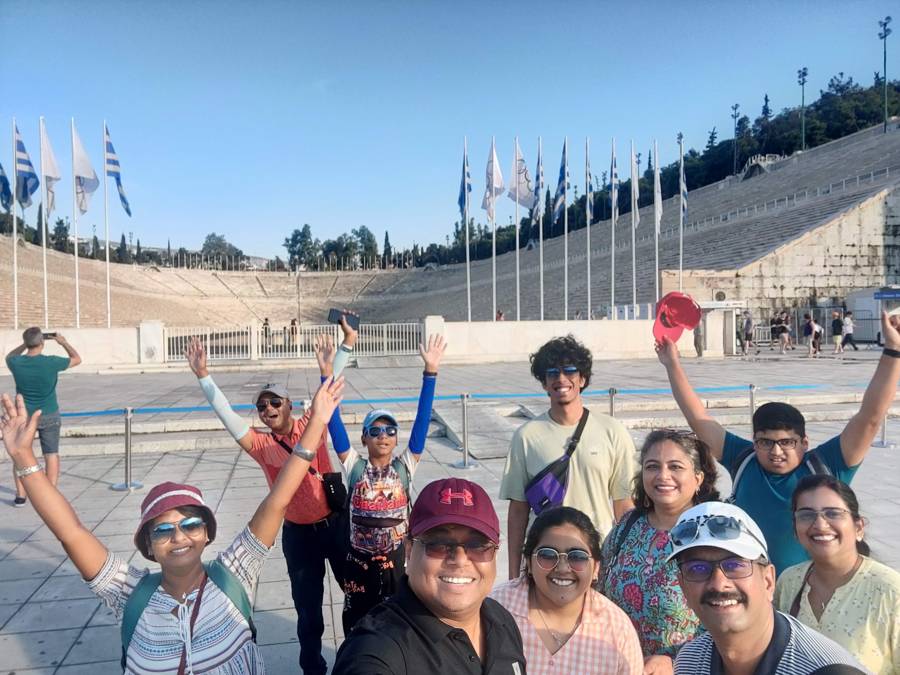
- There was a racecourse here from the 6th century BC, and the first stone stadium was built around 330 BC.
- Herodes Atticus rebuilt it in Pentelic marble by AD 144, with seating for about 50,000.
- Restored for the first modern Olympic Games, which opened here on 6 April 1896, funded by the benefactor George Averoff.
- It is widely described as the only stadium in the world built entirely of marble, and it is still the finish line of the Athens Classic Marathon.
Figures from Wikipedia’s Panathenaic Stadium article.
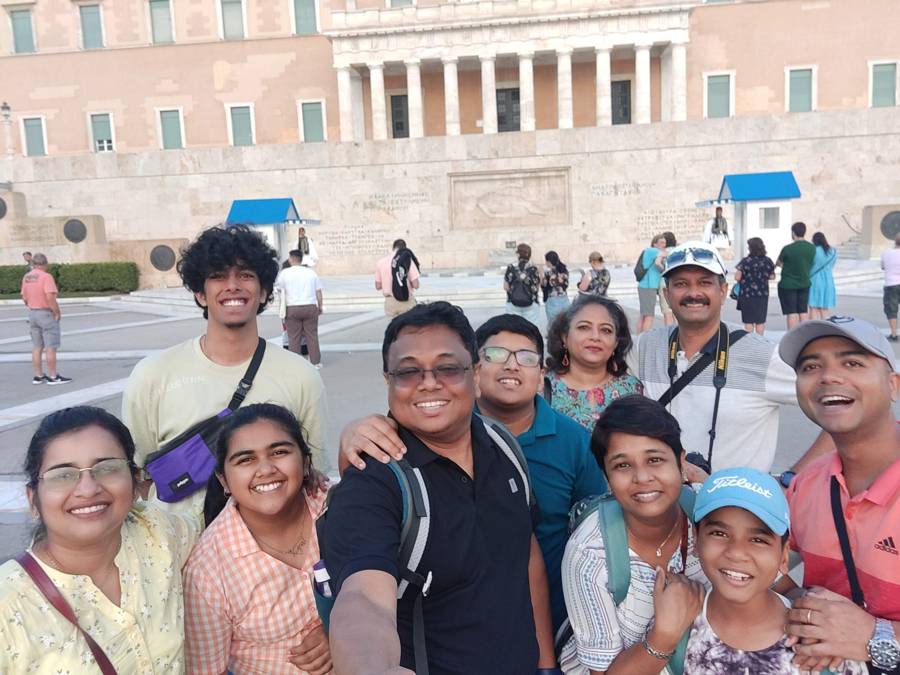
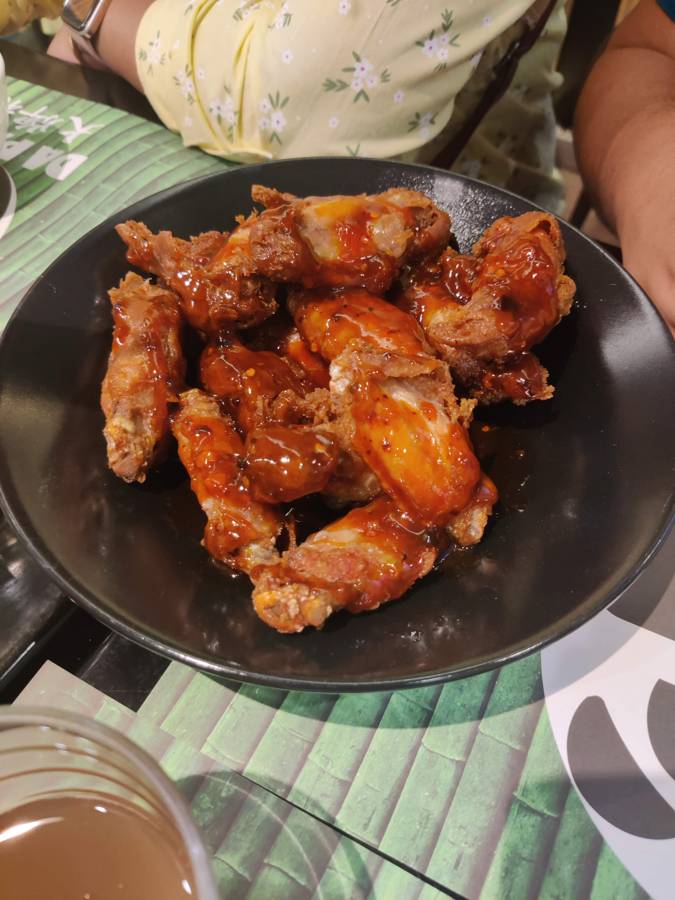
Our evening walk ended at Syntagma Square once more, with the sentry boxes of the ceremonial guards behind us and the Parliament lit by the last of the daylight. That completed the day’s loop: a good deal of civilisation, on foot. For dinner we went a long way from Greece and had Chinese at Da Panda, where the plate of sticky glazed chicken wings made it a very satisfactory finish to a long walk.
Day 3: Monday 5 June. Athena, in her own house
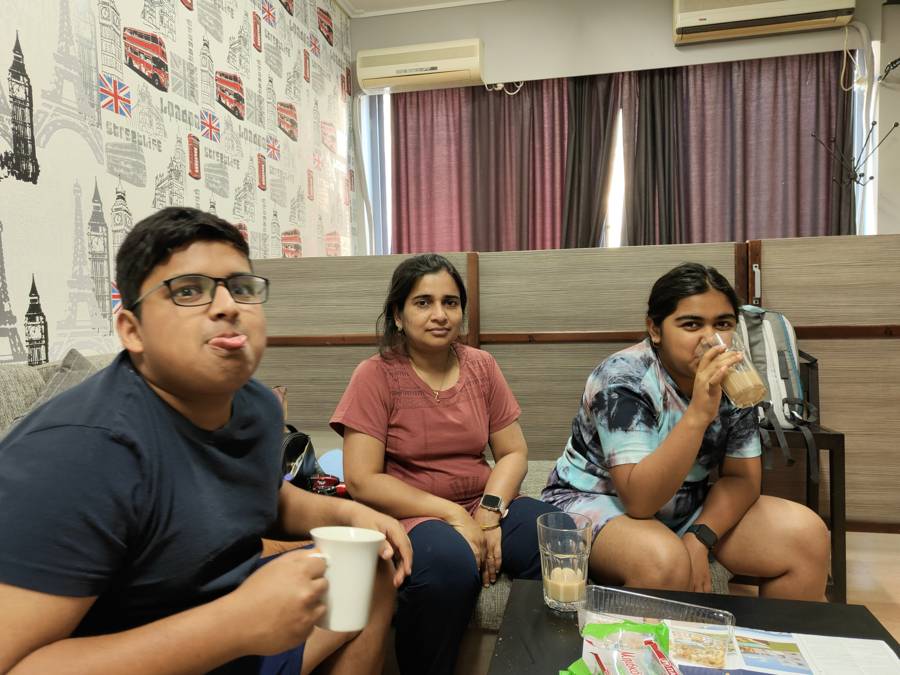
We were up early for the main event. Breakfast was the Indian ready-to-eat kind that we had carried from home, with hot drinks, and no one complained, because the plan was to be on the Acropolis before the crowds and the heat. The Acropolis is an easy walk from Ermou, and we left while the city was still quiet.
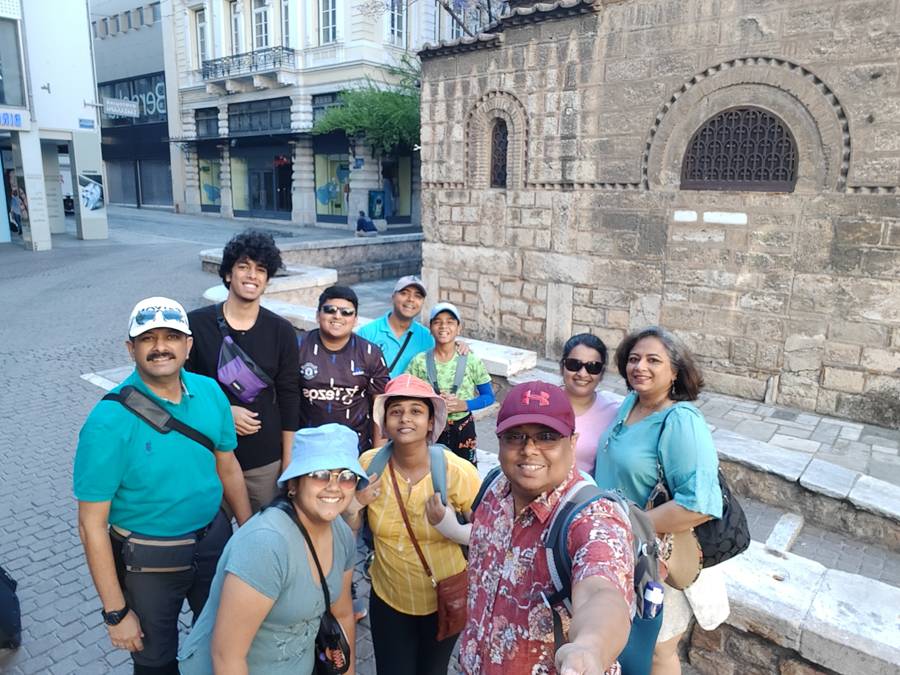
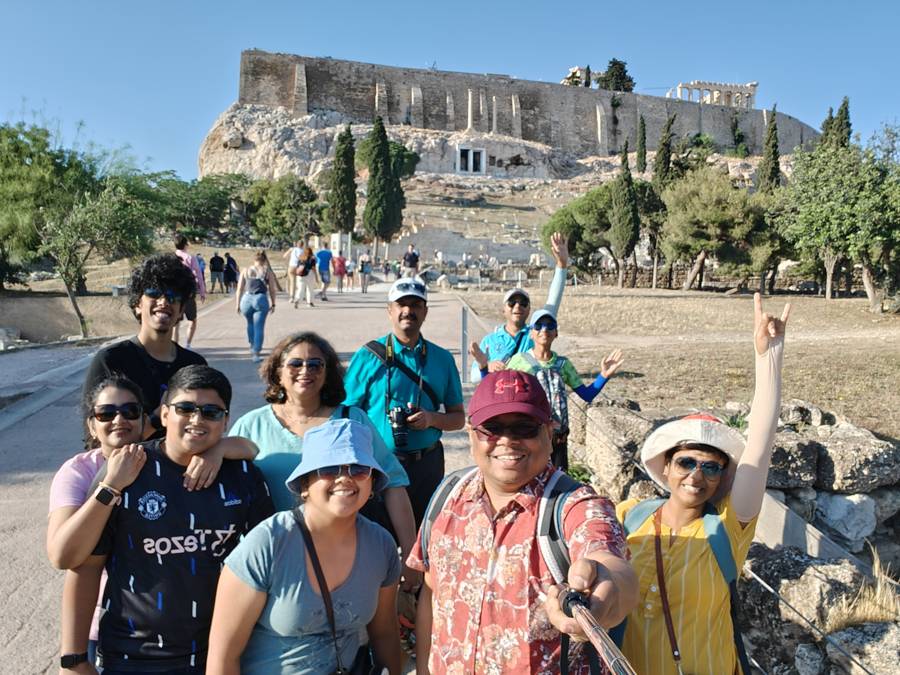
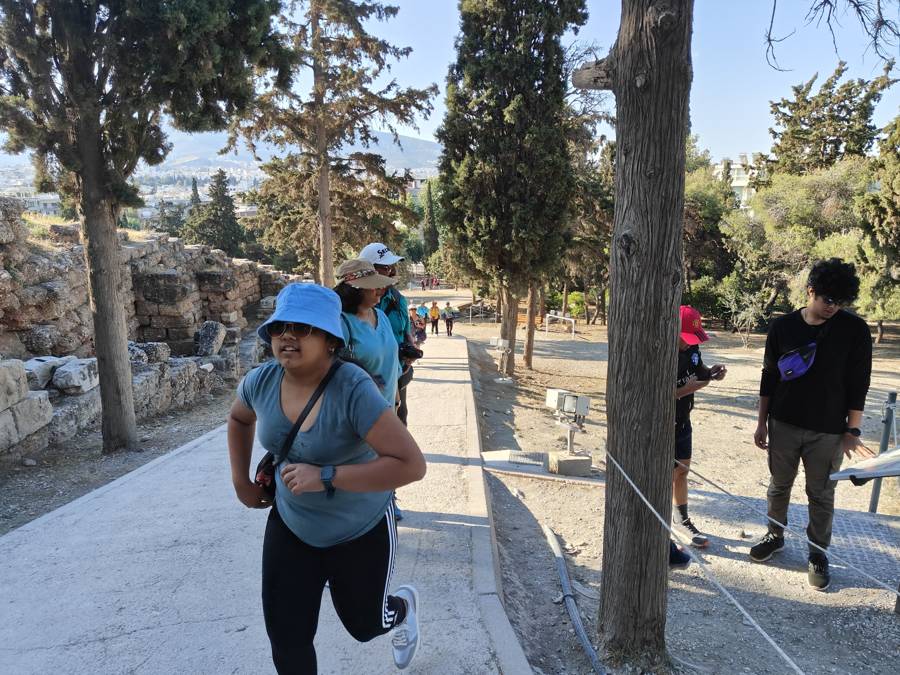
The walk to the Acropolis climbs through the pine-shaded slopes, and the first hour of it is a kind of preview: a view of the Odeon of Herodes Atticus from above, a path under old trees, and the crowds still sleeping. Someone jogged up part of it, which is the most reliable way to make everyone else feel old.
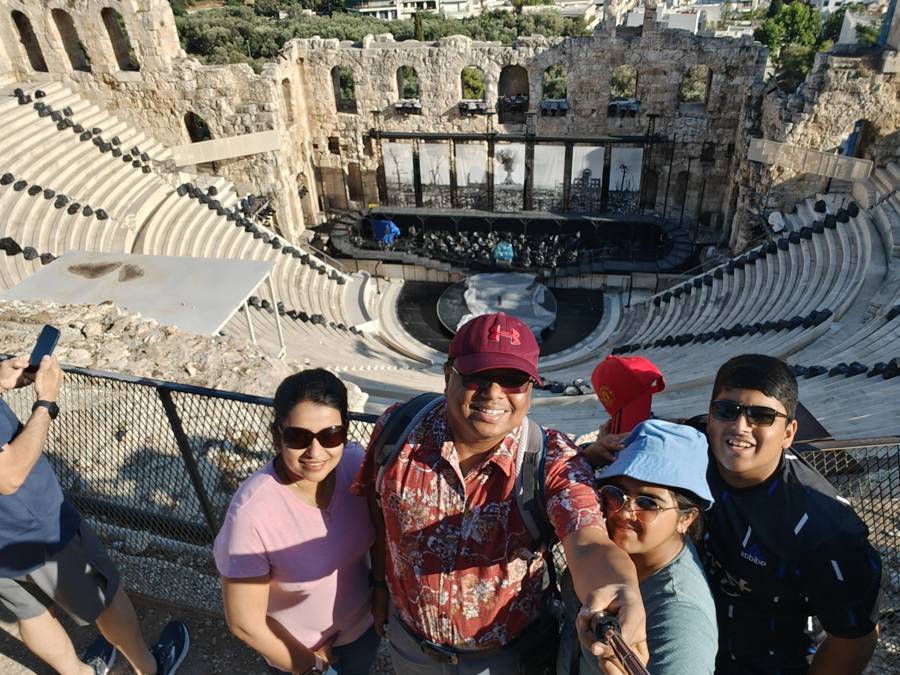
- Built in AD 161 by Herodes Atticus, a wealthy Athenian and Roman senator, in memory of his wife.
- About 5,000 seats across 32 rows. It was roofed in cedar with no supporting columns, which was a feat for its day.
- It is still used for concerts and in the summer festival season.
Figures from the Odeon page at A View on Cities.
Then we were at the top, with the Parthenon in front of us under a sky of deep blue. Athena, the goddess of wisdom, craft and strategic warfare, is the patron of the city and the reason it is called Athens, and this is her house. In her time, a 12-metre statue of her, made of ivory and gold, stood inside it. The Greeks built her a temple that has now outlived the statue, the religion and most of its roof, and still looks better than most things we have built since. Scaffolding was up when we visited, because the long restoration of the Acropolis never quite finishes.
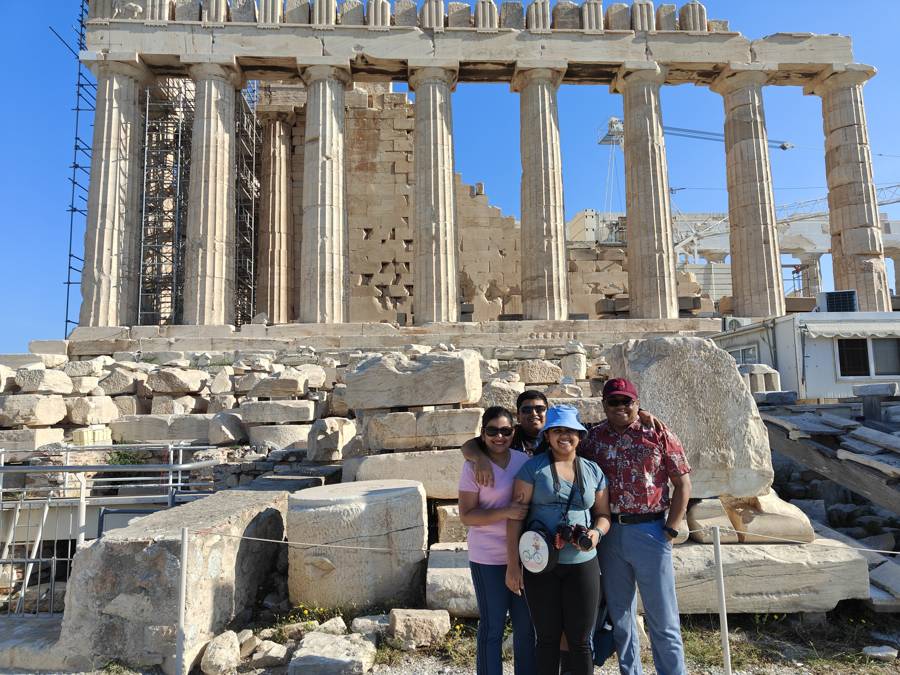
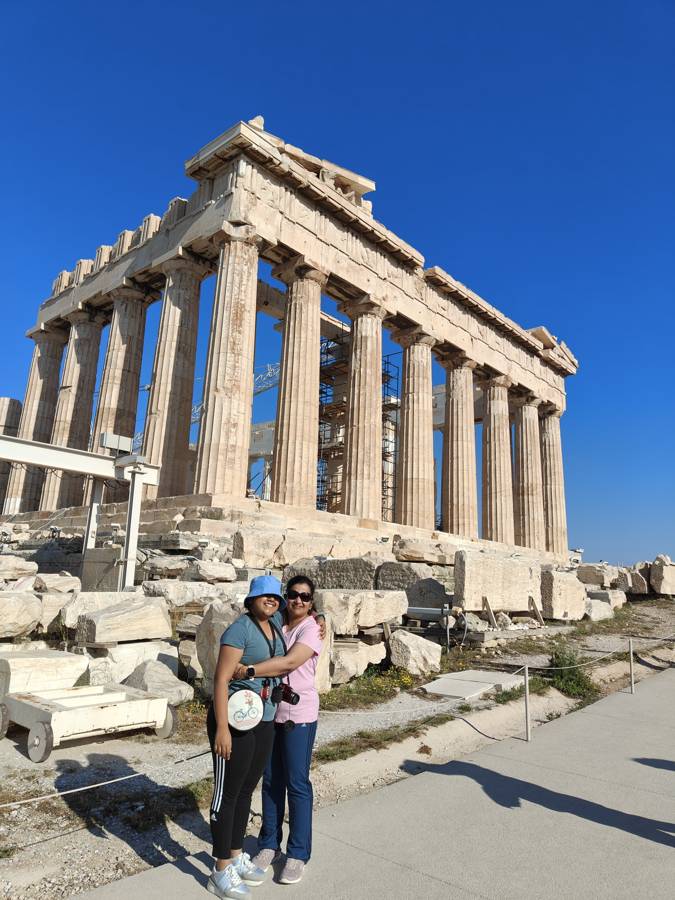
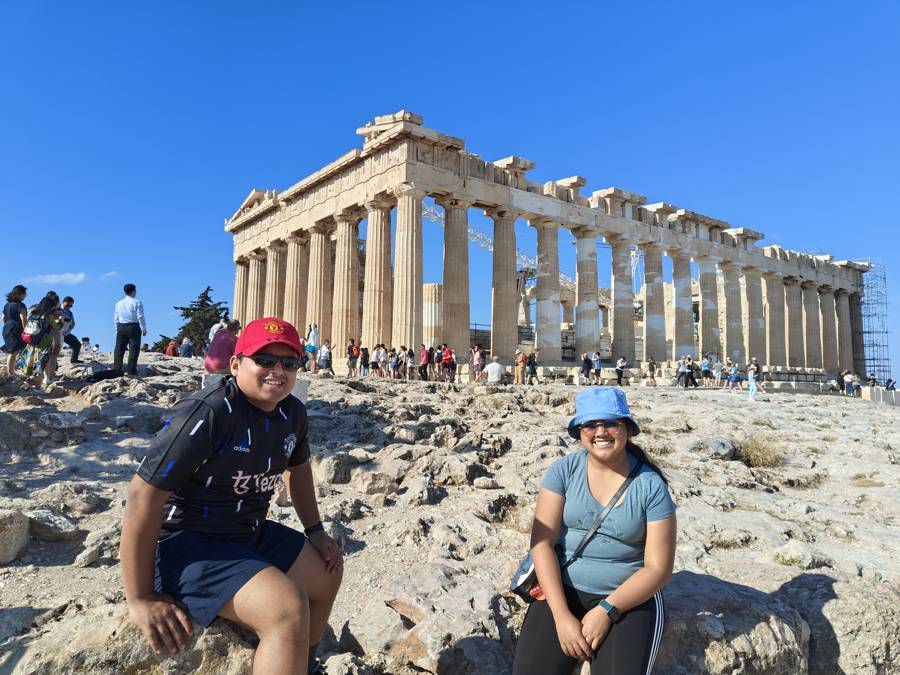
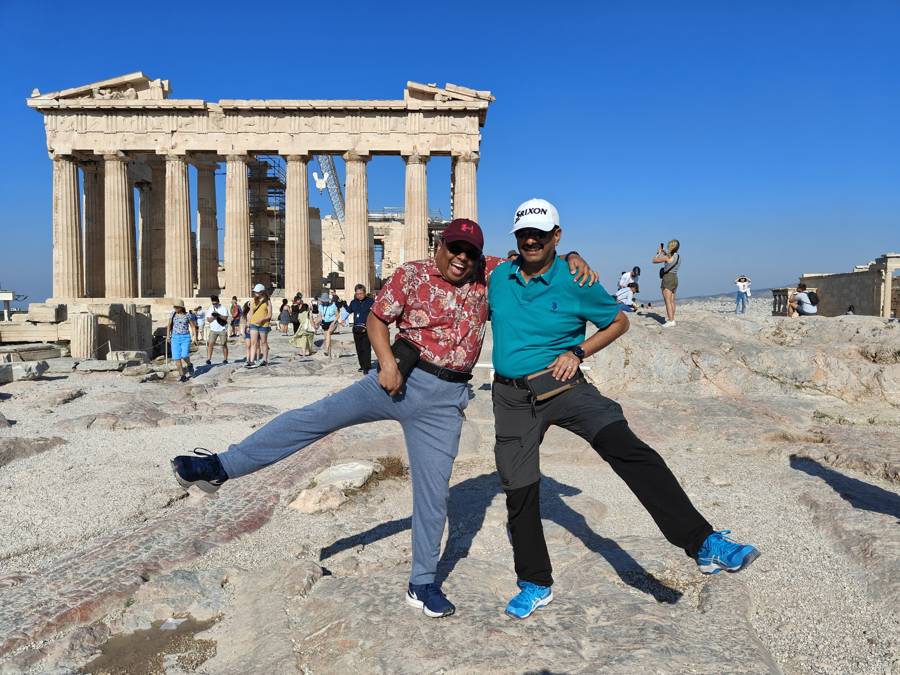
- Built between 447 and 432 BC under Pericles, by the architects Ictinus and Callicrates, with the sculptor Phidias.
- A temple to Athena. Its great statue, the Athena Parthenos, stood about 12 metres high in ivory and gold, and no longer exists.
- 46 columns on the outside, in a ring around the building, and 19 inside.
- It became a church in the 6th century AD and a mosque in 1458. In 1687, the Ottomans were using it as a gunpowder store when a shell blew it open, which is why the roof is gone.
- Many of its sculptures were removed by Lord Elgin in the early 19th century and are in the British Museum. Greece wants them back.
Figures from History.com’s article on the Parthenon.
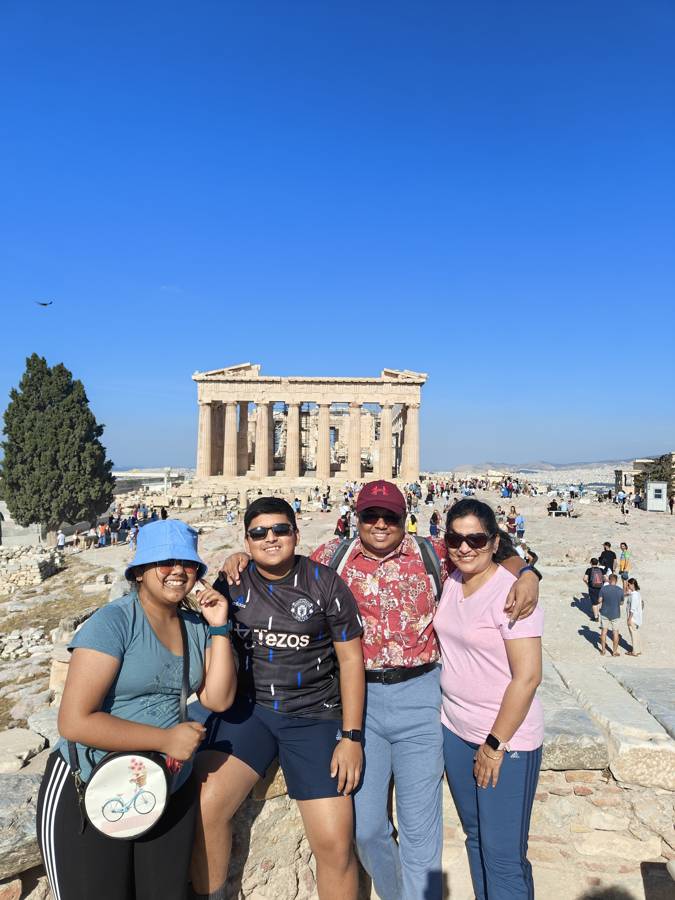
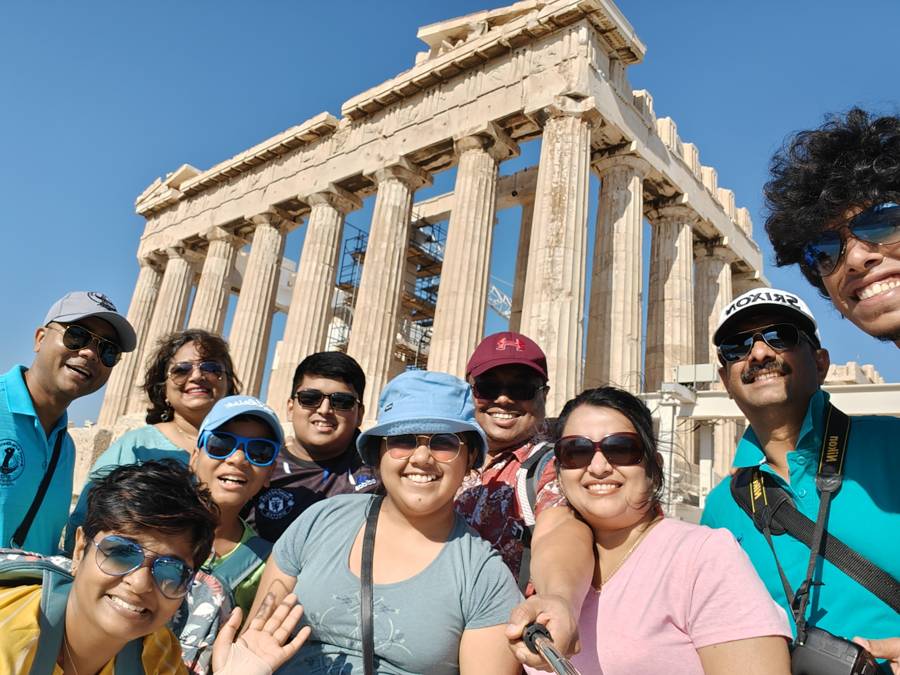
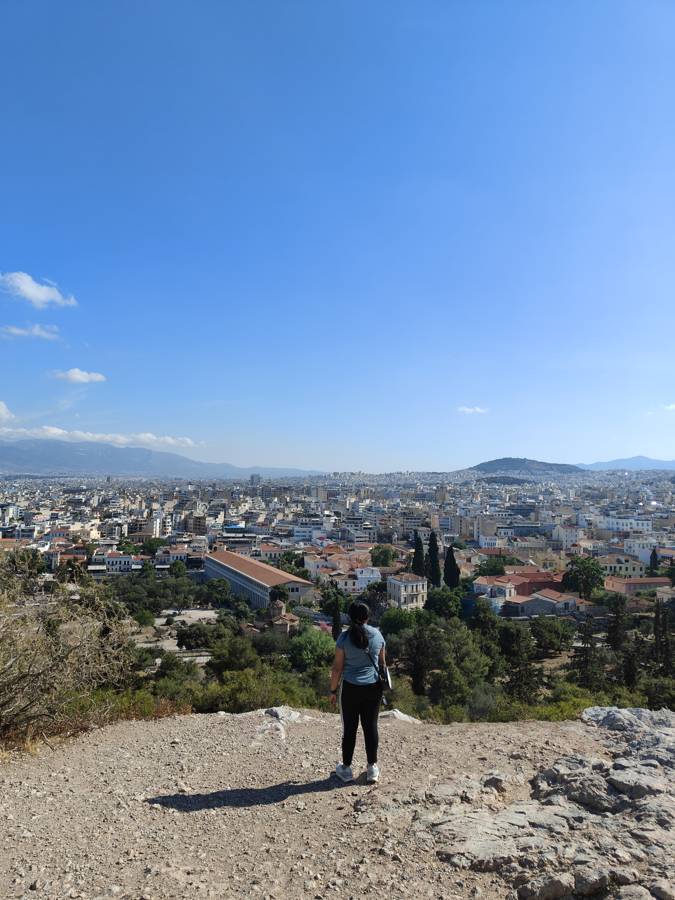
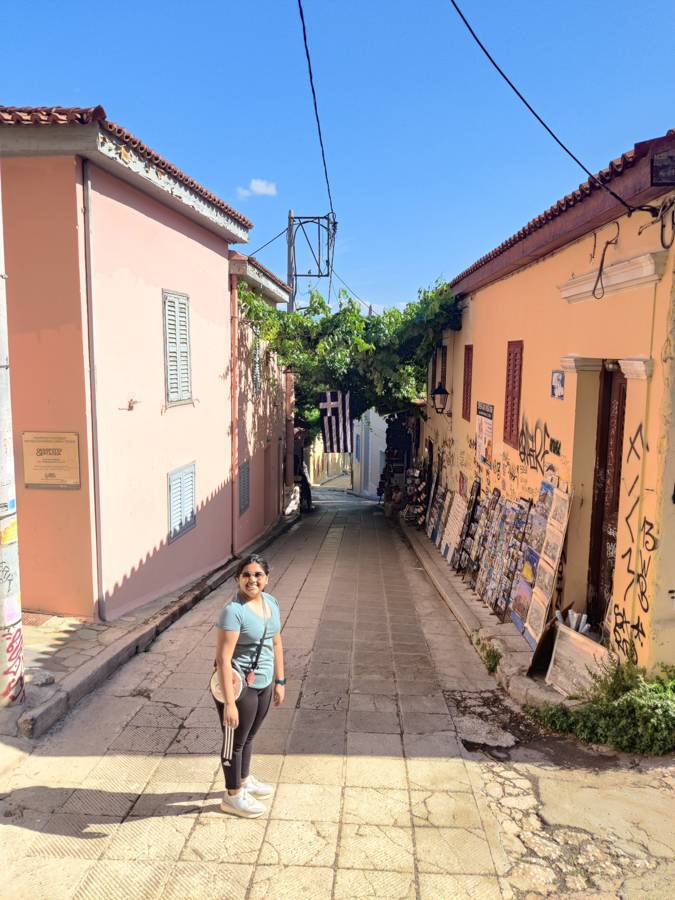
From the rock, the city runs out in every direction, all white concrete blocks to the hills, and it is easy to see why it all started here. After the Parthenon we dropped back down to the old quarter through the cool lanes of Plaka, where even the stairs look like a painting.
Coffee in the sand
Athens is full of cafés, but one of the best sights was in the market, where Greek coffee is made the old way: in a small brass pot, heated in hot sand. You may call it Turkish coffee, and so did we, but be careful about doing so in Athens. Whatever it is called, it arrives thick, dark and small, and the grounds are left at the bottom as a warning.
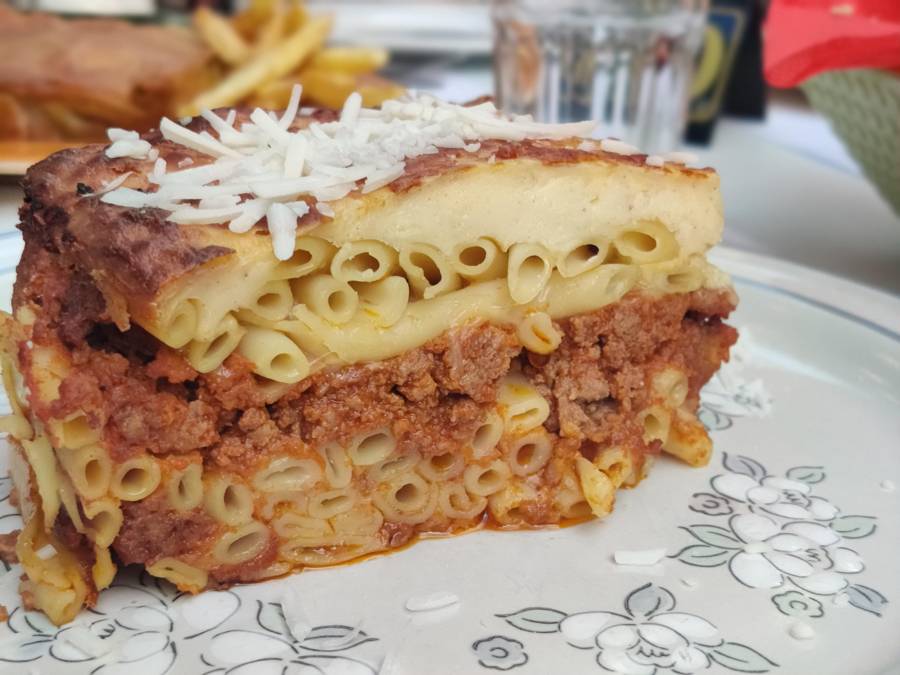
Dinner was pastitsio, the Greek baked pasta with a thick layer of béchamel on top. It came to the table the way the gods would have wanted it, as a very large, very hot slab, and it vanished at roughly the speed of Hermes.
Day 4: Tuesday 6 June. Poseidon, and a long boat
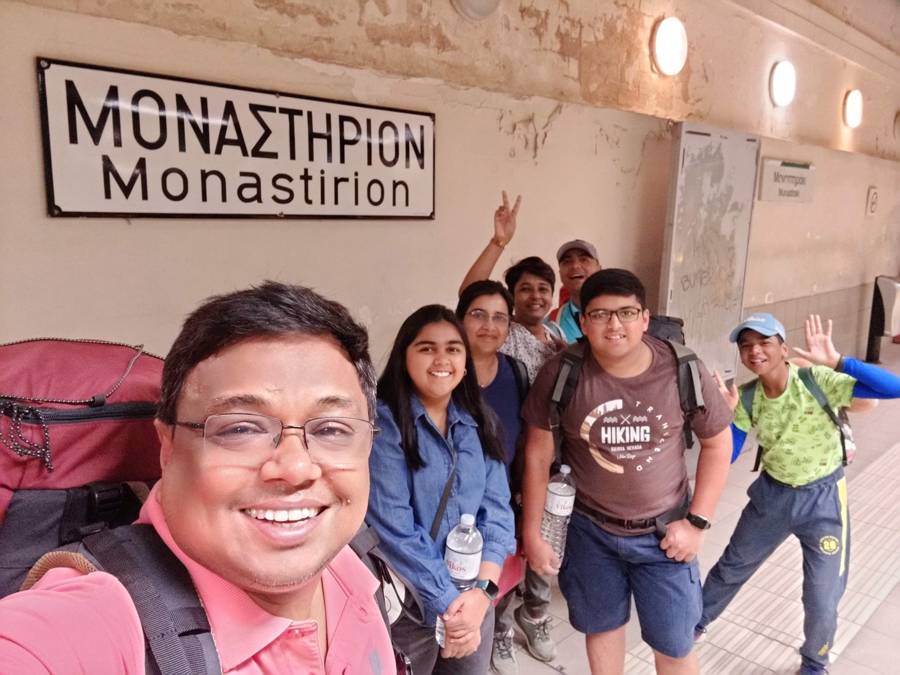
If Athens was Athena’s town, the next part of the trip was Poseidon’s, and he began collecting his dues at a quarter to six in the morning, when the ferry group (the Boses and the Majumdars) gathered at Monastiraki metro station with their backpacks. The metro took us straight to Piraeus, the port of Athens, with one change-free ride.
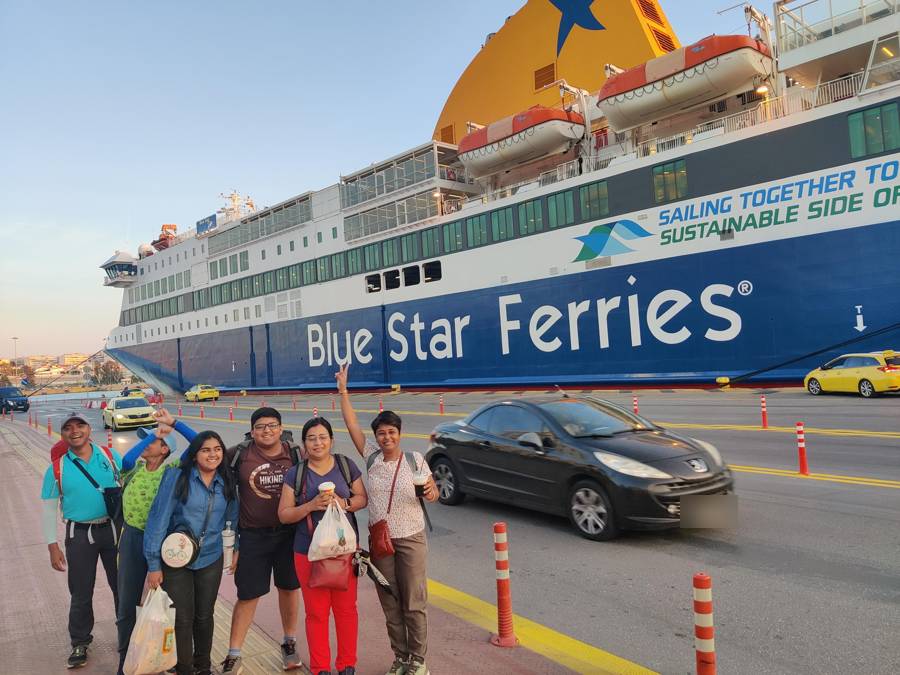
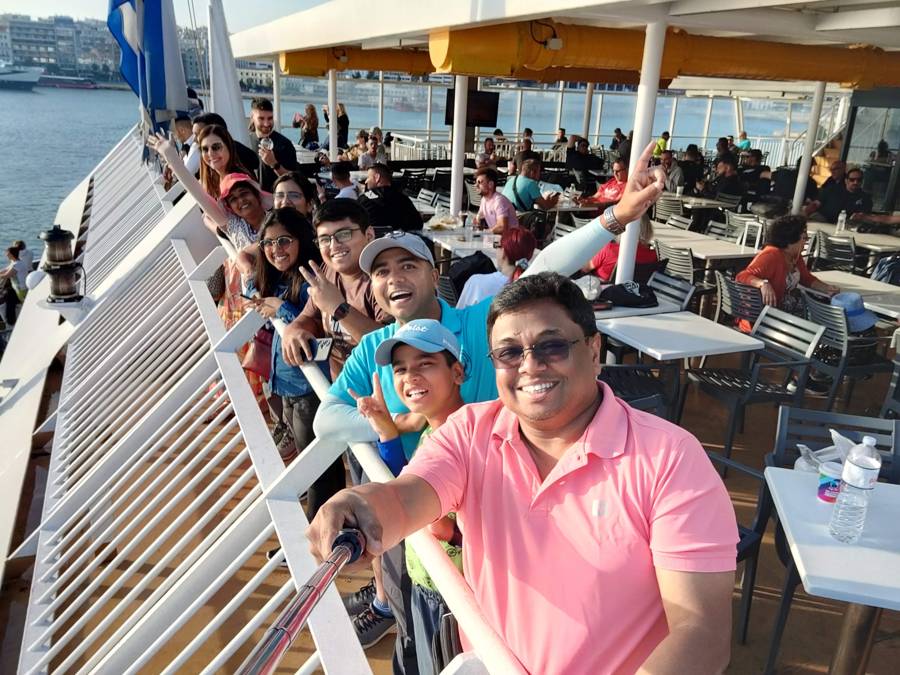
The ferry took 7 hours and 25 minutes, which is the trade-off for a cheap seat and a good view. We had deck-lounge tickets, which meant a seat in a covered lounge and as much time as we liked at the rail, which was most of it. There were tables at the stern, a long wake of white water behind us and a Greek flag cracking in the wind. Poseidon was in a generous mood: the sea was calm and the sky was clear all the way.
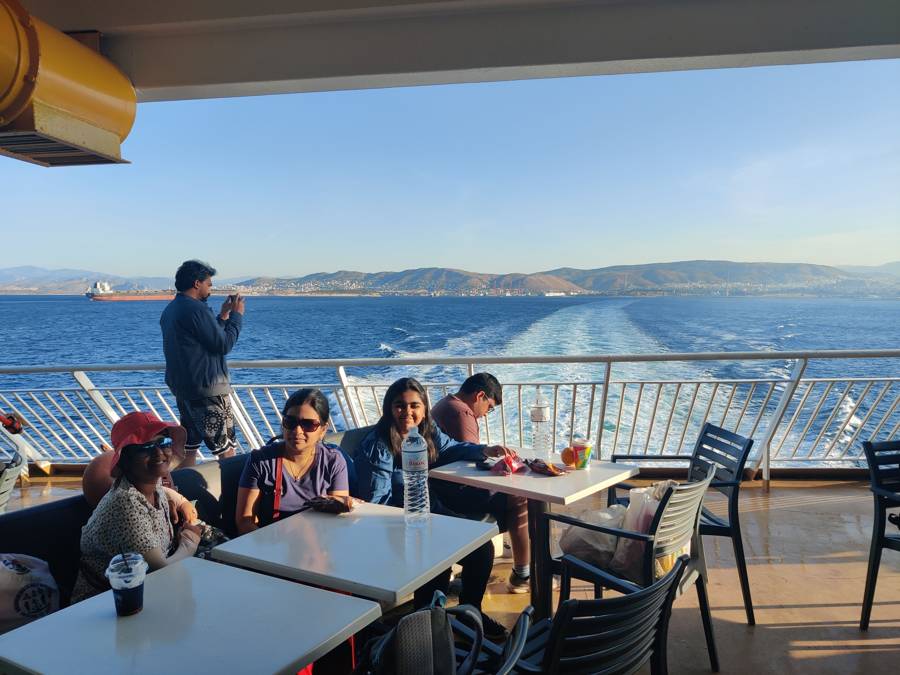
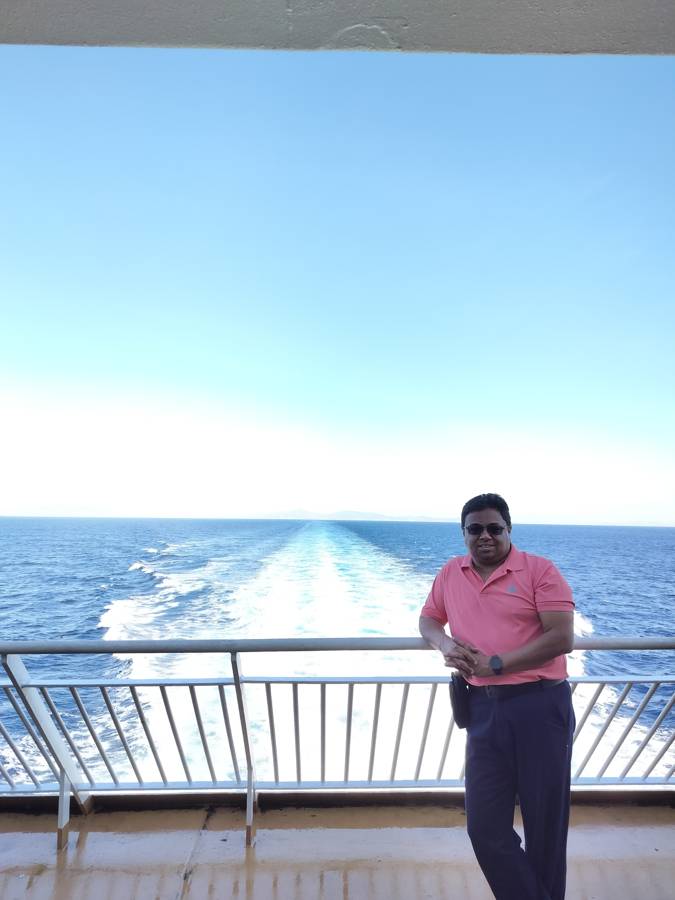
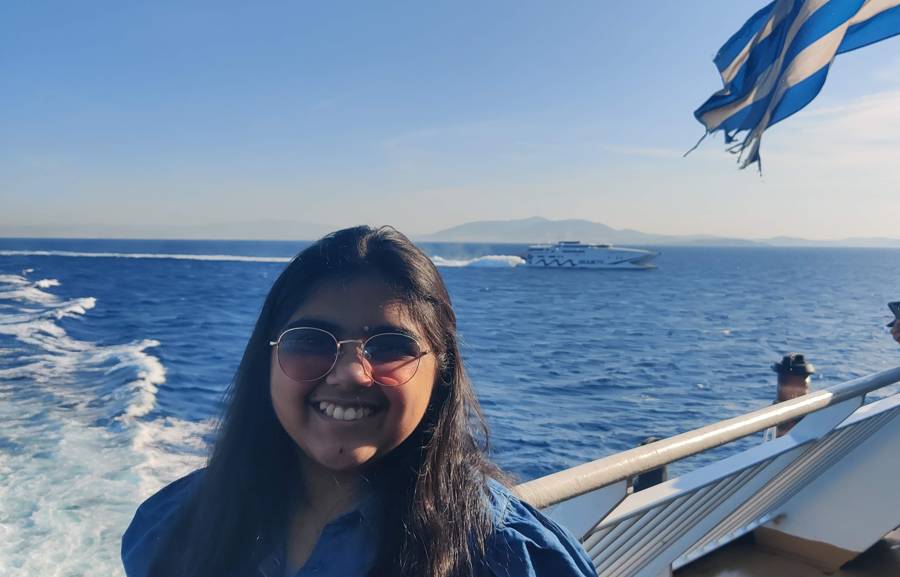
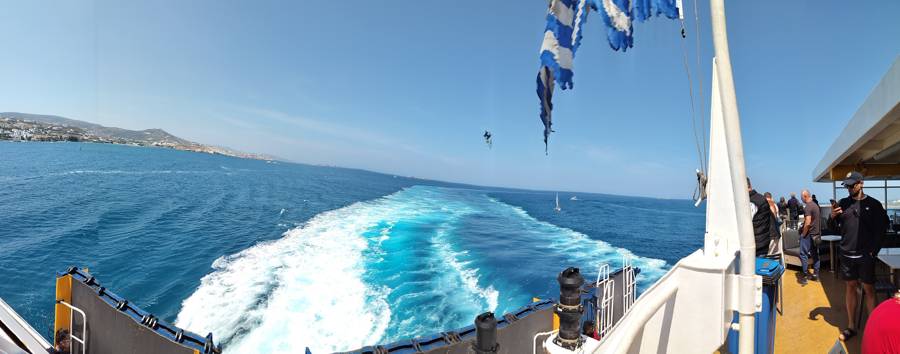
Then, in the afternoon, the caldera appeared: a wall of dark cliffs with the white town of Fira laid along the top like icing, and a cruise ship so large it looked like part of the scenery. We arrived at the port of Athinios and climbed the winding road from the sea to the rim.
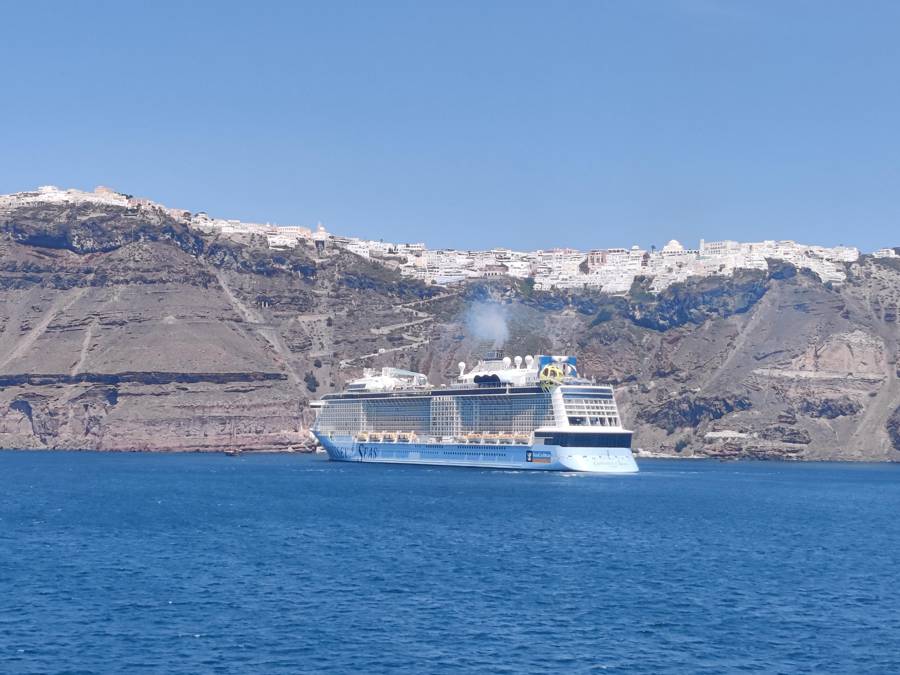
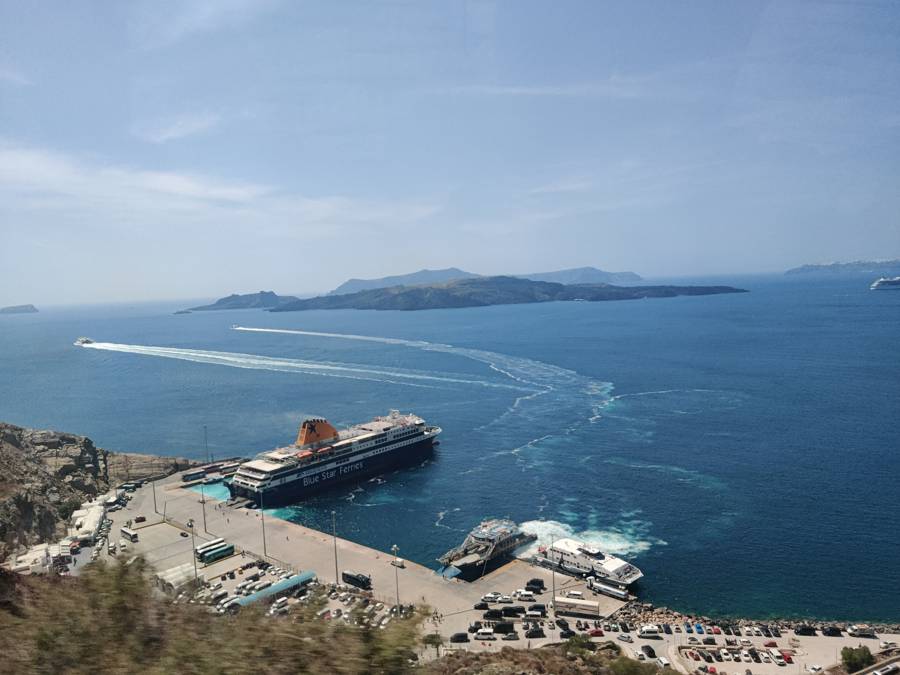
- The island is the rim of a drowned volcano. The Minoan eruption, around 1600 BC (the exact date is still debated), was a VEI 7 event, one of the largest volcanic eruptions in human history. It threw out roughly 28 to 41 cubic kilometres of material and left a huge seawater-filled caldera.
- The caldera wall drops more than 300 metres at its highest point. The islands in the middle, including Nea Kameni, grew after the eruption, and Nea Kameni last erupted in 1950.
- The Minoan town of Akrotiri, at the southern tip, was buried in ash and pumice, and has been excavated since 1967.
- Some people link the eruption to Plato’s story of Atlantis. Current scholarship does not support it, so, sadly, the island is merely a volcano.
Figures from Wikipedia’s articles on the Minoan eruption and on Santorini.
A home with a cat in charge
We stayed in Katerina Kafieri Apartments in Firostefani, a short walk north of Fira along the caldera edge. The place was run by an old lady and her cat, and I am still not sure which of them was in charge. The decor was a delight: old, vintage and full of character.
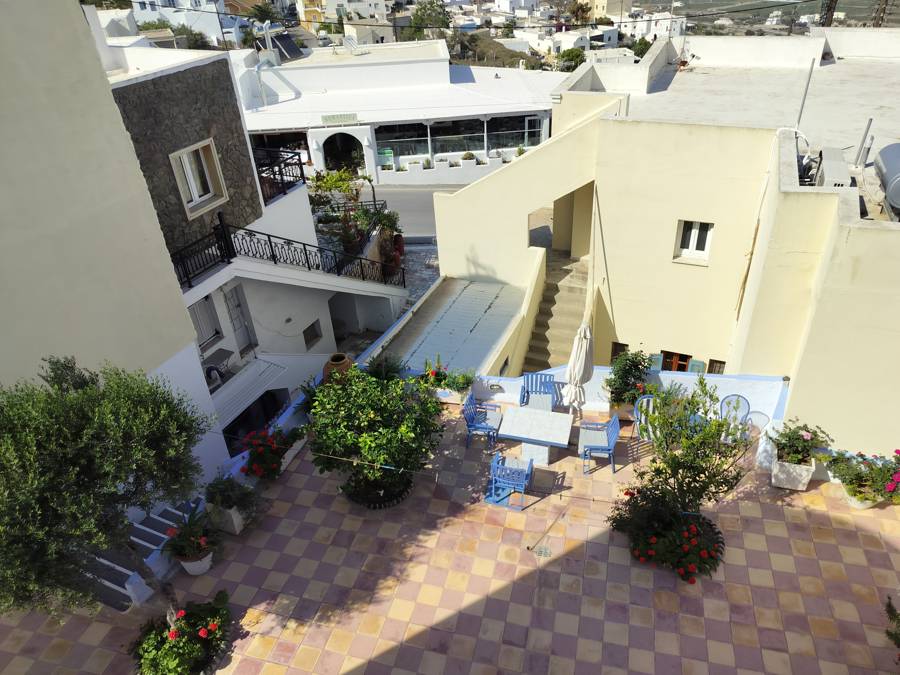
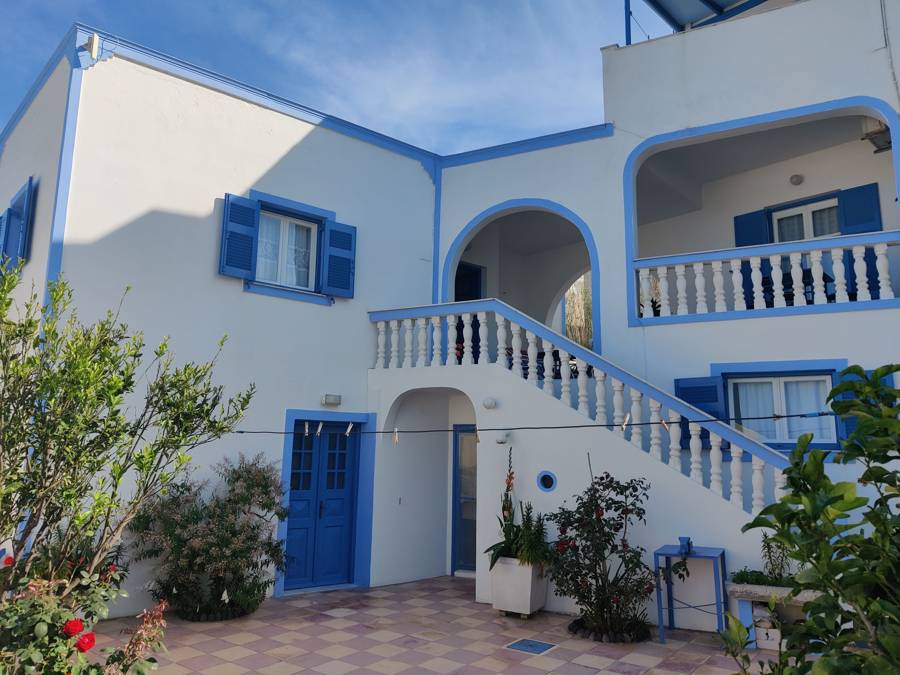
That evening we walked the caldera path from Firostefani towards Fira, with a drop on one side and white houses on the other. Past a blue-domed church, with the volcanic island of Nea Kameni behind it, the path ran on to the cliff edge. In the evening light the caldera turned gold, with a cruise ship parked in the middle as if for the view. A breeze came up, and the jackets came out, which is a thing nobody warns you about on a Greek island in June. The sun touched the horizon at around twenty past eight.
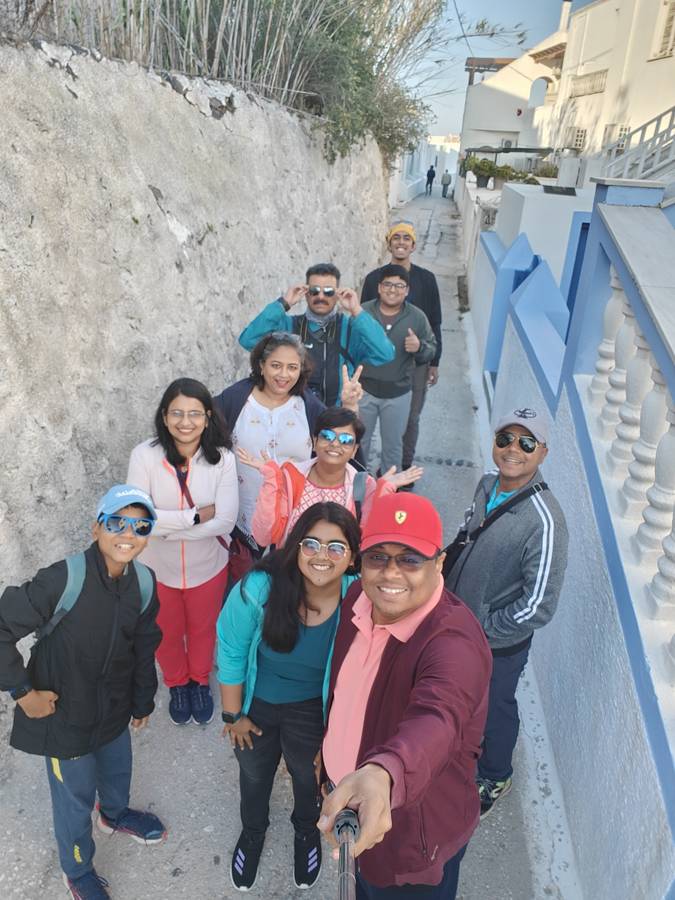
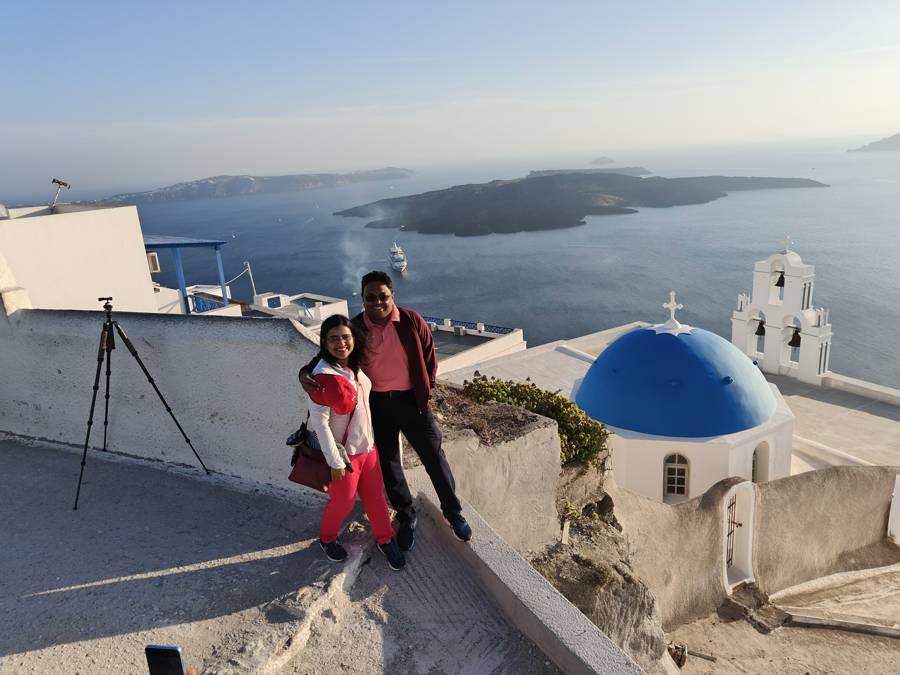
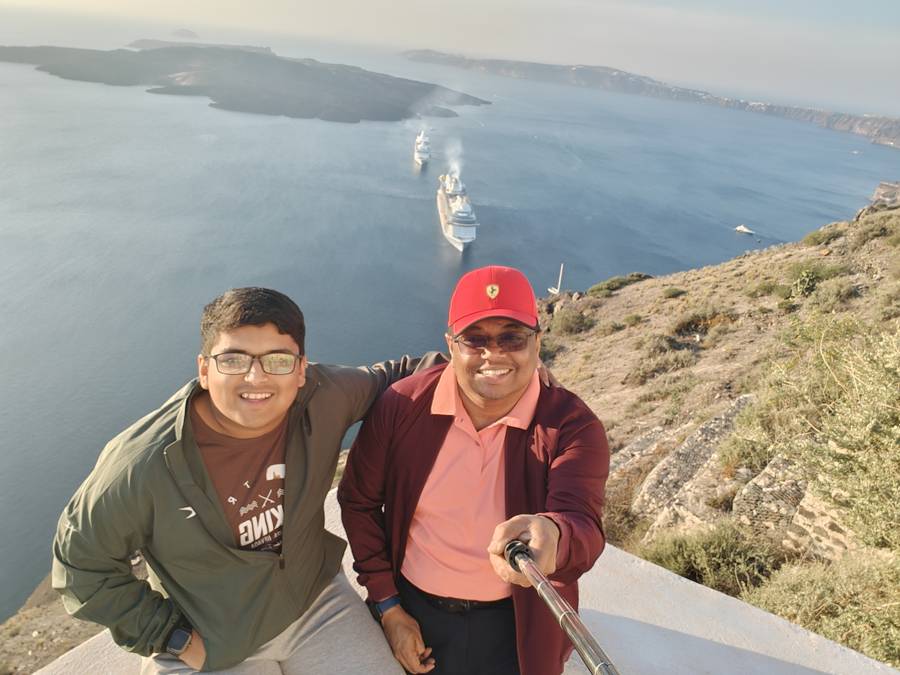
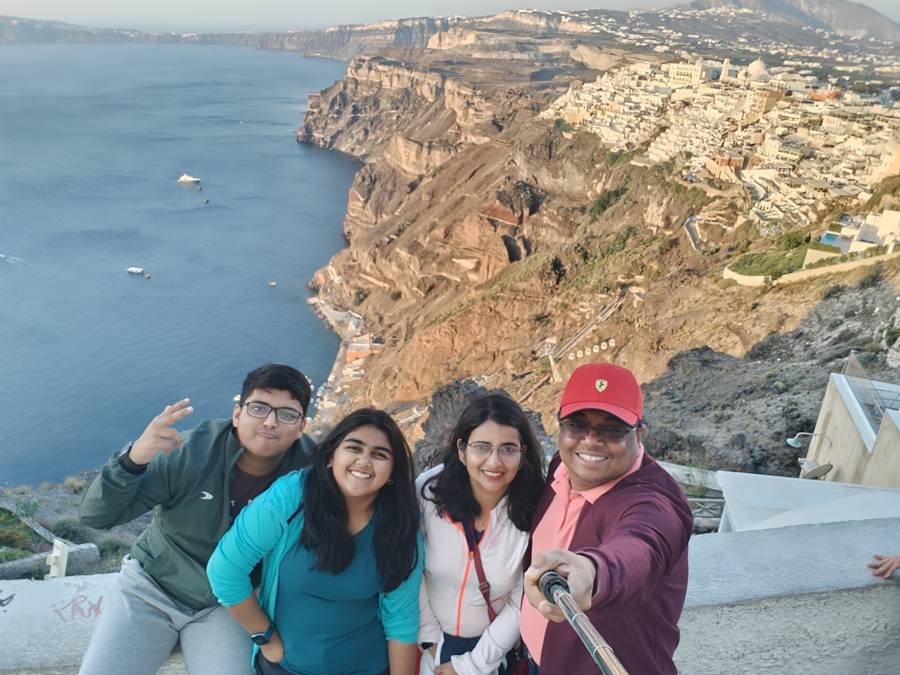
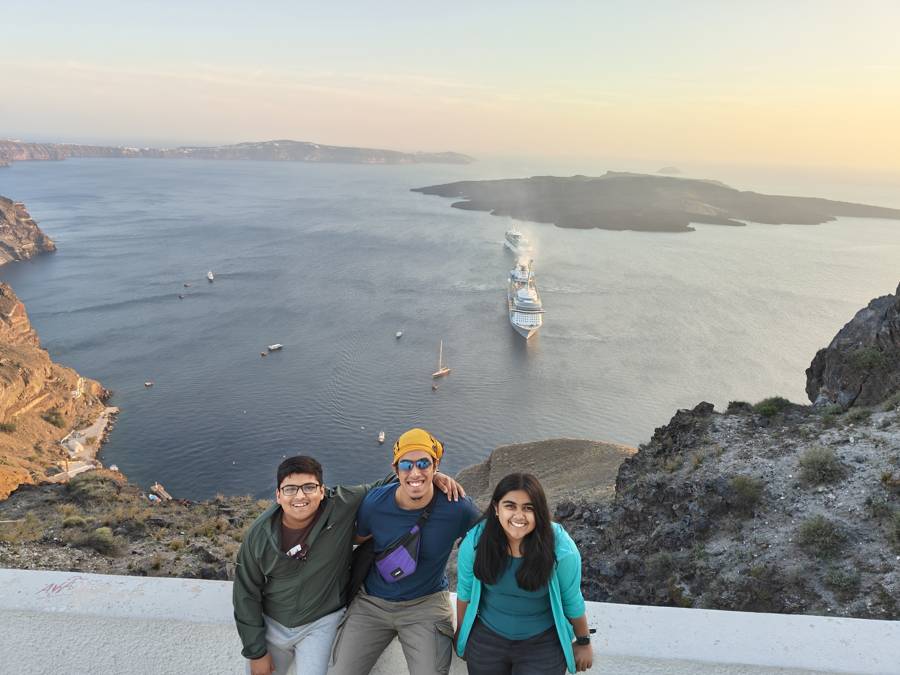
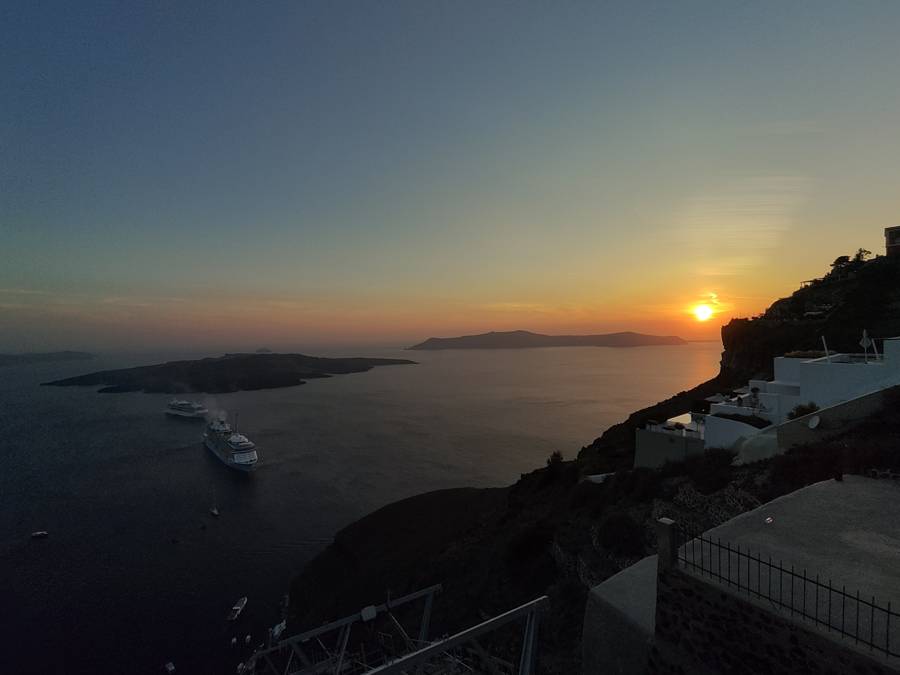
If there is a god of sunsets, it is Helios, who drove the sun across the sky in a chariot, and I salute him. In our country he would be known as Surya, who does the same job with seven horses. Either way, he does it with style.
Day 5: Wednesday 7 June. Aphrodite’s postcard, and Hades’ beach
The island is small enough to see by public bus, and we did. In the morning, before we left, the caldera rim at Fira was already busy, with cruise ships sitting in the bay and the white terraces of Fira Town stacked up the cliff.
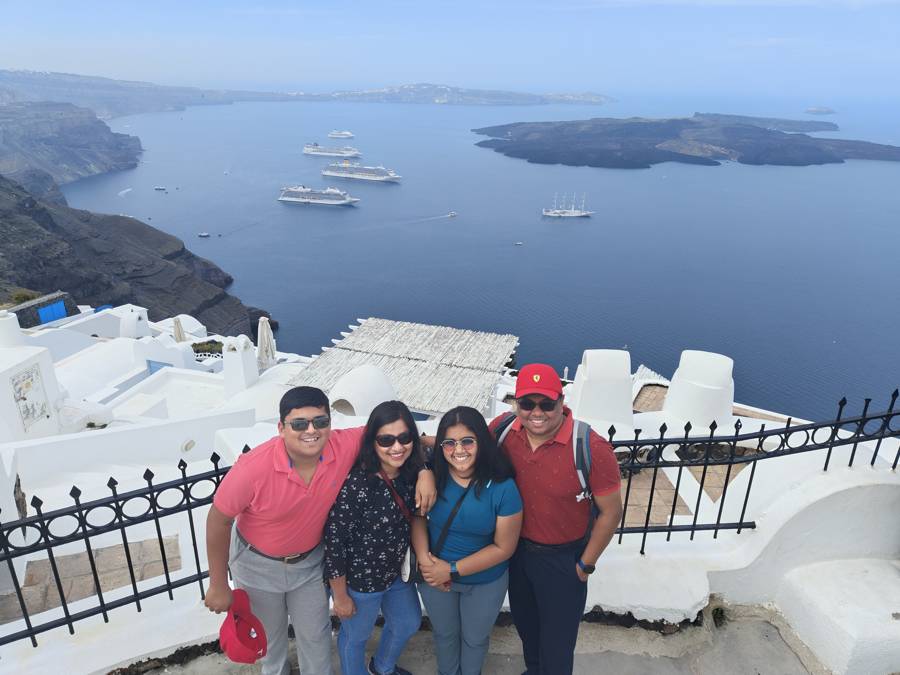
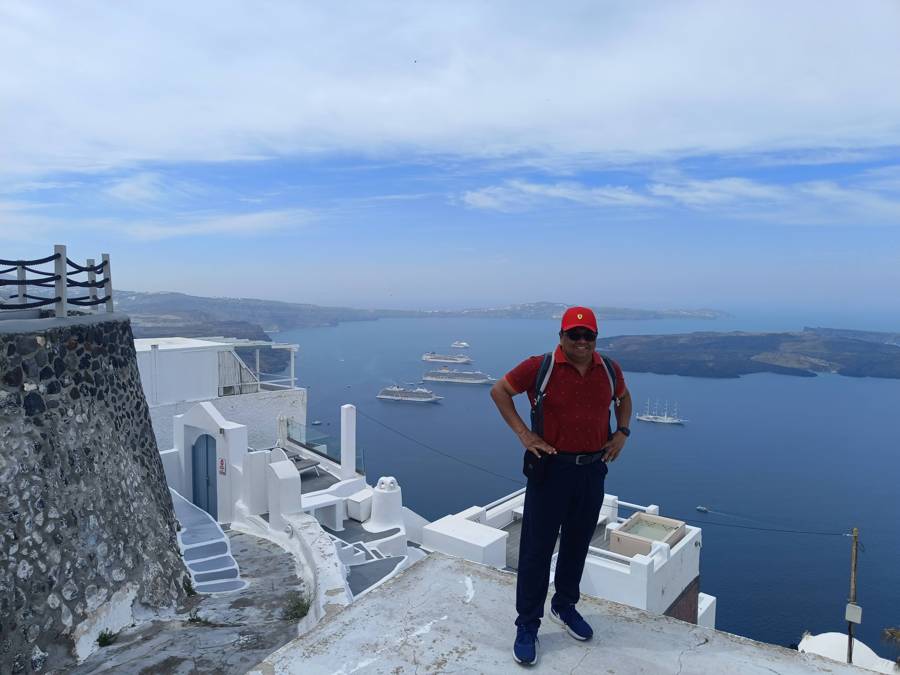
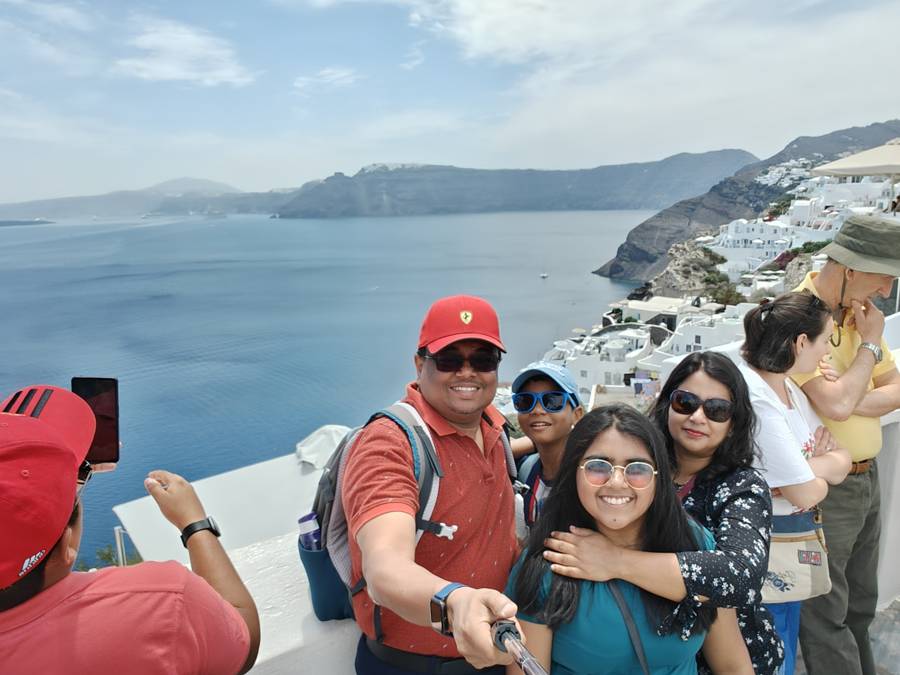
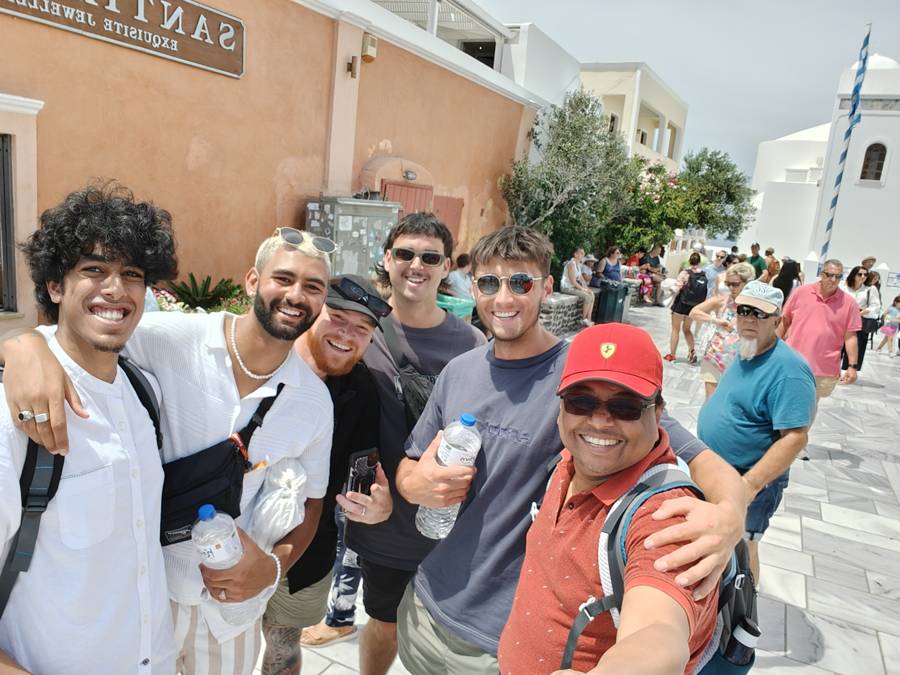
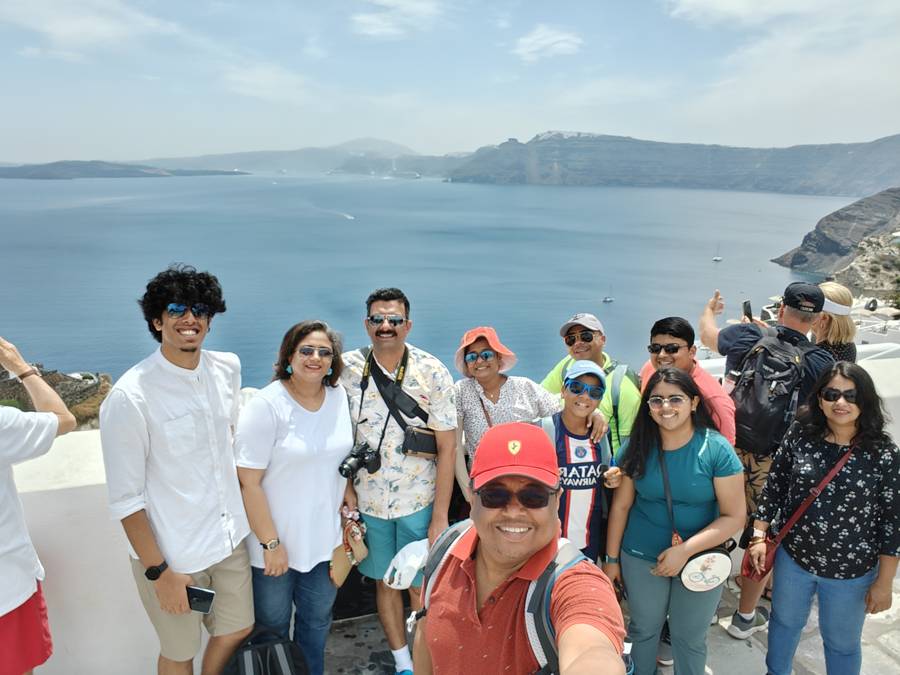
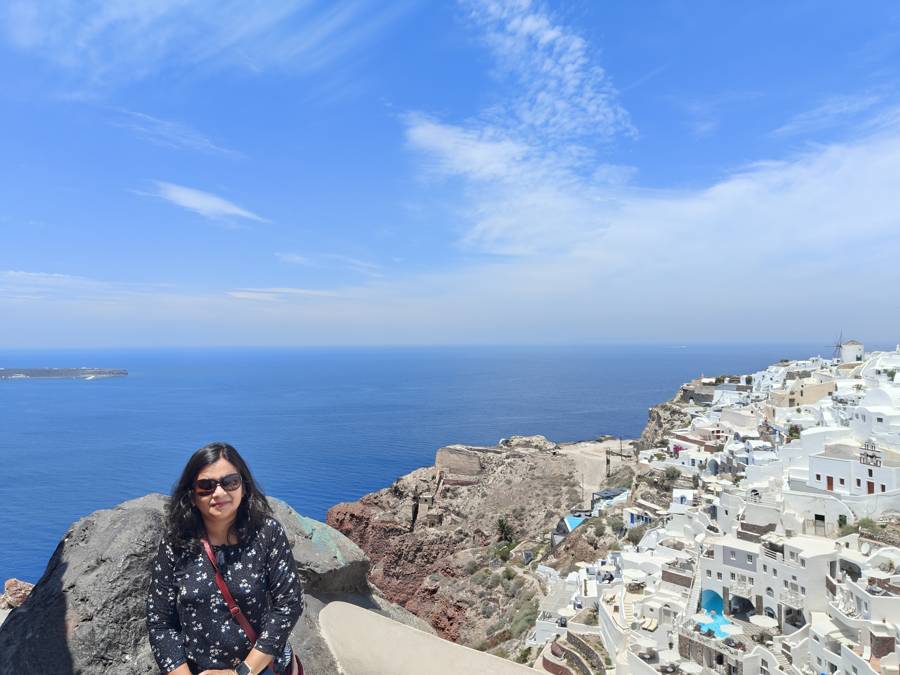
Then we took the public bus to Oia, at the northern tip, which is the picture-postcard end of the island. It took the heaviest damage on the western caldera edge in the 1956 earthquake. If Aphrodite runs a postcard business, this is where she would set up the shop. The streets are narrow and white, the sea is a dazzling blue, and every second person is taking a selfie. We took ours too, and then a group of familiar faces turned up. They were fellow travellers we had first met in the laundry in Athens, and this was the second time our paths crossed, which called for a photograph.
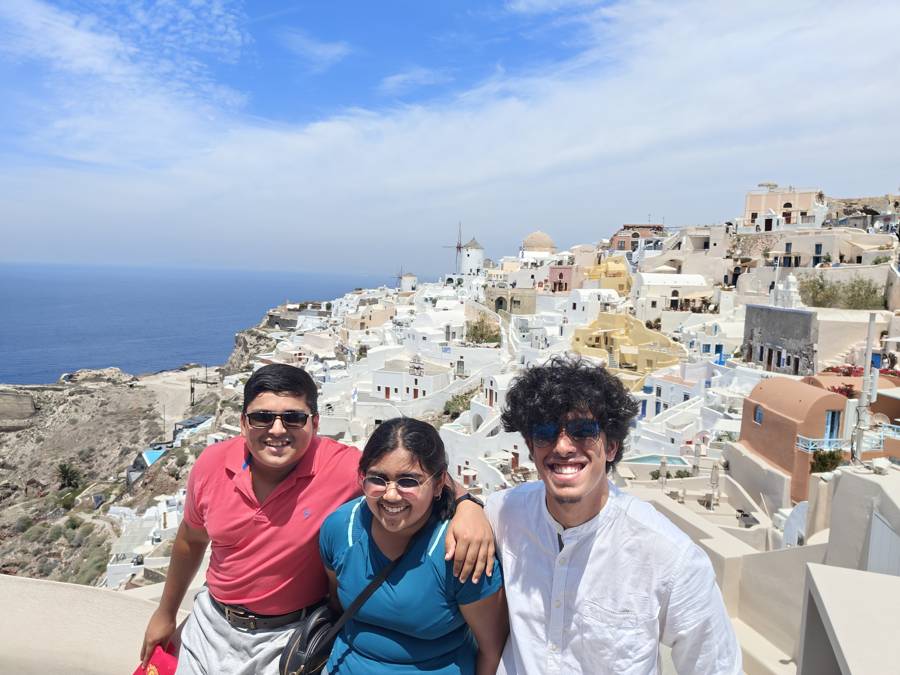
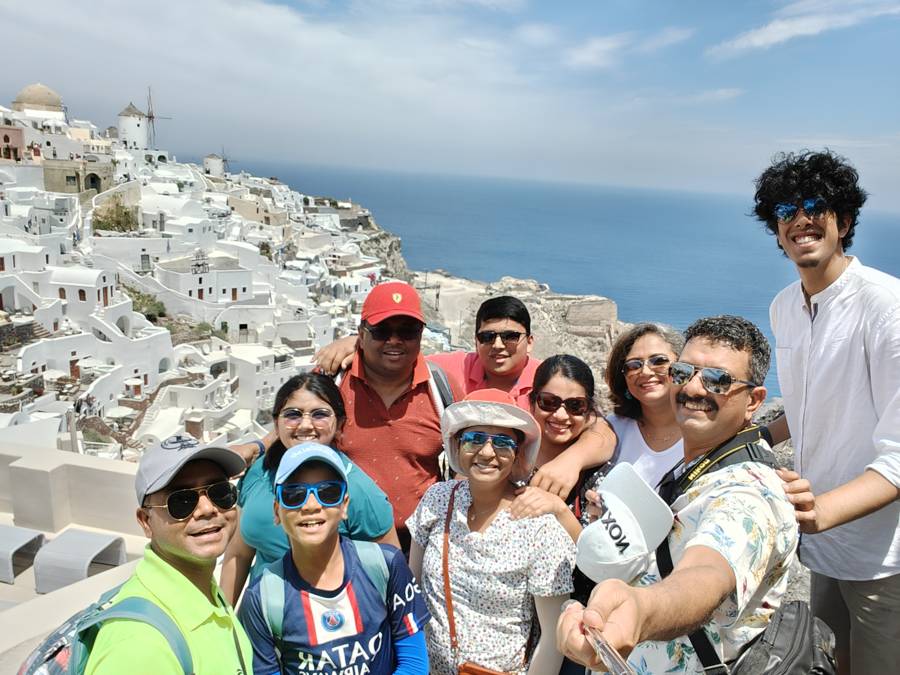
We took the public bus back to Fira. Then, because we had time, we did what any decent traveller on Santorini should do, and went to see the black beach.
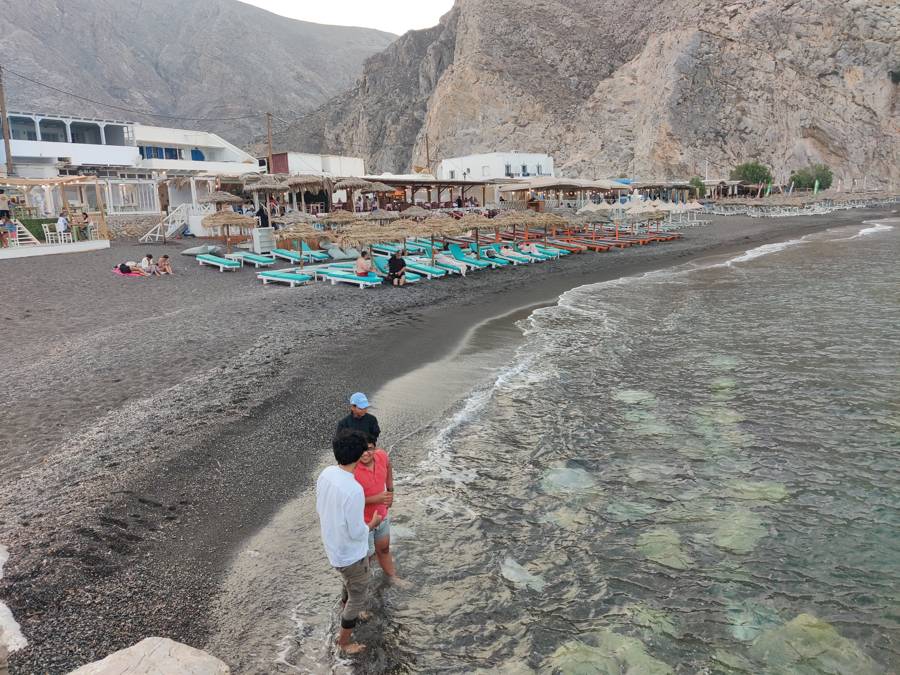
Perissa is the other face of the island. Where Oia is white and blue, Perissa is dark, and the sand is volcanic and the colour of charcoal, with a great brown mountain behind. If Aphrodite is in charge of the north, the south belongs to Hades, who has a sense of drama. Black sand is an honest souvenir of what the island is made of,. We went back to Fira by bus in the evening.
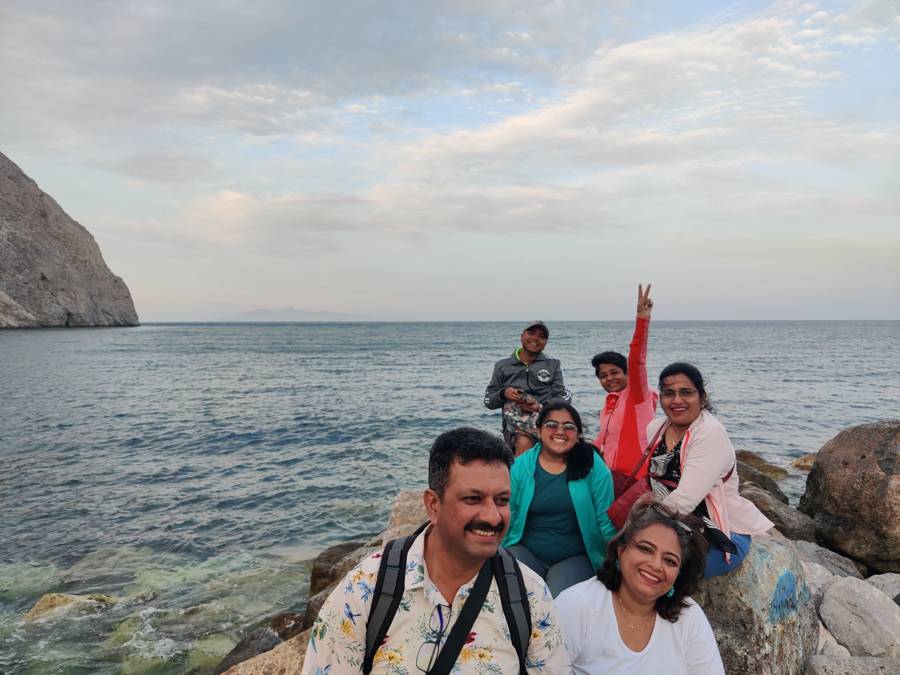
Day 6: Thursday 8 June. A flight, a hill and the owl
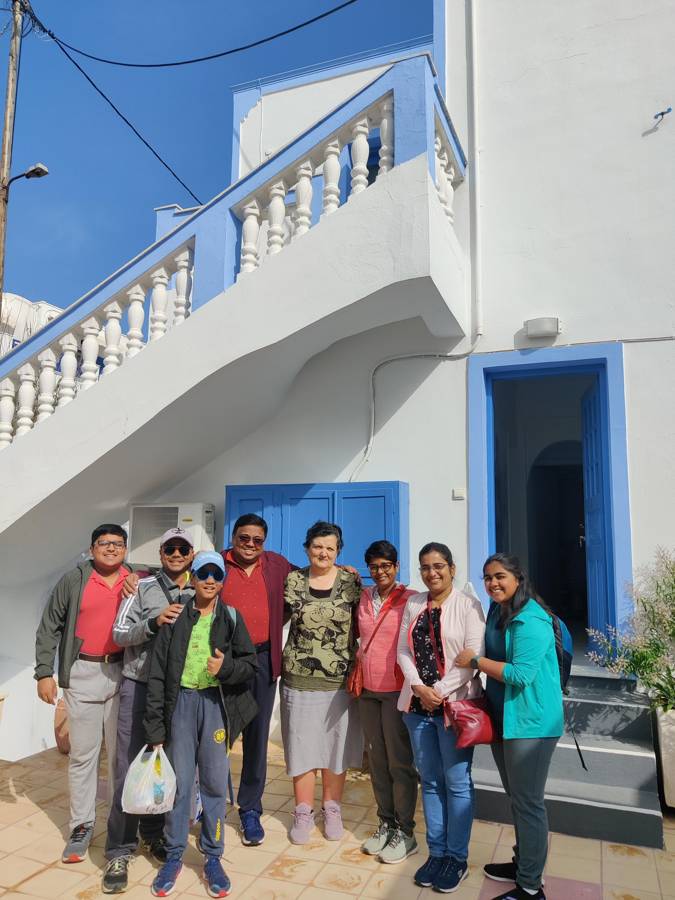
The morning was a farewell to the old lady, the cat and the blue door. The apartments had been so good that it was hard to leave.
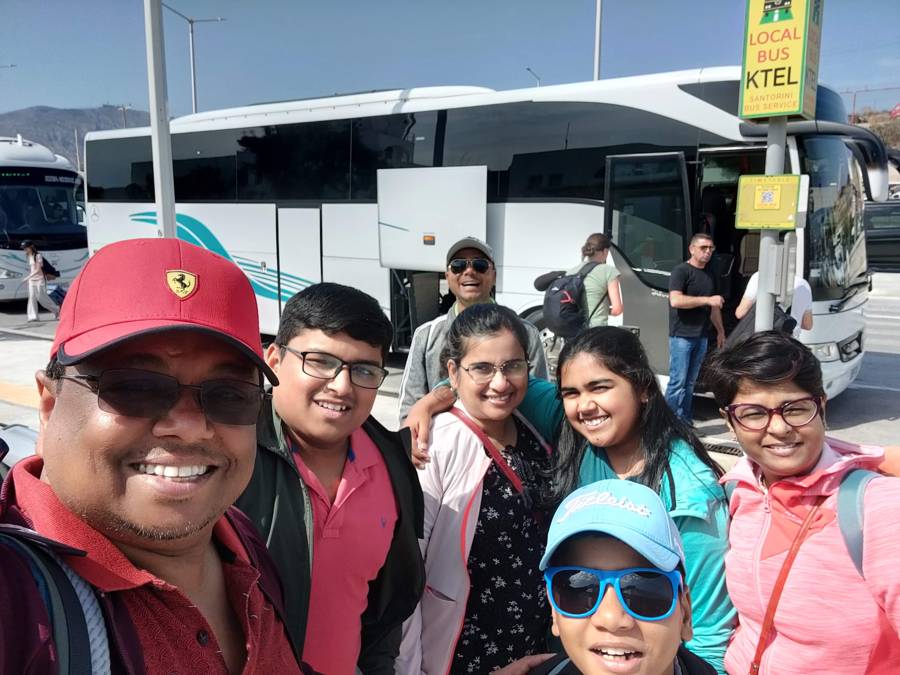
The ferry group became the flight group. We took the bus to the airport and the plane to Athens, a flight of 55 minutes, travelling light. The Valloors were on the 15:30 ferry with the luggage, due into Piraeus at 11:15 that night. In the afternoon we were back in the same apartments in the centre of Athens.
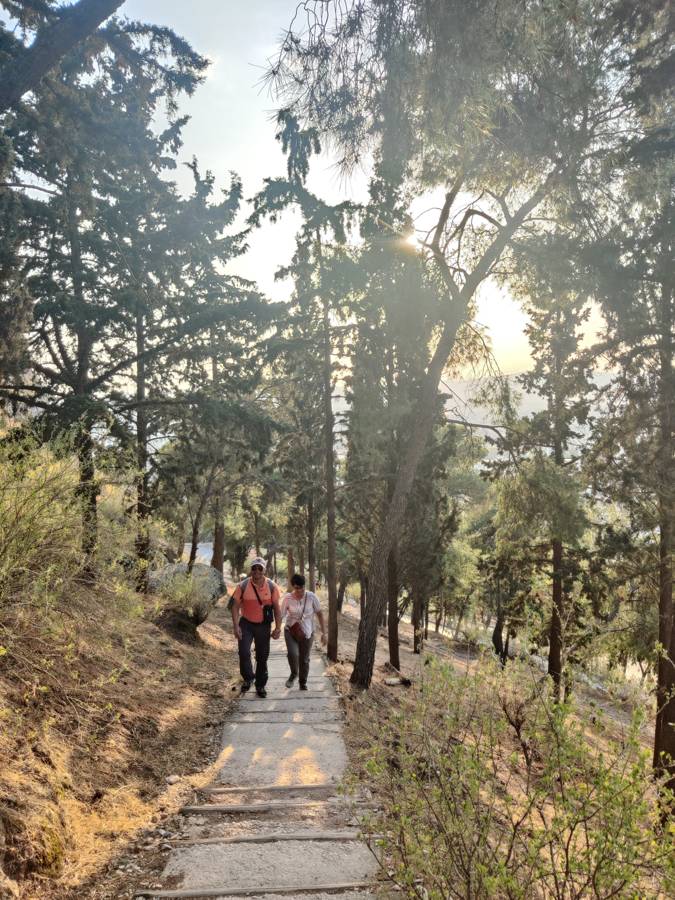
In the evening we climbed Lycabettus Hill, the tallest hill in central Athens. The path takes you through tall pines, and at the top there is a small white chapel and a big view. It was the other great viewpoint of the trip.
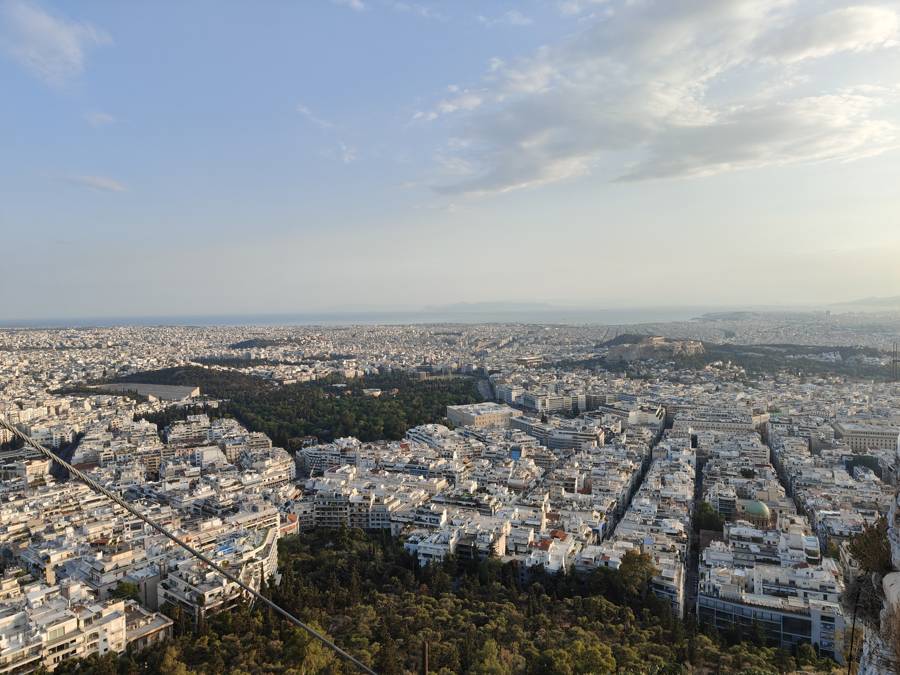
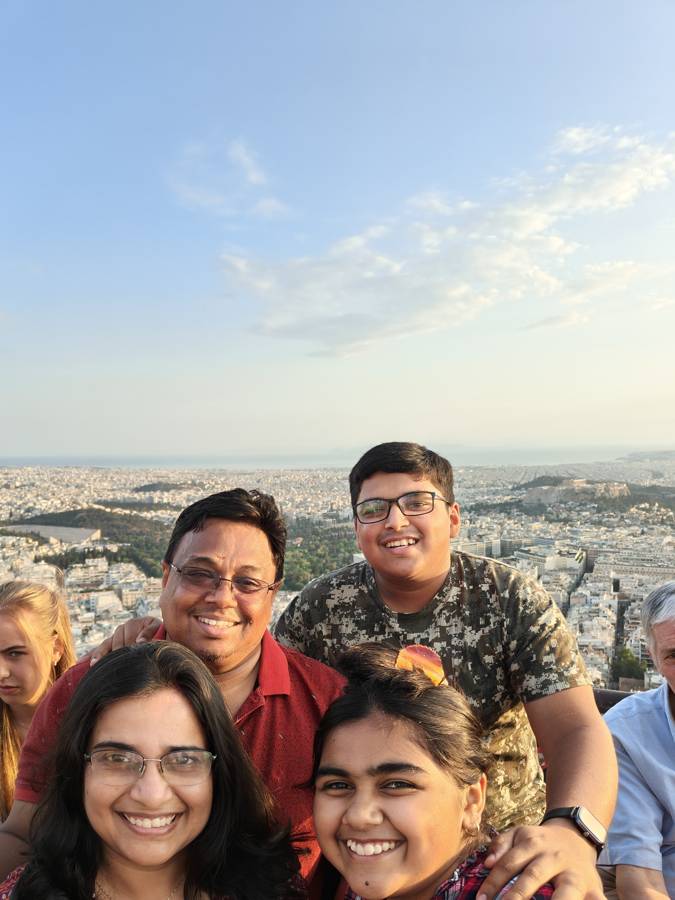
- The highest point in central Athens, 277 metres above sea level, a limestone hill rising out of the city.
- A white chapel dedicated to St George stands at the top.
- Legend says that Athena was carrying a huge limestone mountain to build the Acropolis when she dropped it, and that is how Lycabettus came to exist. She dropped it, the story goes, after the box holding the infant Erichthonius was opened, which is a perfectly good reason to drop a mountain.
- There is also an open-air theatre near the summit. It closed in 2008 for safety reasons and reopened in September 2023.
Figures from Wikipedia’s Mount Lycabettus article.
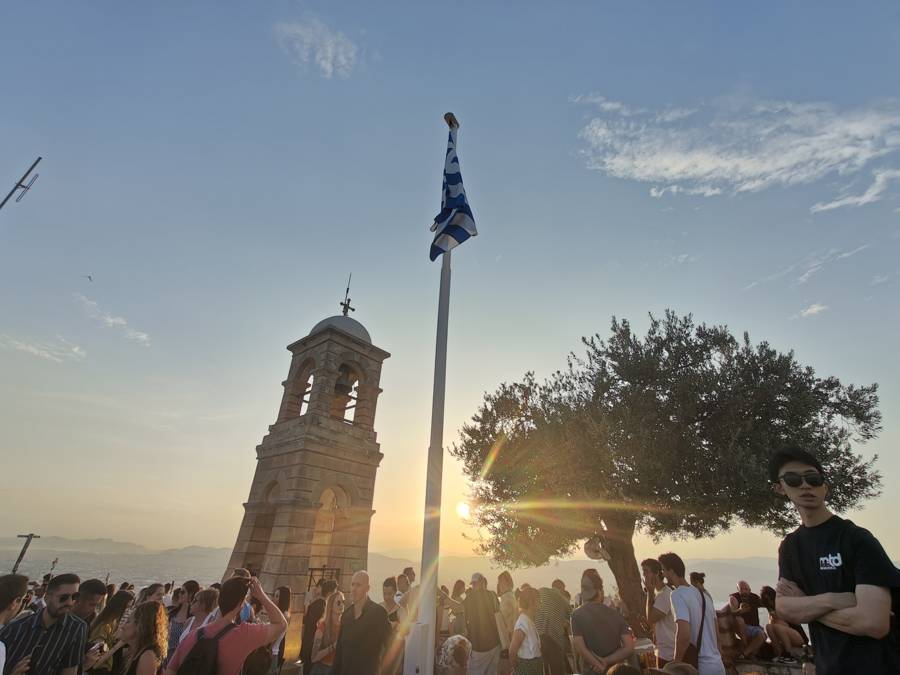
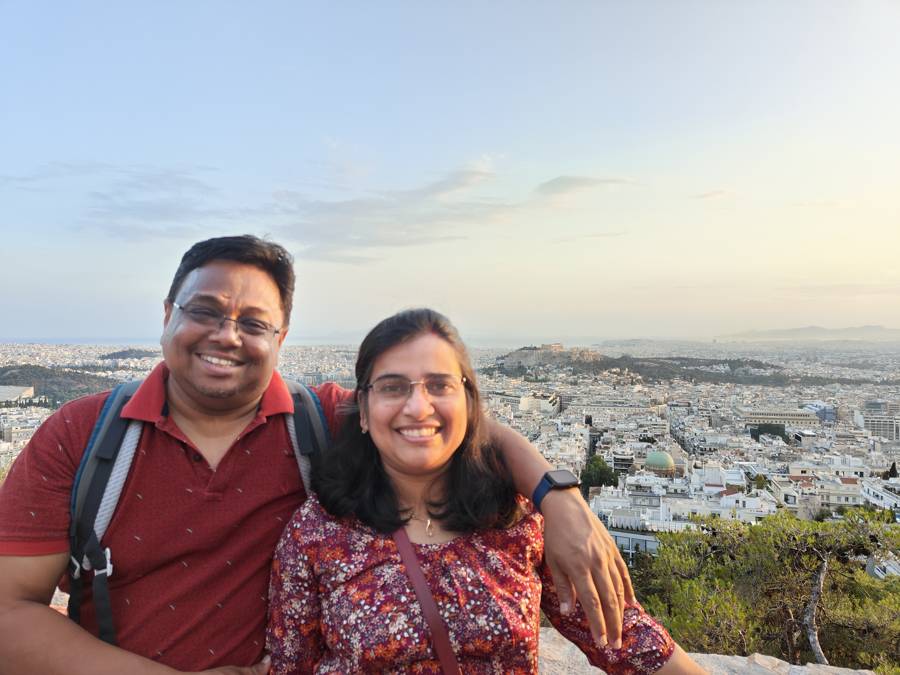
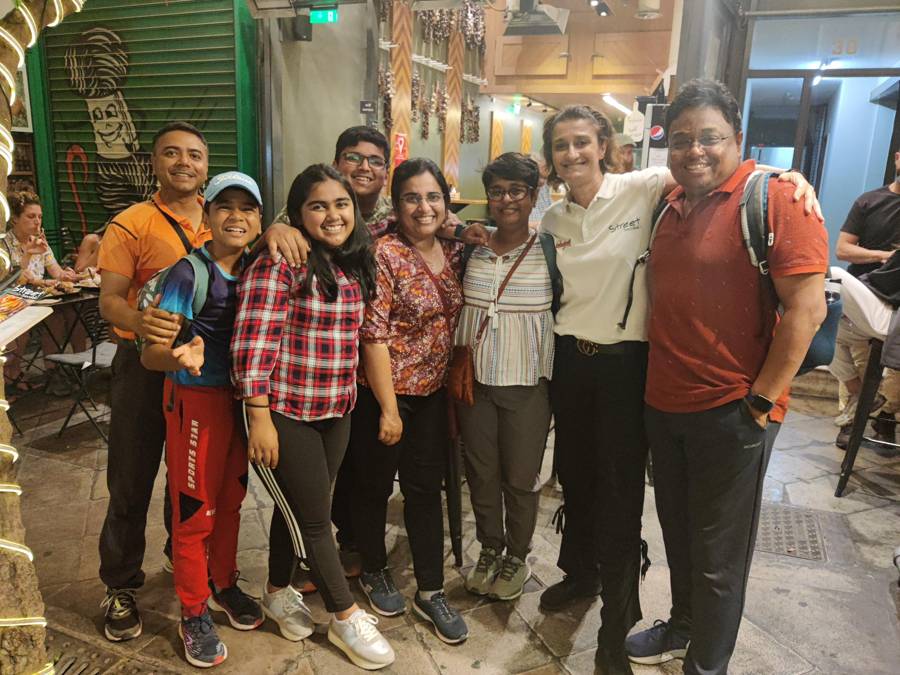
We finished the day with dinner at Street Souvlaki, the gyros place from our first night, a restaurant so good we went back. The staff were friendly enough to join the photograph.
Day 7: Friday 9 June. Hermes again, at five in the morning
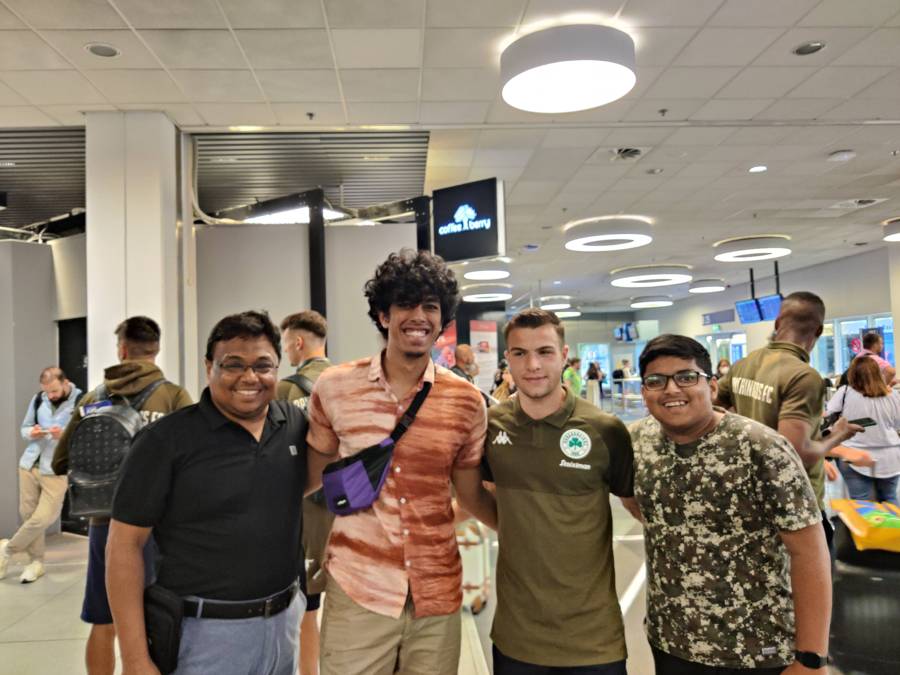
The gods of travel had one more test. We caught the X95 airport bus again, the same one that had brought us in, and were at Athens airport before six. On the bus we got talking to an American lady in a sun hat, who comes to Greece every year and stays for three months. We swapped notes, and she was amazed at how much we had planned. The fact that we were on the X95 at all was, she said, proof of our planning, because the bus is cheap and not many visitors know about it. Praise from an old Greece hand is a fine way to leave. The flight to Naples was waiting, and so was Italy, a different set of gods with the same love of ruins. That is the next post.
The pantheon, as we met it
We went to Greece expecting statues and found a whole cast of characters. Here are the gods we ran into, with their nearest cousins from home. The matches are for fun, and no scholar of comparative mythology has been consulted.
- Hermes, messenger, god of travellers and merchants. Present at every airport, ferry and discount fare. His nearest cousin at home is Narada, the wandering sage who carries news.
- Zeus, king of the gods, in his temple by the stadium. Cousin: Indra, with whom he shares a very old ancestry in the sky-father Dyaus Pitar.
- Athena, goddess of wisdom and strategy, owner of the Parthenon and the city. Cousin: Saraswati for the wisdom, with a dash of Durga for the strategy.
- Poseidon, god of the sea, who gave us a calm crossing. Cousin: Varuna.
- Helios, the sun god, who timed his exit beautifully on the caldera. Cousin: Surya.
- Aphrodite, goddess of love, in charge of Oia’s postcard business. Cousin: Rati, the partner of Kama.
- Hades, ruler of the underworld, who took charge of the black beach. Cousin: Yama.
The verdict
The vibe. Athens felt very earthly and quietly wonderful: calm, peaceful and full of colour, a city of people who seemed to enjoy their own streets. The locals were excellent everywhere we went. The restaurants and markets were colourful, the city was spotless, and the whole place felt at ease with itself.
The walking. With a YouTube route, a free audio guide and apartments in the heart of the old town, we walked everywhere and saw the famous spots without needing a car, a coach or a tour. The location of our stay could not have been better, and I would pick it again.
The food. Very good all the way through, from the gyros at Street Souvlaki (which we visited twice) to pastitsio and a Chinese dinner at Da Panda. We bought water and fruit at a supermarket, and carried some ready-to-eat breakfasts from India, which kept the mornings quick and the budget calm.
The stays. Both were excellent. The Athens apartments were comfortable and perfectly placed. The one in Santorini was special: an old lady and her cat, and some of the most charming vintage decor I have seen.
The deal. The ferry and flight fares were a find, and splitting into two groups let us try both ways and save a good deal on tickets. The ferry people carried the luggage, and the flight people travelled light.
The group. We were a jovial, fun lot, and the trip was all the better for it. It is much easier to talk to the gods when you have good company.
Who should go. Anyone who can walk, wants some history without the hush of a museum and enjoys a good view. Go in early June, carry a light jacket for the windy caldera evenings, and bring a very large appetite.
Facts checked against: Panathenaic Stadium, Temple of Olympian Zeus, Stoa of Attalos, Mount Lycabettus, Minoan eruption, Santorini, History.com on the Parthenon, Roman Agora and Odeon of Herodes Atticus at A View on Cities.
Saswat wrote his own account of the whole trip, Greece, Italy and Istanbul: read the trip through Saswat’s eyes.